

Almost every SaaS founder I talk to says the same thing: "We know we need a community."
Then comes the notorious "but". They don't know how to go about it. They've never run one. Community needs different skills, and they assume it will eat time, people and money they'll never get back. So they do what their peers did. They open a Slack or Discord, invite a few customers and call it a support channel.
A few months later, they have 20 or 50 members, and the growth stops.
I've been building communities since 2005. CrazyEngineers has 400,000+ members today. I also built a developer community at a B2B SaaS company where I led growth, and now I build Jatra, a community platform made for exactly this kind of business. So yes, I have an opinion on platforms, and I'll tell you when it matters.
This guide is the path I'd follow to build a customer community for a B2B SaaS, step by step. If you're new to communities altogether, start with how to build an online community. This one goes deeper into what's different for SaaS.
Build it around your niche, not your help desk
My strong advice to every SaaS founder: build the community around the niche your product operates in. Not around support.
Let AI handle the support. AI is great at answering support questions now, and it's only getting better. Your AI can even learn from the answers in your community. But the community itself has to be about the niche, the bigger problems your customers wake up thinking about.
Look at it from the customer's side. Nobody wakes up excited to visit a support forum. They go there when something breaks, get the answer and leave. But people do keep coming back to a place that helps them get better at their work.
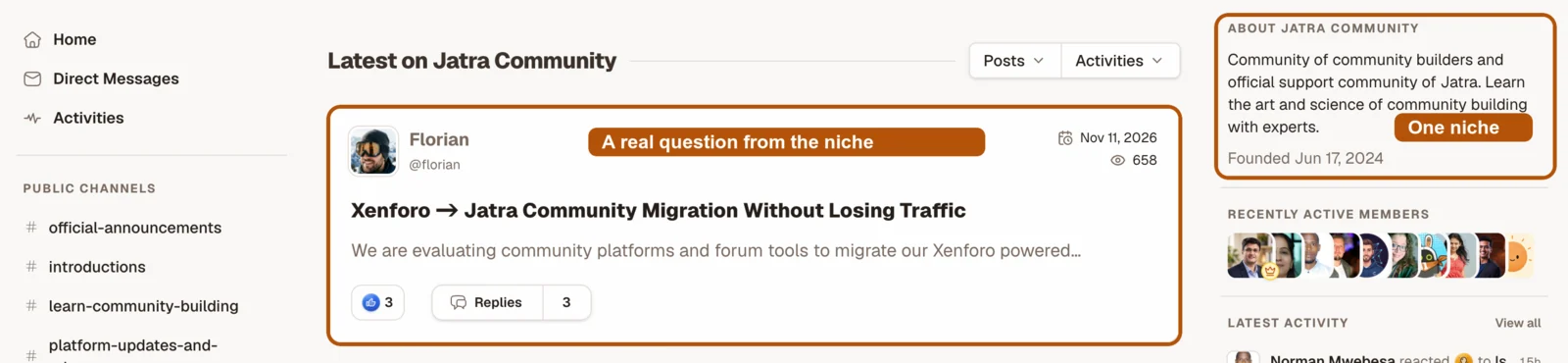
That's what we did with Jatra's own community. It's about the art and science of community building: how to grow a community, how to do SEO for it, which platform to pick, what to report to management. Support and feedback are a very small part of it.
Support is one of the things a community does. It should never be the whole thing.
Know who you're building for
Before you pick a platform or write a single post, get clear on who the community is for.
In a B2B SaaS, here's the twist: the person who pays isn't the person who posts. In every SaaS community I've run, the paying customer was usually a CXO. The person actually in the community was someone on their team, the marketer, the developer, the support lead who uses your product every day.
Build for that person.
Write down their dreams, goals, aims, fears and pain points. What are they trying to achieve this quarter? What makes them look good in front of their boss? What keeps them stuck? Half a page is enough.
Tip: Read your support tickets and sales call notes first. Your customers have already told you what they struggle with. Most of your first content is sitting right there.
Pick a micro niche you can own
Never build a generic community. Never try to cater to a huge user base. The narrower you go, the easier it is to build.
Jatra's playbook is simple: find a micro niche where your customers face real problems, and dominate it. Cover it in its full length and breadth, and of course depth. Depth is important. Quality always beats quantity.
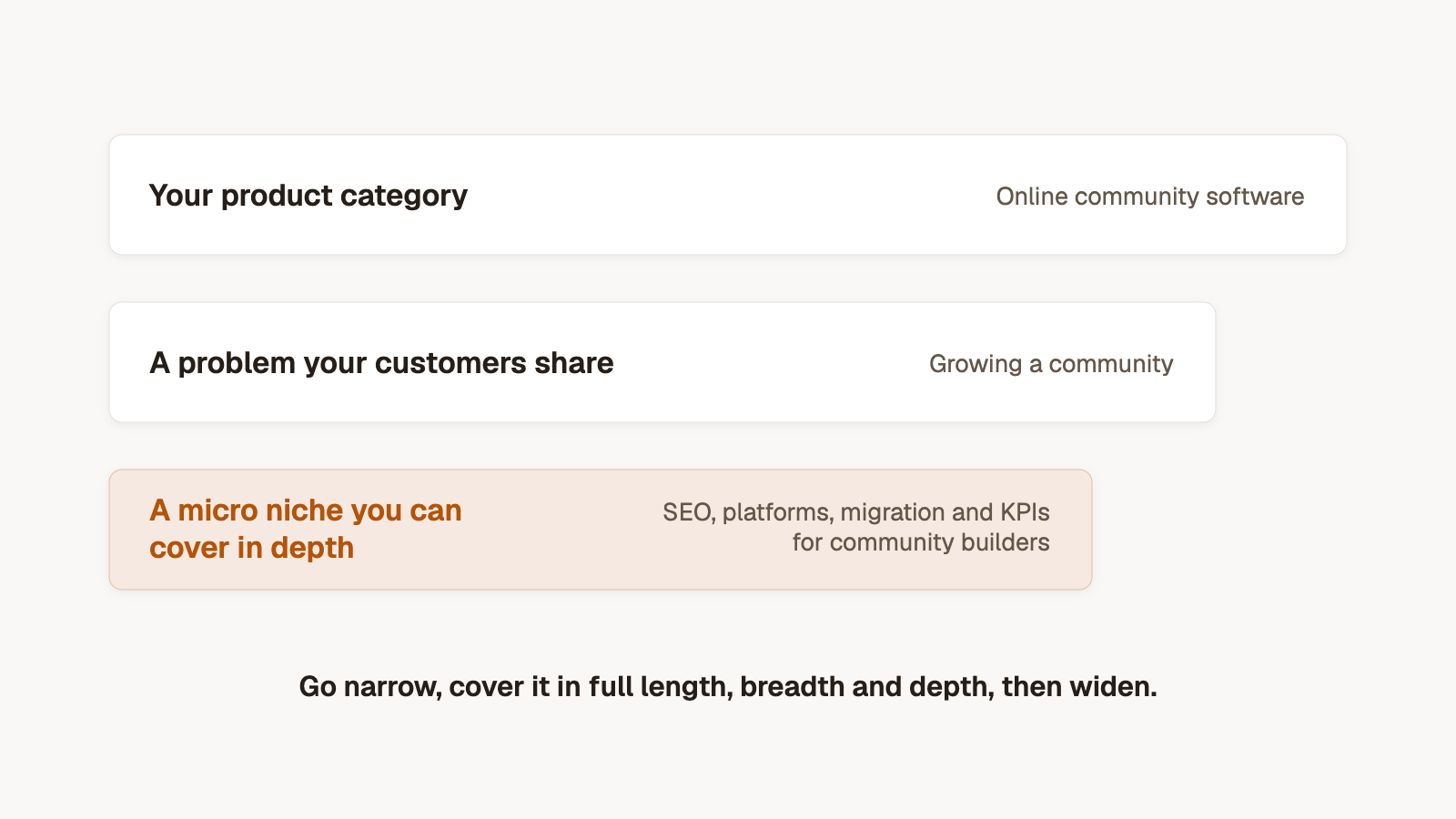
Two examples from my own work.
Jatra's community picked online communities, and then the problems community builders actually face. How do I do SEO for my community? How do I choose a platform? How do I migrate from my current one? Why isn't Slack enough? What KPIs should I report to my management? "I have a new community, and I don't know where to start." Every one of those is a real question, answered on the community, with the aim of helping our potential customers.
The second one is creators.wiral.social, a community for people building their presence on LinkedIn. Wiral is another product I run, so I'm biased here too. We're in the early days, and we're super specific. Every piece of content answers a small, common question: What's the right time to post? How should I update my profile? What should I write about? How often should I post? Should I comment on other people's posts? Should I accept every connection request? How many requests can I send a day?
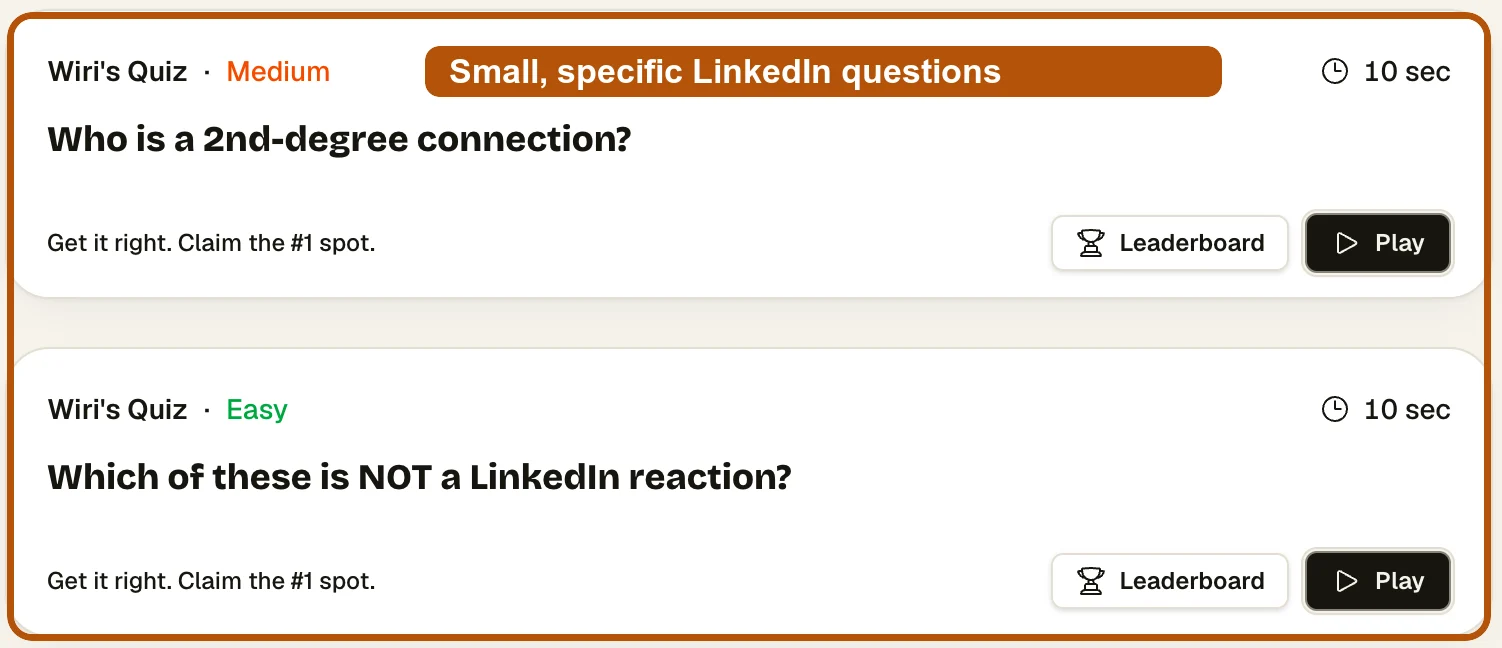
Small questions. But those are exactly the ones people search for, and nobody answers them well in one place.
The first members will appreciate that you're talking about their problems: the points they care about, your opinions, your observations, your experience in that niche. And if you can drive some founder-led content, do it. Founders know the niche better than anyone in the company, and people can tell when a post comes from someone who's lived it.
Pick a platform that won't cap your growth
This is where most SaaS founders make their first big mistake.
They start on a closed platform, usually Slack or Discord, because their customers are already there. And it works in the initial days. You send invites by hand, people join with enthusiasm, and it feels alive.
Then growth stops.
These platforms hide the content from Google and from anyone who isn't logged in. Nobody outside can see the value the community is creating. So you end up relying on paid ads, social media posts, events and personal referrals to bring every new member in. It becomes very tiring. You may gather the first 20 or 50 members, and then you're stuck.
The second problem is chat itself. Chat is a good feature. It should never be the main way your members talk. In chat, a useful post lives for a few minutes, maybe a few hours. Imagine you share something really important. Then 10 or 15 messages arrive after it, and it's gone. Nobody outside will ever find it, and even your members need the right keywords to dig it up. So you keep answering the same questions again and again.
Discord has announced that from November 16, 2026, large public Discoverable Servers get a web page, and some new messages will slowly become searchable from mid-December. That's a small step. Older messages and private channels stay hidden, and those pages live on Discord's domain, not yours.
What I recommend instead: a community with structured, asynchronous discussions that Google and people can find. Every good answer gets its own page that you can link to from your docs, your emails and your support replies. Over time it becomes a knowledge base your customers wrote together, and it compounds. Content we wrote on CrazyEngineers back in 2010 still brings in hundreds of visitors every month.
Go hybrid. Keep the discussions about your niche public. Keep support tickets, complaints and anything account-specific in private channels. When customers complain, they just want to be heard by a real person from your company. They don't need an audience.
If you're comparing platforms, my checklist is in how to choose a B2B community platform, and the shortlist is in the best community platforms for B2B SaaS.
Seed it before you invite anyone
Here's the only test that matters on launch day: the first customer who joins finds something useful.
So fill the room first. Take the questions your customers already ask, the ones from your tickets, sales calls and the forums they read, and answer them properly in the community. As discussions, Q&As, articles and how-to guides.
I usually recommend about 50 pieces of content in the first 10 to 15 days. It's not about volume. Some communities need 10 deep threads, some need 100. What matters is that each answer is the best one on the internet for that question.
It's fine to seed from your own account and your team's accounts. Members care about the answer, not who typed it.
The full method, with a 30-day plan, is in how to seed a community.
Invite your customers in batches
Once the content is in, don't announce the community to your whole customer base. Invite in batches.
Start with your most active customers, or anyone you can talk to over the phone, on a Zoom call or in person. Give them special access. Then watch how they interact. Do they read? Do they come back? Do they ask follow-up questions? Ask them what's missing.
How you invite is up to you. Look at your customer list, or send personal invitation emails. Just make sure every person in that first batch is someone you can talk to one on one. That's important. Their behaviour is the feedback you need.
You'll have to do this for the first 20, 30, 50 members. After that, members start joining on their own.
Get your team answering
In the initial days, you'll have to answer most questions yourself. That's normal.
Have your teammates and colleagues sign up, even if they only have an account to start with. Then, as the community manager or owner, tag them on the specific questions they know best: product questions to product, integration questions to engineering, billing questions to support.
There will be some resistance at first. Nobody wants to answer in a community where nothing is happening. But as people see the community growing and members asking follow-up questions, the motivation comes. We've seen this in almost every community we've built. You shouldn't have to push them.
And if you're a small company, founders and senior people should show up too, even for 5 to 10 minutes a day. React to posts. Reply. Share your view. Customers notice when the people who run the company are there.
Watch, listen, and invite the next batch
After every batch, look at what happened. Which content did people read? Which questions came up that you hadn't covered? Who came back a second time?
Fix the gaps. Write the missing answers. Then invite the next batch. Keep this loop going for the first few weeks.
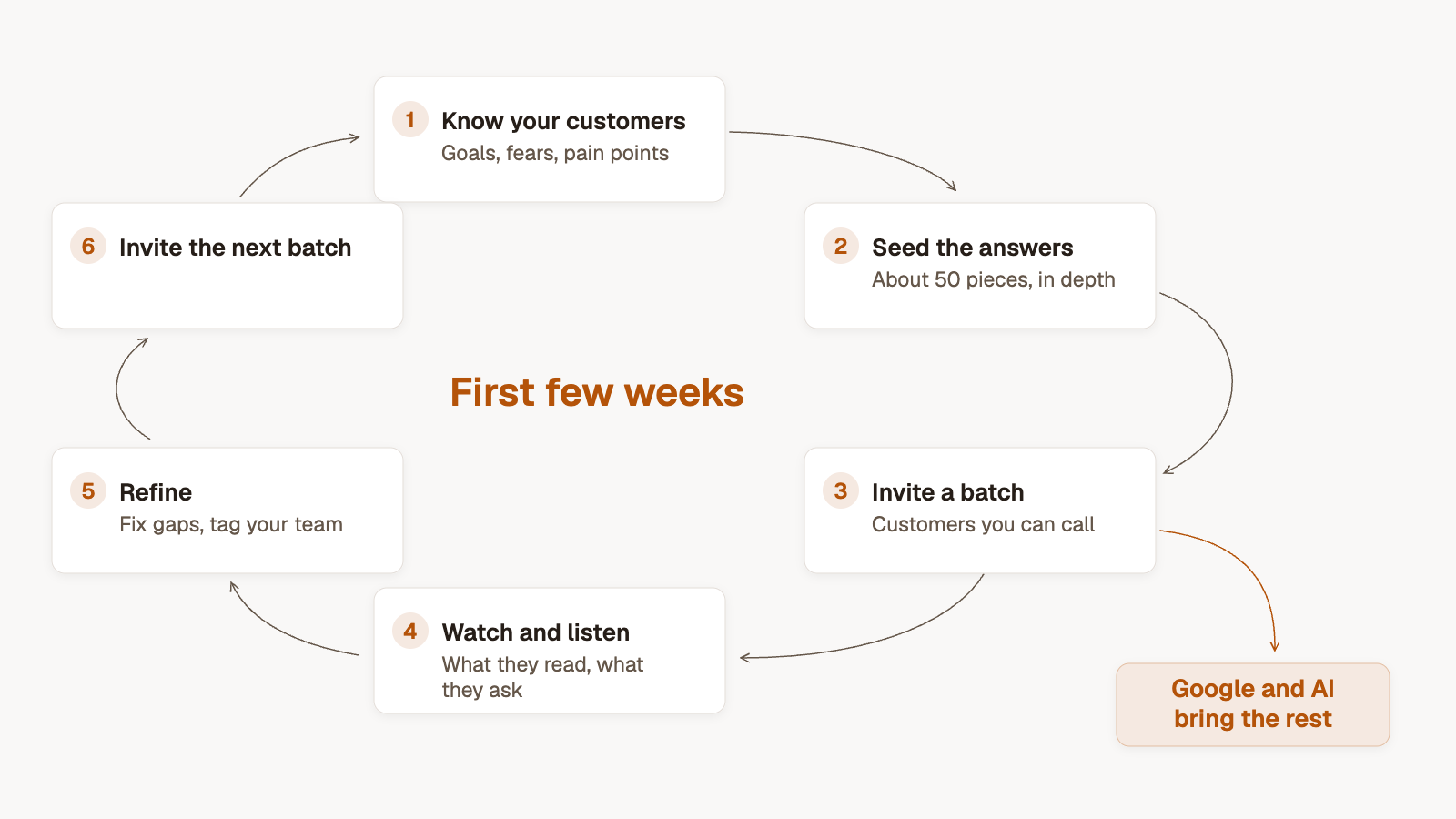
That's how you build a solid foundation. If you'd like the same loop laid out week by week, follow the 90-day B2B SaaS launch plan.
Bring feedback, roadmap, changelog, events and jobs inside
This is one of the reasons I built Jatra. SaaS communities are a bit different from other communities, and they need their own tools.
Look at how most SaaS companies work today. Feedback goes to a separate tool like Canny, on its own page. The roadmap sits on another page of the marketing site. The changelog is published somewhere else again. Events live on a webinar page. Jobs go on a careers page. Five places to send your customers.
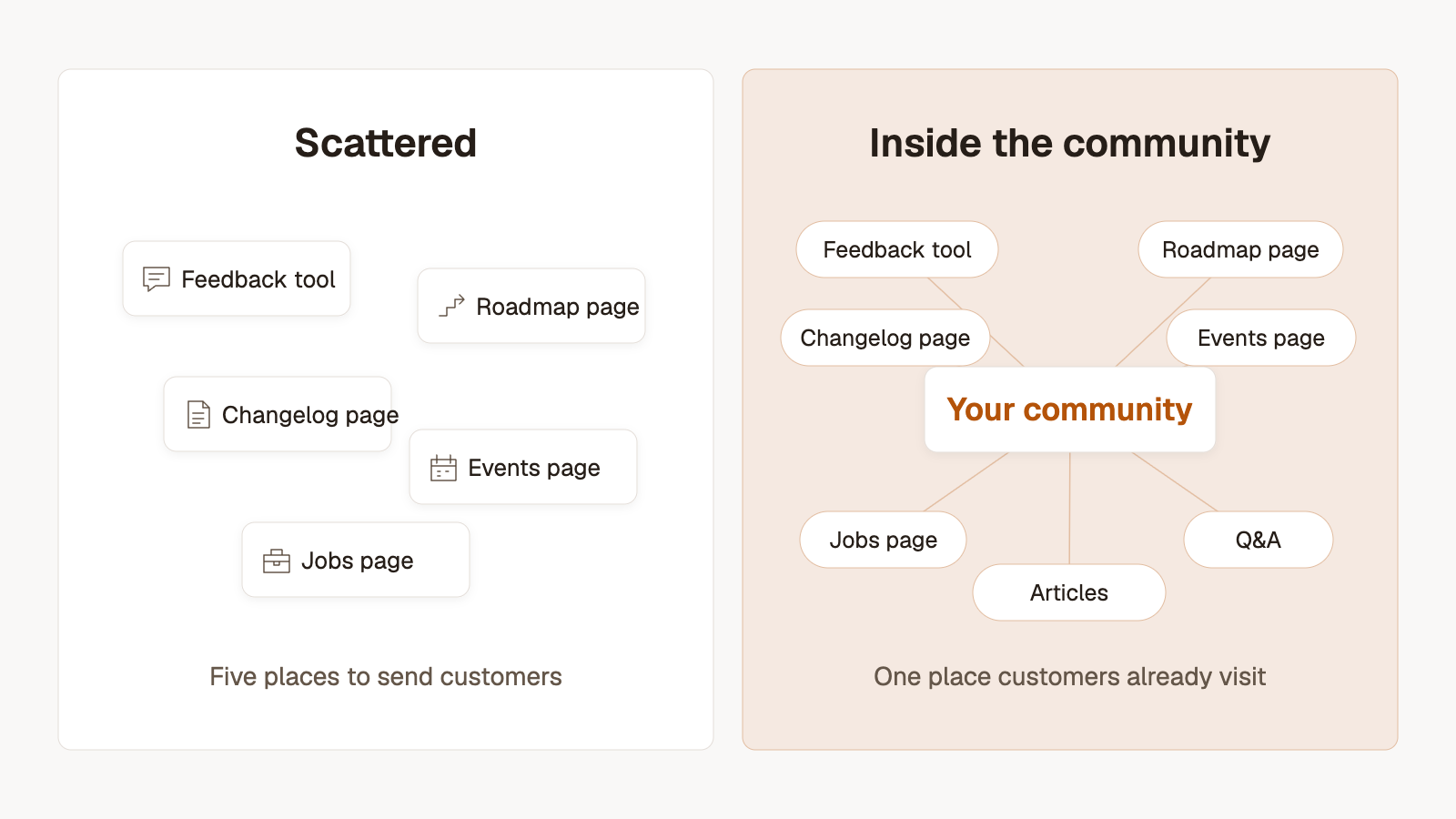
All of these belong inside the community. If your customers are already talking and learning there, that's where they should leave feedback, see what's coming, read what's shipped and sign up for your next event.
Jobs too. There's no merit in hiding your openings on a separate page when the best people to hire are already in your community. They use your product. They want it to get better. They discuss it with other customers. Share your job posts and events with them first, inside the community, and they'll feel like insiders. They'll appreciate it a lot. I've also noticed more and more companies sharing job posts in niche communities first, before LinkedIn or the big job boards.
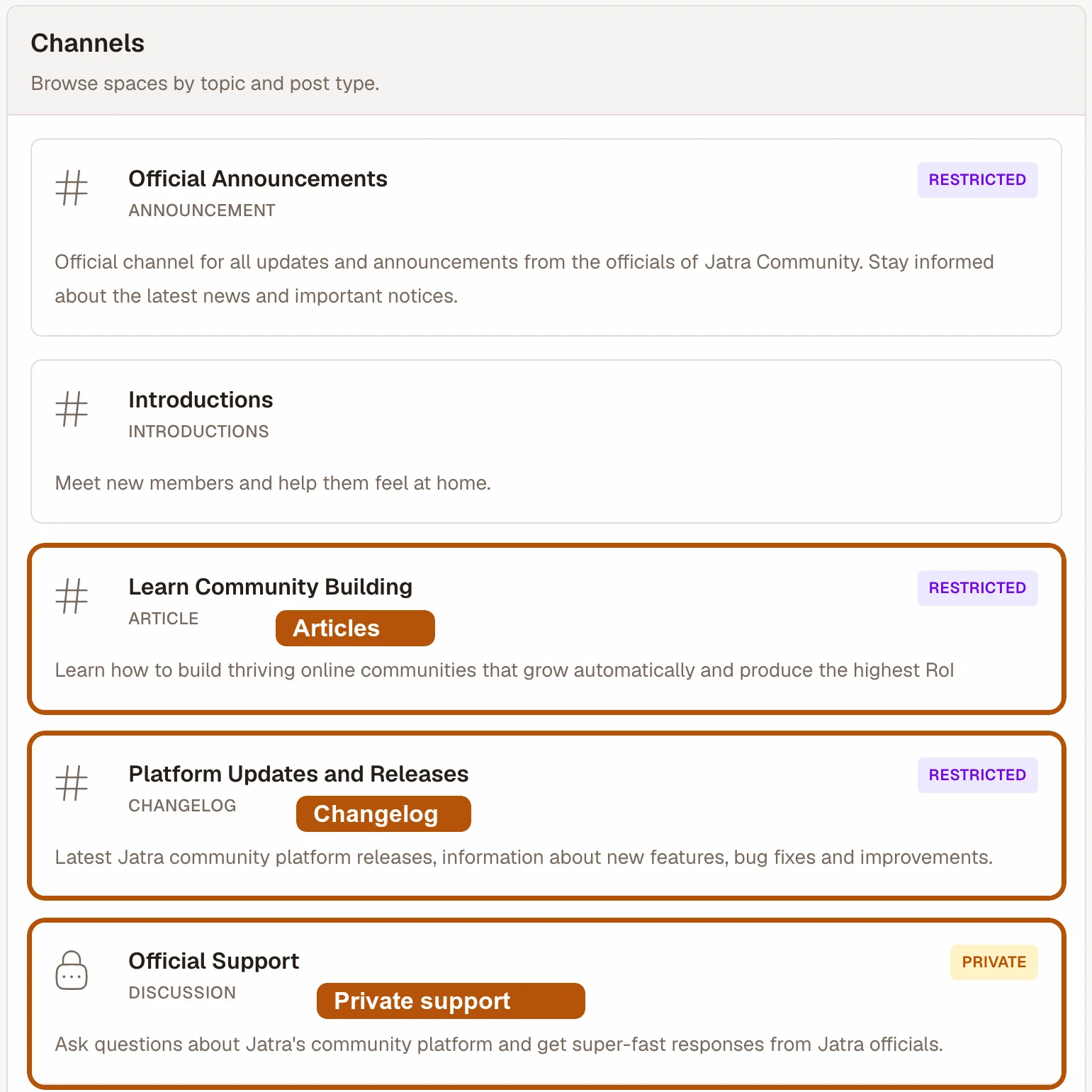
Jatra has feedback, a public roadmap, a changelog, events and jobs built into the community for exactly this reason. Whatever platform you pick, check that it can do the same, or you'll be paying for five tools and sending your customers to five places.
Let Google and AI bring the rest
Once the public content gets indexed, something changes. New people find your answers on Google and in AI tools like ChatGPT, Perplexity and Claude. They see the value before they ever sign up. You've solved the growth problem without paying for every new member.
This is how a community becomes a growth channel, not just a cost. It brings you users organically, gives you product feedback, keeps customers around and turns some of them into evangelists. And it's 100% yours: your domain, your content, your data. That's not true of a Reddit, Facebook or LinkedIn group.
It also helps to weave the community into your product. Gumlet's developer community launched on Circle in June 2022 and, in the company's own words, got crickets for months. It turned around after moving to Discourse, once the community came first across the website, the product dashboard and support emails, and employees committed to answering questions promptly. It grew to about 2,200 visitors and about 60 sign-ups a month.
Put links to the community where your customers already are: in the product, in your help widget, in onboarding and support emails, in your docs. Make it the first place people think of when they have a question.
Build a knowledge base, not a chat room
The best way to think about your community: it's a knowledge base your customers write together, and it grows on its own.
That's why multi-content communities matter so much. A community that's only chat, or only discussion threads, can't hold everything your customers need. A good SaaS community has Q&As with accepted answers, long-form articles and guides, discussions, feedback and a roadmap, a changelog, events and jobs, all in one place, each kind where it fits best.
Every piece links to the others. Every good answer can be found. And it keeps working for you long after you wrote it.
What to tell your leadership
Your CEO will ask what this community is doing for the business. Don't answer with the member count. The member count is the biggest vanity metric there is. It's just the number of records in your database.
Show them the numbers that matter: how many returning members you have, how many new users came in organically through the community, what product feedback came from it, and how quickly questions get answered. Growth is slow at first and then it compounds, so report the trend, not the week.
For building the full case for budget, see how to build the business case for a B2B customer community.
Frequently asked questions
Should a SaaS customer community replace support?
No. Let AI and your support team handle support, and keep account-specific issues in private channels. Build the community around your niche, and let support be one of the things it does.
How many customers do you need to start a community?
Fewer than you think. You need a handful of customers you can talk to one on one, and about 50 useful pieces of content waiting for them. Invite in batches from there.
Is Slack or Discord good enough for a SaaS community?
For a few early customers, maybe. For growth, no. Closed chat platforms hide your best answers from Google and bury them in the scroll. A hybrid community with public discussions and private support channels grows on its own.
Who should own the community inside a SaaS company?
Usually marketing or product, with one named person running it day to day. In a small company, founders should show up too, even for 5 to 10 minutes a day. More on this in who should run your community.
How long before a SaaS community starts working?
With a narrow niche, proper seeding and batch invites, you'll see the first traction within 10 to 15 days of steady work, and growth by day 30 to 45. Search traffic takes longer and compounds over time.
Where I'd start
If I were building a customer community for a SaaS tomorrow:
- Write down who it's for: the person who uses your product, not the one who signs the contract.
- Pick one micro niche where they struggle, and own it.
- Choose an open, hybrid platform with feedback, roadmap, changelog, events and jobs built in.
- Spend 10 to 15 days writing about 50 answers worth finding.
- Invite your first batch of customers personally, and tag your team on their questions.
- Watch, fix the gaps, and invite the next batch.
Then keep showing up. That's it. No magic.
If you'd like help with the first months, Jatra's managed plans include setup, content research and strategy, and on the higher plan we seed the community with you. Book a call and tell us about your product.
I've also written two shorter pieces on this for founders on Jatra Community: How to Build a SaaS Community in 2026 and How to Build a SaaS Community Effortlessly.