
A quick disclaimer before you dive in. I'm the founder of Jatra, a community platform. I built it after nearly 20 years of frustration in the online community space, while growing communities of different sizes.
I've tried to be fair to everyone here. Some platforms in this list are excellent for creators. Some are strong technical forum products. Some are better suited to large customer-success teams.
If you are still defining your requirements, start with how to choose a B2B community platform, then use this comparison to build your shortlist.
But if you are a B2B SaaS company, the question is narrower:
Which community platform helps customers get answers, helps your product team learn, and helps future buyers discover your expertise?
That is the lens I am using in this comparison.
Three jobs of a B2B SaaS community
A B2B SaaS community has three real jobs.
-
Support customers. Customers want answers from people who understand the product. A chatbot can help, but it does not replace the trust created when your team is visibly present.
-
Collect product feedback. Your community is where customers surface bugs, pain points, feature requests, workarounds, and ideas. Keeping feedback, roadmap discussions, and changelog updates close to the community matters.
-
Win new customers. This is the underrated one. If your public community content is crawlable by Google and readable by AI tools, every useful answer can become a future acquisition asset.
Most companies only think about the first job. That is why they end up choosing chat tools or creator platforms and later wonder why the community is not creating durable business value.
Platform comparison
Pricing and public plan names were re-checked on September 12, 2026. Always verify the linked pricing pages before buying because community platform pricing changes often.
Platform comparison matrix
Scroll horizontally to compare every column| Platform | Best fit | Search visibility | B2B-native content depth | Feedback + changelog | Jobs board | Hands-on support included | Entry pricing |
|---|---|---|---|---|---|---|---|
| Jatra | B2B SaaS communities that need support, content, SEO, and hands-on help | Server-side rendering, own-domain setup, structured content | Discussions, articles, news, announcements, events, feedback, changelog, jobs. Quizzes on Growth. | Native | Native | Yes - setup, seeding, and growth guidance | From $299/mo |
| Bettermode | Customer communities with larger budgets and no-code customization needs | Server-rendered with JSON-LD; auto-generated sitemap with no documented manual override | Strong templates and visual builder | Templates / configurable spaces | Template / configurable space | No - services may be separate | From $399/mo billed annually; API and webhooks from Growth at $1,500/mo billed annually |
| Gainsight Customer Communities | Enterprise customer-success teams that need ideation, events, groups, and Gainsight CS workflows | Server-rendered pages on the customer's own domain | Forums, knowledge base, ideas, events, groups, product updates | Native ideation and product updates | No native jobs board | Named CSM on Business and Enterprise | Contact sales |
| Discourse | Technical communities that want open-source depth and forum maturity | Crawler-visible static HTML; native llms.txt since v2026.1.0 | Excellent discussions, weaker native non-forum content types | Feedback via plugins; no native changelog | No native jobs board | No - self-managed or vendor support | Free hosted plan on a subdomain; custom domain from $100/mo |
| Circle | Creator-led communities, courses, memberships, and paid spaces | Custom domain on all plans; client-rendered post bodies and no forum schema in our April 2026 audit | Strong courses and memberships, weaker B2B utility content | Not native in the B2B sense | No native jobs board | No | From $89/mo |
| Mighty Networks | Membership businesses and creator communities | Post indexing requires Scale or above ($179/mo); plan-gated networks expose only the landing page | Strong engagement and monetization features | Not native in the B2B sense | No native jobs board | No | From $79/mo; Scale $179/mo |
| XenForo | Traditional forums with technical ownership | Server-rendered; Question threads support QAPage markup | Forum-first; richer content usually needs add-ons | No native changelog / feedback workflow | Add-on or custom setup | No | Cloud from $60/mo; self-hosted $195 plus optional annual renewal for updates and support |
| vBulletin | Legacy forum owners who want hosted or self-hosted forum software | Server-rendered forum pages | Forum-first; dated B2B utility layer | No native changelog / feedback workflow | Custom setup | No | Cloud $24.95/mo monthly or $18.74/mo billed annually; self-hosted $179 plus optional $79/yr maintenance after year one |
| Higher Logic Vanilla | Mid-market and enterprise support communities that want vendor-led guidance | Server-rendered public discussions; verify your chosen theme and integrations | Forums, Q&A, knowledge base, ideation, groups, subcommunities | Ideation; confirm add-on fees and changelog workflow in the quote | No native jobs board | Customer success services; confirm dedicated CSM coverage in the quote | Contact sales |
| Khoros Aurora | Global brands running large support communities alongside social care | Server-rendered with clean slugs; sitemap and accepted-solution rich results require support involvement | Forums, knowledge base, blogs, ideas, events, Q&A, groups | Native ideas; confirm changelog workflow | No native jobs board | Enterprise support; confirm CSM coverage and service levels in the quote | Contact sales; visit-based billing is documented |
For the enterprise rows, Khoros documents which SEO features require support. Our Vanilla evaluation covers public rendering and data portability. Neither vendor publishes a simple entry price, so confirm packaging and support in a written quote.
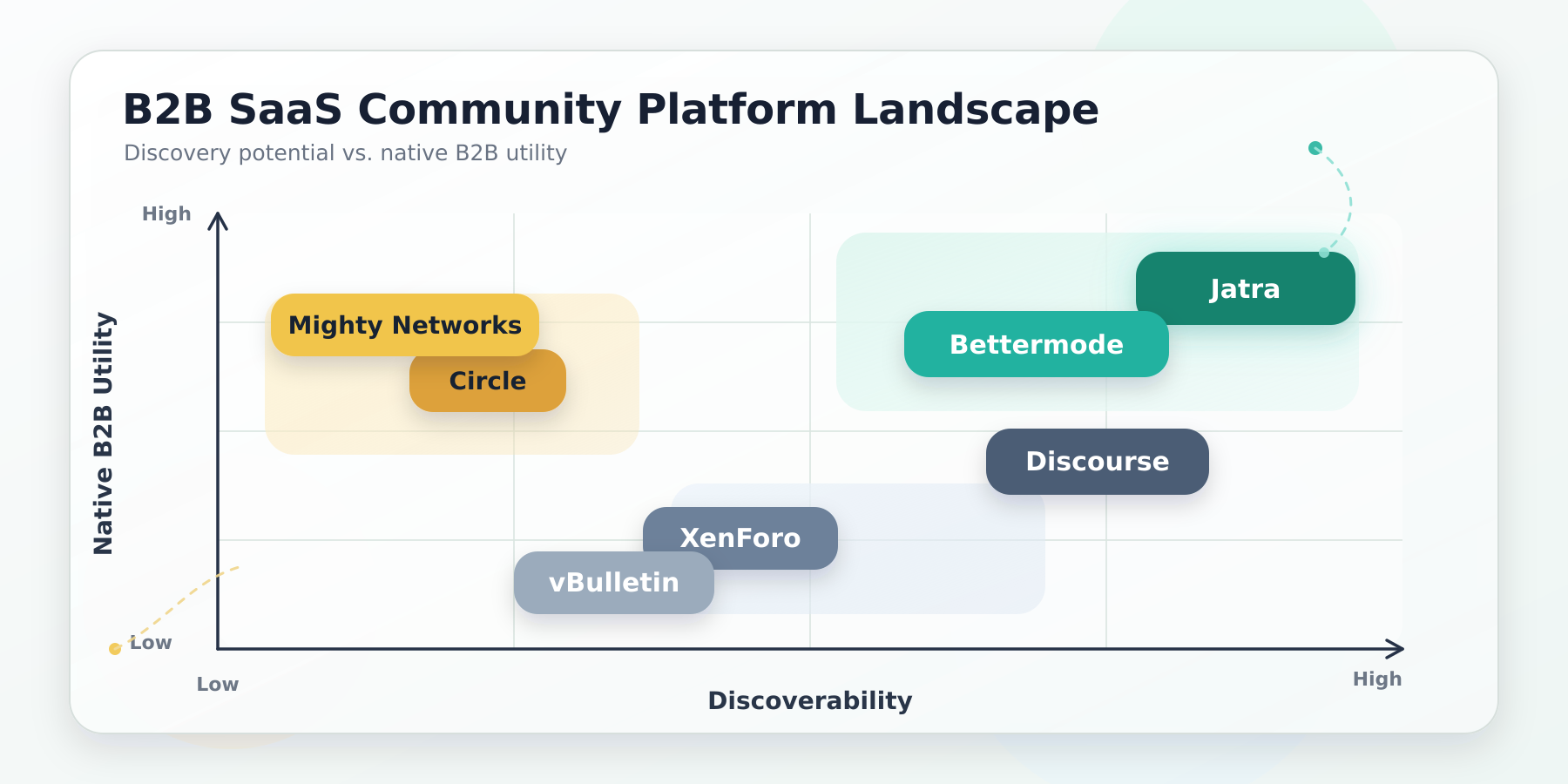
A table is precise, but it does not show the shape of the market. The map below covers the original eight platforms on the two axes that matter most for B2B SaaS: discoverability and native B2B utility. Higher Logic Vanilla and Khoros Aurora are included in the table, but are not plotted on this map.
Slack and Discord are not community platforms
Time and again, SaaS teams think about community and run the same algorithm in their head:
- We need a customer community.
- Our customers already use Slack.
- Let's use Slack.
I understand the temptation. Slack is familiar. Discord is easy to start. WhatsApp and Telegram feel lightweight.
But they are chat tools, not community platforms.
You can check the Discord half in about fifteen seconds. Open Discord's robots.txt and read the disallow list: /channels/ is blocked, and that is where server conversations live. For the wider tradeoff, see Discord compared with an indexable community.
The problem is not that conversations cannot happen there. They can. The problem is that the value disappears into a stream. Good answers are hard to rediscover. Search engines cannot use the content. New members cannot easily see what has already been solved. Your customer knowledge does not compound.
That is fine for internal teams or private groups. It is weak for a B2B SaaS community that should reduce support load, educate users, collect feedback, and bring in new buyers.
Slack has a second problem that shows up later. Pro costs $7.25 per active user per month on annual billing, so 1,000 billable active members for a full year would cost roughly $87,000, before taxes or discounts. Actual costs depend on activity and guest-account rules. In a 2023 interview about SuperHi's move, its community manager recalled spending over $50,000 a year on Slack. Strapi and Meilisearch also published their reasons for leaving.
If you are evaluating a move, I wrote about moving a community off Slack. If you are still deciding whether to move, start with getting a dormant Slack community moving again.
How to pick the right platform
If you are B2B SaaS, you probably do not need a platform optimized for course creators, paid memberships, or influencer-led communities.
You need three things.
1. Built-in SEO and AEO
Look for a platform that exposes public content to Google and makes it easy for AI crawlers to understand your best answers.
Every answered question, solved thread, product explanation, and member-contributed how-to can become a long-tail search asset. Your future customer is searching for answers in Google, ChatGPT, Perplexity, and other AI interfaces. If your community is readable, your community can become the source they find.
In one community I helped build, traffic went from about 30 visitors a month to roughly 17,000 visitors a month in 10 months. No ads. No social push. Just useful community content becoming discoverable.
For a practical evaluation, see what to test before you buy forum software.
The technical detail that quietly decides whether this works is rendering. If a platform relies heavily on client-side rendering, crawlers may not see the full page as reliably. If it renders useful HTML on the server, your content has a better chance of being discovered.
I wrote a plain-English explainer on why server-side rendering matters for community SEO if you want the mechanics.
Not everything should be public. Customer complaints, private beta feedback, and sensitive account discussions can stay private. The point is control. You should be able to decide what compounds publicly and what stays behind the wall.
2. Feedback and changelog close to the community
Many SaaS companies split this across separate tools.
The community lives in one place. Feature requests live in Canny, Upvoty, or UserVoice. The changelog lives somewhere else. The roadmap is another page. Support articles live in a help center.
That creates friction.
Users do not want to repost feedback in another tool. Product managers end up copying feedback manually. Support teams keep linking people away from the community. The customer experience becomes fragmented.
This frustration is one of the reasons I built Jatra. Jatra lets you run a feedback channel and a changelog channel inside the community itself. Roadmap is planned as a natural extension of the same workflow.
3. Customer support that does not send people away
In older forums, discussions did most of the work. A user asked a question. Staff or members answered.
That still matters, but B2B SaaS communities need more than discussions. Your support team may need articles, announcements, webinars, product updates, onboarding resources, downloadable guides, job posts, and release notes.
If all of that lives outside the community, users keep getting sent away.
This is where multi-content communities matter. A B2B SaaS community should not be just a message board. It should be a searchable customer knowledge layer.
An honest overview of B2B community platforms
Here is my read on the major options.
Bettermode
Bettermode is the closest serious B2B-native rival in this list.
Its biggest strength is customization. The visual builder is mature, and the platform supports a wide range of community structures: Q&A, articles, knowledge base, ideas, events, and customer portals. It also has integrations that fit customer-success motions, including HubSpot, Salesforce, Zendesk, and Intercom.
Two things to check before you sign. Bettermode generates sitemaps automatically, with no documented manual override. A Capterra review dated February 14, 2025 reported sitemap errors preventing Google indexation and ten days to acknowledge the bug. That is one customer's historical experience, not a claim about every account today. API and webhooks sit on Growth, starting at $1,500 a month billed annually; API access does not itself guarantee control over sitemap generation.
For larger teams with budget, implementation bandwidth, and a clear customer community plan, Bettermode can make sense.
Where I would be careful is organic-growth control. If SEO and AI visibility are major reasons you are building the community, ask very specific questions before buying:
- Can you control sitemap behavior?
- Can you control canonical URLs?
- Can different content types carry the right schema?
- Can your team fix indexation issues without waiting on support?
- Which plan includes the integrations or API access you actually need?
Bettermode is strong software. It is also meaningfully more expensive once you move beyond the starter tier.
For a focused shortlist, see alternatives to Bettermode.
Discourse
Discourse deserves respect.
It is open source, mature, technically strong, and battle-tested. It has excellent moderation, trust levels, permissions, plugins, themes, and a large technical community. For developer-heavy communities, open-source projects, and technical support forums, it remains one of the best products in the world.
Discourse also has a concrete AI-discovery feature: native llms.txt support starts with v2026.1.0. This gives operators another way to describe their public content to compatible tools; it does not guarantee AI citations. The commercial distinction is domain ownership: its current hosted pricing offers a free subdomain plan, while custom domains start with Pro at $100 a month. The old $20 Starter tier is no longer listed on the current pricing page.
I ran Discourse for years. I still think highly of it.
The catch is operational cost.
Anything custom eventually touches themes, plugins, Ember conventions, hosting decisions, Docker rebuilds, or developer time. Hosted Discourse reduces some of that burden, but pricing jumps from Pro to Business quickly. Self-hosting gives control, but it creates maintenance work.
Discourse also remains forum-first. It is excellent for discussions. It is less complete if you want feedback, changelog, jobs, articles, and other B2B content types to behave like first-class product surfaces with their own structure.
If your team is technical and wants a serious forum, Discourse is a strong choice. If your growth strategy depends on multi-content SEO and non-technical community operations, factor in the hidden work.
I covered the wider shortlist in Discourse alternatives for SaaS teams.
Circle
Circle is polished. The product feels modern, the UX is clean, and it is excellent for creators selling courses, memberships, and paid communities.
That is also the issue.
There is a technical version of the same problem. In the public Circle pages reviewed for our April 2026 audit, head metadata was present in the initial HTML, while post bodies rendered in the browser and no DiscussionForumPosting or QAPage markup was found. Treat that as a dated observation of the pages tested, and check your own trial community. Circle includes custom domains on all plans, so configure yours before building a public content library on the default circle.so subdomain.
Circle is built for creator-led community businesses more than B2B SaaS customer communities. If your goal is to sell courses, host paid spaces, run events, and manage memberships, Circle is a strong platform.
For B2B SaaS, the fit is weaker.
You do not get native B2B workflows like feedback, changelog, jobs, and product knowledge surfaces in the way a SaaS community typically needs them. You can work around some of this, but you are adapting a creator platform to a customer-community job.
Circle can work if community engagement is the core product. It is not the first platform I would pick if the goal is support deflection, product feedback, SEO, and AI discovery.
For the detailed evaluation, see Circle alternatives.
Mighty Networks
Mighty Networks has a clear point of view: community, courses, events, memberships, apps, and monetization.
For creators and membership businesses, that is a strength. Mighty has good engagement mechanics, native apps, events, and a strong creator-business framing.
The part a B2B reader should check is in Mighty's own SEO documentation. Indexing member posts and profiles requires Scale or above, starting at $179 a month. If access to the network is through plans, only the landing page is indexed, regardless of the subscription tier. Public content visibility must also be enabled.
For B2B SaaS, the mismatch is similar to Circle.
The platform is not primarily designed to turn public customer knowledge into searchable assets. It is designed to help hosts create paid experiences and engaged member spaces. That can be valuable, but it is a different job.
If you are running a paid membership business, evaluate Mighty seriously. If you are building a SaaS customer community to support users and attract buyers, it is probably not the cleanest foundation.
XenForo and vBulletin
The legacy forums get one important thing right: they render real forum pages and give you durable ownership.
I am not assessing these from the outside. I ran CrazyEngineers on legacy forum software for nearly 14 years. These platforms can work. They are stable, familiar, and strong at classic forum behavior.
XenForo in particular is still a serious product. It has good moderation, permissions, add-ons, and a strong forum experience. vBulletin still exists for teams that want traditional hosted or self-hosted forum software.
The limitation is the layer above the forum.
A B2B SaaS community usually needs more than threads. It needs articles, support answers, feedback, changelog, roadmap, jobs, announcements, product education, and structured content types that search engines and AI systems can understand.
With legacy forums, you can often build or bolt these things on. But that is the point: you are bolting them on.
For owner-operators with developer capacity, that tradeoff can make sense. For a SaaS team that wants modern customer-community workflows out of the box, it is usually too much assembly.
Check the schema on the actual thread types you plan to use. XenForo does support QAPage on Question threads: its official support forum documents this, and a developer-confirmed fix addresses missing answer text in that markup. For either platform, validate a normal discussion and a solved question from your chosen version and theme instead of assuming that all threads emit the same schema.
For a closer comparison, see XenForo alternatives.
Where Jatra fits
Jatra is the platform I wanted when I was building communities the hard way.
It is built for businesses that want a public, branded, useful customer community on their own domain. The goal is not just engagement. The goal is durable customer knowledge.
A few reasons Jatra fits B2B SaaS communities well:
-
Server-side rendering. Public community content is discoverable from day one.
-
Multi-content support. Discussions, articles, news, feedback, changelog, jobs, announcements, and quizzes can live in one community.
-
Structured content. Different content types can be treated differently instead of forcing everything into a generic post format.
-
Own-domain SEO. Your community should build your brand's authority, not a vendor's default subdomain.
-
Hands-on help. Many SaaS teams do not fail at community because the software is bad. They fail because no one knows what to do after launch. Jatra includes practitioner-led help with setup, content seeding, and growth direction.
If you want a generic membership platform, Jatra is not the right choice. If you want a private chat group, use Slack or Discord.
But if you want a B2B SaaS customer community that supports customers, captures product insight, and creates searchable public knowledge, Jatra is built for that job.
You can see the platform running at community.jatra.club, including the public platform updates and releases channel. To evaluate plans, visit Jatra pricing.