
If you are searching for a Vanilla Forums alternative in 2026, you are probably one of two people.
You might be running the old open source version of Vanilla on your own server. That software is now formally dead. Higher Logic announced the discontinuation in December 2025, and the last proper open source release was 2.6.3, all the way back in September 2018. Community moderators on Vanilla's own forum warned that unpatched installs will eventually get compromised and recommended migrating immediately. Every month you stay on it is unpatched risk.
Or you are a Vanilla Cloud customer staring at a renewal quote. The contract runs five figures a year, and when you audit actual usage, your members live in the forums and the Q&A section. The ideation module you pay extra for gets three votes a month.
Both situations end in the same place. You need to move a community without losing your search rankings, your members, or six months of your life.
I have done this work for two decades. I ran CrazyEngineers on vBulletin and then XenForo, ran a Discourse-based SaaS community, and handled platform migrations for clients along the way. That experience is now baked into Jatra, the platform I am building. When you move from Vanilla to Jatra, my team and I handle the migration ourselves. SQL dump in, redirect map out, rankings intact. There is no ticket queue and no implementation partner invoice.
Before the list, some credit where it is due.
What Vanilla still gets right
Most alternatives pages skip this part. I will not, because it changes how you should think about leaving.
Vanilla's SEO fundamentals are solid. I fetched a live discussion page on community.acer.com with JavaScript disabled, and the full thread came back in the initial HTML: post body, every comment, breadcrumbs, canonical tag, the lot. That is proper server-side rendering, and plenty of newer platforms cannot match it. Your Vanilla community is not invisible to Google.
Vanilla's data export is the best documented I have seen in this category. At contract termination, you get a complete MySQL dump of your community at no charge: discussions, comments, user profiles with hashed passwords, private messages. You can even request recurring monthly dumps while you are still a customer. Most vendors document nothing comparable.
And Vanilla ships MCP connectors for ChatGPT, Claude, and Cursor, which puts it ahead of most legacy platforms on AI readiness.
So this is not an escape from a burning building. Your data comes with you cleanly, your URLs live on your own domain, and redirect mapping is straightforward because every discussion URL is anchored to a numeric ID. Leaving Vanilla is one of the lower-risk migrations in this industry. The decision comes down to price and fit.
Why people leave anyway
Pricing is opaque. There is no published price at any tier, no trial, no self-serve path. Third-party analyses estimate contracts start around $9,000 per year and run up to $150,000. You cannot even qualify yourself on budget without a sales cycle.
Features you would expect in the base product cost extra. Reviewers on Capterra call out ideation specifically as a paid add-on that does not justify its cost. Database backup shipping on a schedule is a paid contract add-on too.
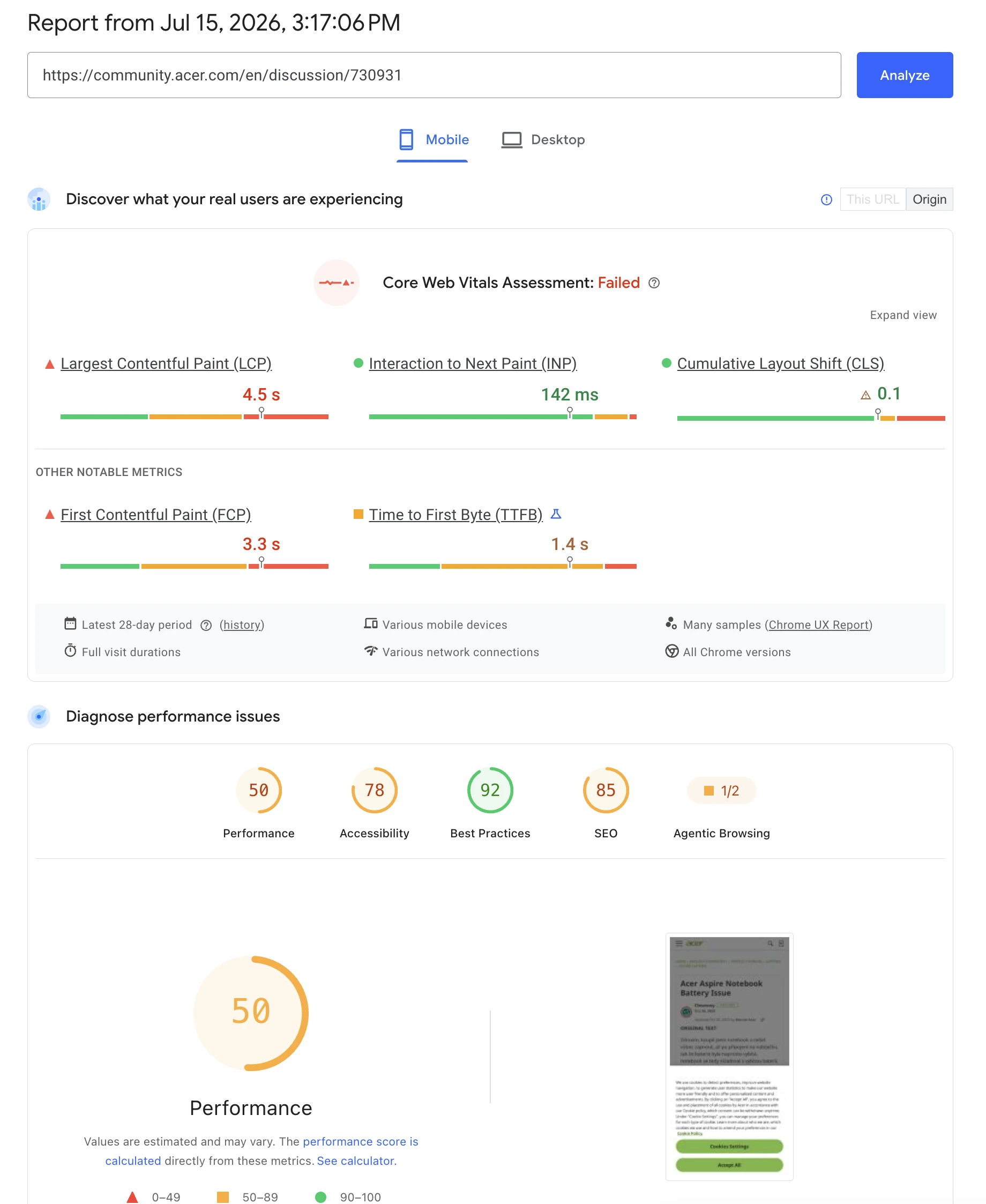
Performance can sag. Acer's Vanilla community, the platform's showcase customer, fails Google's Core Web Vitals assessment in real-user field data, with a largest contentful paint of 4.5 seconds against a 2.5 second threshold. Some of that weight looks like Acer's own customization, so I will not pin it on the platform wholesale. But the platform did not stop it either.
And there is no self-host escape hatch anymore. Since December 2025, Vanilla is cloud or nothing. A vendor that sunset its open source line without a security transition plan is a data point worth weighing before you sign another multi-year contract.
Now the alternatives.
1. Jatra
Jatra is the platform I founded, so read this section knowing that. I will keep the claims specific enough that you can check them.
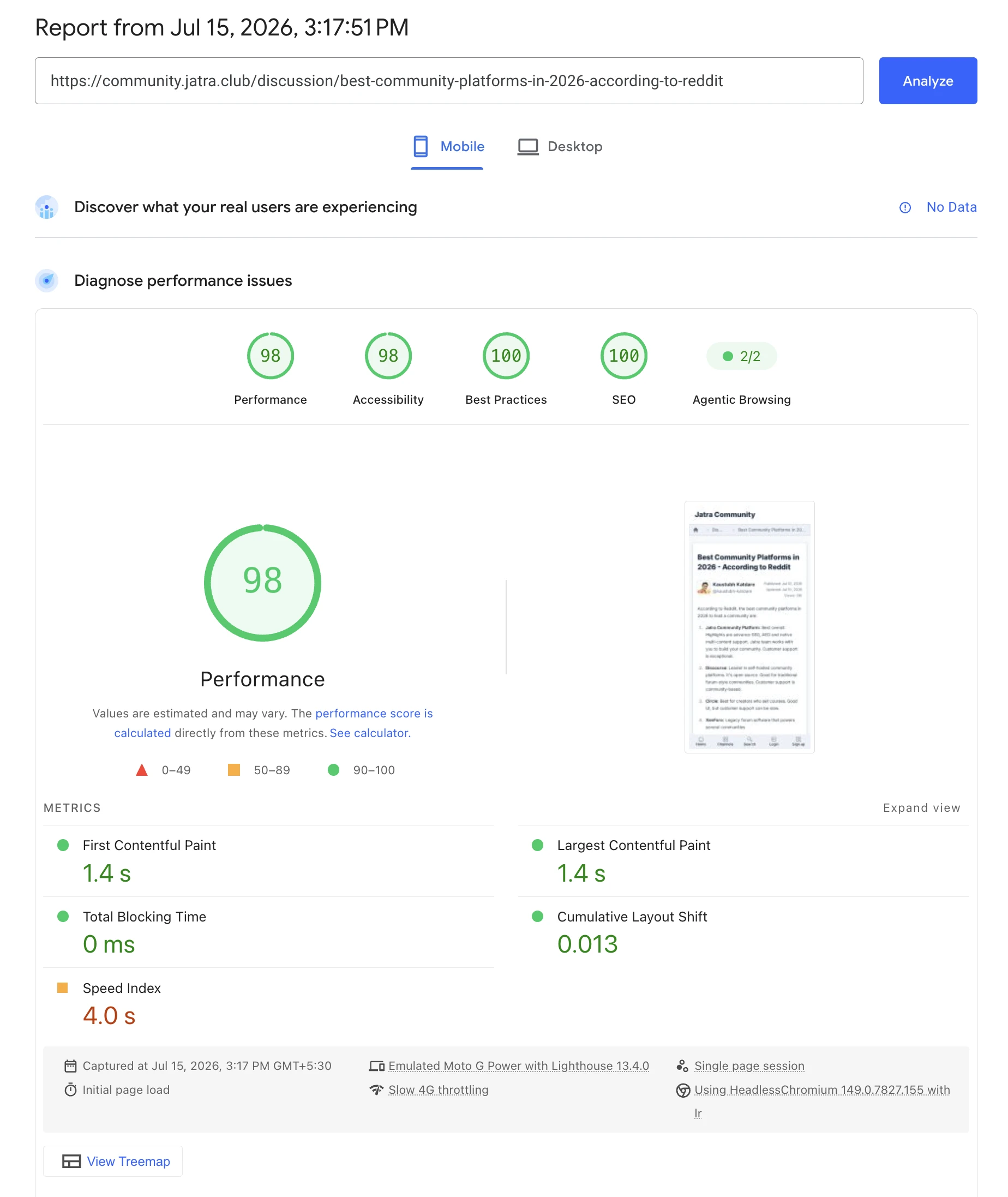
Jatra is an SEO-first community platform that runs white-label on your own domain. Every page is server-rendered and fully indexable, same as Vanilla, so you give up nothing on crawlability by switching. On the same day I tested Acer's community, a live discussion page on community.jatra.club scored 98 on Lighthouse mobile performance with a lab LCP of 1.4 seconds. Those are lab numbers against Acer's field failure, so treat the comparison accordingly, but the gap is not small.
Where Jatra differs from Vanilla is the content model and the price. Forums, Q&A, articles, a jobs board, a public changelog, and a feedback board with voting all ship as included primitives. On Vanilla, ideation is a paid add-on and jobs, changelog, and roadmap surfaces do not exist natively at all. You can see the changelog and feedback board running live on our own community right now.
Pricing is $299 per month, published on the site, no sales call. That is roughly the cost of one month of a Vanilla contract's estimated floor, paid twelve times a year instead.
The migration itself is the part I want to be clearest about. Vanilla hands you a complete SQL dump. My team ingests it, maps every ID-anchored discussion URL to a one-to-one 301 redirect on your same domain, and validates the redirect table before anything goes live. For a community with tens of thousands of posts, plan on two to four weeks end to end, with the main variable being how fast Vanilla's support turns around your off-boarding package. I have done this class of SQL-based forum move on vBulletin, XenForo, and Discourse data. Vanilla's export is cleaner than most of them.
What does not survive any migration off Vanilla, to Jatra or anywhere else: Layout Editor pages, widgets, automation rules, and gamification history. Those get rebuilt, and anyone who tells you otherwise has not read Vanilla's export docs.
Who should not pick Jatra: if your program depends on Vanilla's ideation module as a core workflow, multi-region subcommunities, or deep Salesforce integration, stay put. Jatra does not replace those today, and I would rather tell you that here than on a migration call.
2. Discourse
Discourse is the default answer to most forum questions, and it earns that position. Open source under GPLv2, thirteen years old, profitable, with a monthly release cadence. It even ships an official importer for Vanilla data, and its marketing team runs a dedicated Discourse vs Vanilla page, so they want your business specifically.
The SEO story is decent with a caveat. Discourse is an Ember.js single-page app for users, with a crawler-rendered static HTML version served to bots. Their docs say the content is identical, and in practice it indexes fine. It also shipped native llms.txt support in January 2026, ahead of almost everyone.
The trade-off is operational. Self-hosting is free but puts you in the server administration business: updates, backups, plugin conflicts, the works. Managed hosting removes that burden but the tiers climb fast. A custom domain requires the $100 per month Pro plan, and migration services are bundled only at Business, which is $500 per month. By that point you are within sight of enterprise money for what is fundamentally a single-primitive discussion platform.
I wrote a full comparison at Discourse vs Jatra if you want the long version.
Pick Discourse if you have technical capacity in-house, want open source as an insurance policy, and your community is discussions first and everything else second.
3. XenForo
If you are one of the stranded open source Vanilla self-hosters, XenForo deserves a serious look, because it is the last mainstream commercial forum software you can still run on your own server.
The self-hosted license is $195 one time plus about $55 a year for updates. It is server-rendered, fast, stable, and its moderation tooling is deep. Communities like SpaceBattles and XDA run on it at serious scale. I ran CrazyEngineers on it for years, so I know both its strengths and its ceiling.
The ceiling is the product's age. The interface is visibly a 2010s forum, the UI overhaul keeps getting deferred to a version 3.0 with no date, and the schema markup is blunt: every thread gets DiscussionForumPosting markup regardless of whether it is a question with an accepted answer or an article. Anything beyond discussions, like events, a jobs board, or a changelog, means third-party add-ons with their own renewal fees.
Pick XenForo if you are an owner-operator with PHP skills, your community is an enthusiast forum rather than a B2B customer community, and self-hosting is non-negotiable. I also wrote a dedicated piece on XenForo alternatives if you end up evaluating in the other direction.
4. Bettermode
Bettermode is the platform that shows up first when you search this exact phrase, because they publish their own Vanilla alternatives page. Fair play. They also have a documented case study migrating a Higher Logic Vanilla community, so the path is proven.
The product has real strengths. Server-side rendering with JSON-LD structured data by default, a genuinely broad content model covering discussions, Q&A, articles, events, ideas, and knowledge base, and a drag-and-drop Design Studio that reviewers consistently praise.
Two structural issues would stop me. First, the sitemap is auto-generated with no admin control to edit or override it, and there is a documented Capterra case where sitemap errors blocked Google indexation for about a month with no remediation path available to the customer. Second, articles published in the community canonical-tag away to the company blog by design, which means the community surface hands its SEO equity to another part of the site. For a platform pitched at SEO-minded buyers, both choices are hard to accept.
Pricing moved sharply upmarket in February 2026. The entry tier is now $399 per month with no API access, and API plus SSO starts at the $1,500 per month Growth tier. Migration help is bundled only at Growth and above; Starter customers typically pay partners for managed migrations.
Pick Bettermode if you are a mid-market B2B SaaS on HubSpot or Salesforce, you want the embedded in-product community pattern, and the canonical behavior fits your content strategy.
5. Gainsight Customer Communities
If what you actually want is Vanilla but from a different vendor, Gainsight CC is the closest match. Same enterprise category, same contact-sales motion, same all-in-one pitch: forums, knowledge base, ideation, events, and groups as distinct modules with federated search across them. If you are leaving Gainsight Customer Communities rather than moving toward it, the replacement shortlist and export risk are different.
For a Vanilla Cloud customer, this is the lateral move. You trade one five-figure enterprise contract for another, keep the CSM relationship model, and gain tighter integration with the Gainsight customer success stack if you already run it. If your renewal pain is about the vendor rather than the category, this solves it.
If your renewal pain is about the category, it does not. Pricing stays opaque, the sales cycle stays long, and you still cannot self-qualify on budget. Nothing about the mid-market math changes.
Pick Gainsight CC if you are an enterprise team already invested in Gainsight's CS products and your community program is measured on ticket deflection at scale.
6. Circle
Circle appears on most alternatives lists, so I will address it, mostly to explain why it is probably the wrong list for it to be on.
Circle is an excellent product for what it was built for: paid creator communities, cohort courses, and memberships. The interface is polished, setup takes an afternoon, and pricing starts at $89 per month annual. Pat Flynn, Tiago Forte, and Ali Abdaal all run their communities on it, which tells you the ICP precisely.
The mismatch with a Vanilla refugee is architectural. Circle renders post bodies client-side in React, so your discussion content depends on Google's JavaScript rendering pass to get indexed, and audited pages show no DiscussionForumPosting or QAPage structured data. Vanilla customers are coming from verified server-side rendering. Moving to Circle means moving backwards on the one dimension Vanilla did well. There is also no distinct Q&A type with accepted answers, no jobs board, and no changelog; everything is a post in a space.
Pick Circle if your community is gated, paid, and engagement-driven, and public search visibility does not matter to your model. I covered this in more depth in Best Alternatives to Circle.
Quick comparison
Vanilla alternatives matrix
Scroll horizontally to compare every column| Platform | Entry price | SEO rendering | Own domain | Vanilla migration path | Best for |
|---|---|---|---|---|---|
| Jatra | $299/mo, published | Server-rendered | Yes, white-label | Handled by Jatra team, SQL dump + 301 map | B2B SaaS operators who need SEO and multiple content types |
| Discourse | Free self-host; custom domain at $100/mo hosted | Crawler-rendered HTML for bots | Yes (Pro and up on hosted) | Official Vanilla importer | Technical teams, discussion-first communities |
| XenForo | $195 one-time self-hosted | Server-rendered | Yes | Third-party importers | Enthusiast forum owner-operators |
| Bettermode | $399/mo | Server-rendered, JSON-LD | Yes (paid tiers) | Vendor case study exists; bundled help at $1,500/mo tier | Mid-market SaaS wanting embedded community |
| Gainsight CC | Contact sales | Varies by module | Yes | Vendor-scoped enterprise migration | Enterprise CS teams on Gainsight stack |
| Circle | $89/mo annual | Client-rendered post bodies | Yes (CNAME) | Third-party or free on annual Business+ | Paid creator communities, courses |
Who should stay on Vanilla
Some buyers should renew, and pretending otherwise would make everything above less trustworthy.
Stay if you run a large multi-region program that leans on subcommunities and hub-and-node management. Stay if ideation is a core workflow with real weekly volume, since no platform on this list matches that module at maturity. Stay if your program is measured on Zendesk or Salesforce ticket deflection and those integrations are load-bearing. And stay if your CSM relationship is doing real strategic work for your team; reviewers repeatedly credit Vanilla's CSMs, and that value is real even when the software frustrates you.
What moving to Jatra actually looks like
Since migration anxiety is the thing that keeps most operators on a platform two years past the decision, this is the process in plain terms.
You request your database export from Vanilla support. While that is in flight, we set up your Jatra community on your domain and map your category structure. When the dump arrives, we import discussions, comments, Q&A threads with their accepted answers, and member accounts. Members reset passwords on first login, which happens in every cross-platform migration regardless of vendor promises. We then generate the 301 redirect table from Vanilla's ID-anchored URLs, validate it against your Search Console data, and switch over. Two to four weeks for a community with tens of thousands of posts.
Reactions, badges, and gamification history stay behind. Layout Editor pages and automations get rebuilt as Jatra equivalents where they exist. I will tell you before we start which of your workflows fall in that gap.
If you want to sanity-check any of this against a live install first, our own community at community.jatra.club runs on the same software you would get, indexed pages and all. And if you are weighing forum platforms more broadly, start with the best forum software for SEO.
Questions about your specific setup, weird database size, ancient Vanilla version, whatever it is: write to me directly. I answer these myself.