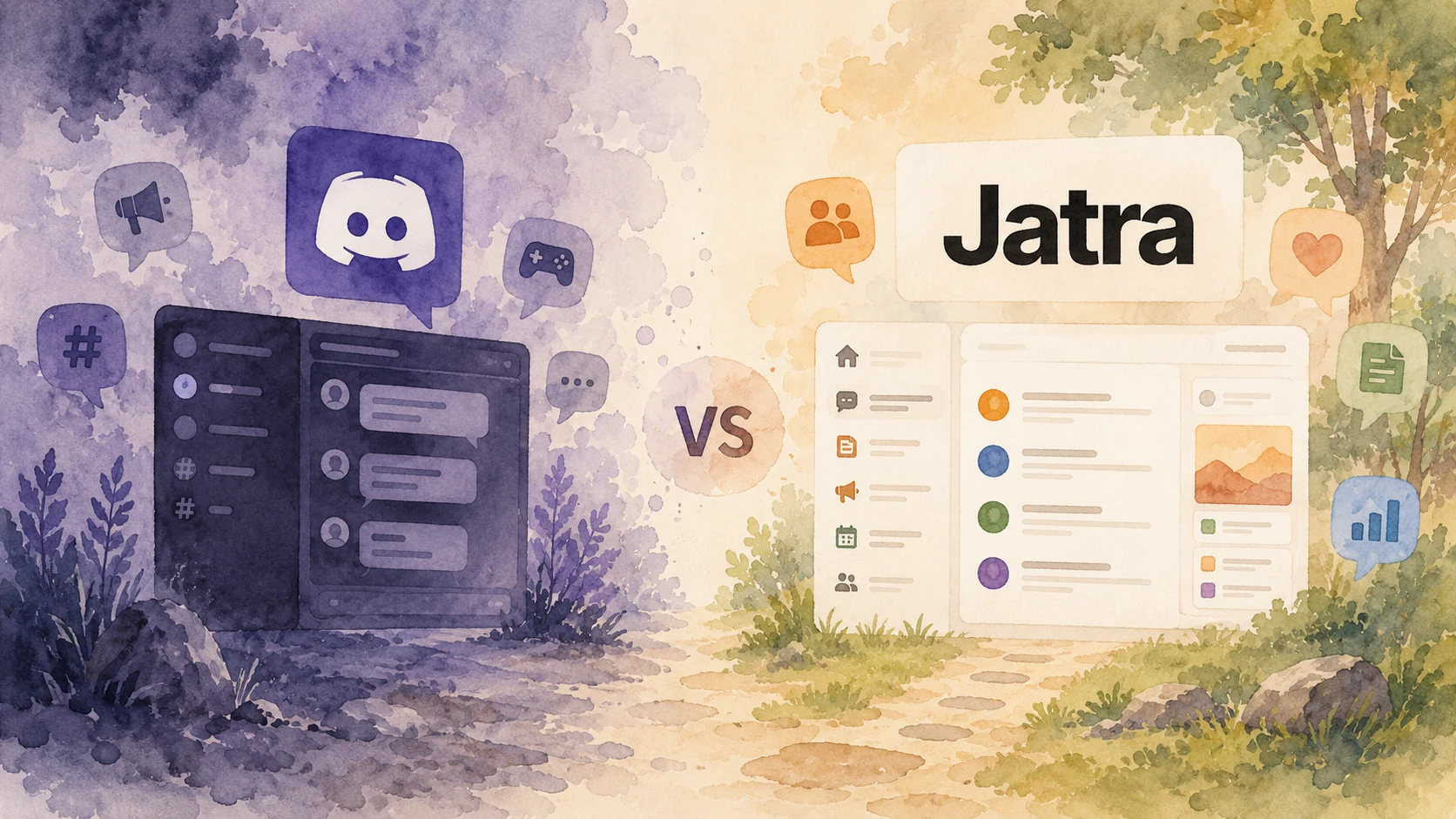

Discourse vs Jatra: Open-Source Forum or SEO-Native Community Platform?

vs

The Open-Source Forum

Discourse

The most respected open-source discussion platform on the internet. Trusted by developer communities, support forums, and public knowledge bases that need self-hosting, plugins, and the deepest forum primitive shipping today. Built around the threaded topic as the unit of value.

The SEO-Native Community

Jatra

A managed, server-rendered community platform built so every post, article, and answer is indexable from the moment it ships. Multi-content from day one — discussions, articles, jobs, events, changelog — all under one domain, all earning organic traffic instead of fighting the platform for it.

By · Founder, Jatra · Updated

Based on platform audits, rendered HTML checks, structured data review, and migration learnings from community platforms.

Verdict

Discourse is the right choice if you want open source, self-hosting, and the deepest forum primitive on the market. Jatra is the right choice if you want a customer community that compounds into an organic acquisition channel without running a forum stack yourself. Most teams are not choosing between two forums. They are choosing between owning infrastructure and owning a search position.

TL;DR

Discourse

  • Open-source, self-hostable, and the deepest forum software shipping today. Mature moderation, trust levels, and a strong plugin ecosystem.
  • Solid SEO fundamentals. Sitemap, canonical tags, and crawl handling are implemented correctly.
  • Client-rendered frontend using Ember.js. Content is hydrated via JavaScript after initial load.
  • Single content primitive. Everything is a topic, regardless of content type.

TL;DR

Jatra

  • Server-rendered by default. Content is present in the initial HTML response.
  • Automatic structured data by post type. Article, QAPage, JobPosting, Event, DiscussionForumPosting.
  • Native multi-content architecture. Discussions, articles, jobs, events, changelog, feedback.
  • Managed platform. No infrastructure, no upgrades, no sysadmin overhead.

Detailed comparison

How they compare, section by section

Four lenses that decide most community-platform calls. Where Discourse genuinely wins, we say so. Credibility comes from acknowledging tradeoffs, not ignoring them.

Jatra workspace showing an SEO-native community platform comparison

Decision help

Choosing for search-led growth?

Get a direct read on whether your community should stay forum-first or move to structured, server-rendered content.

01

Why does Discourse render forum content with JavaScript, and what does it cost in 2026?

Discourse has strong SEO documentation and has clearly invested in search visibility for years. The question is not whether it supports SEO. It does. The question is what its rendering model costs in 2026, when search engines and AI systems prioritize fast parsing, structured clarity, and immediate content access.

Discourse uses Ember.js to render pages on the client. The initial HTML response is largely a skeleton, and post content is injected after JavaScript execution. Search engines can process this, but there is a difference between eventually visible and immediately parseable. That difference impacts indexing speed, structured data extraction, and AI citation likelihood. It also affects Core Web Vitals on lower-end devices.

Across an 8-month audit of a mid-sized Discourse instance with around 18,000 indexed pages, two patterns showed up consistently in Search Console and Lighthouse. New topics took longer to begin generating impressions compared to server-rendered pages on the same domain. Rich Results coverage was limited. Even content that resembled Q&A or long-form guides was treated as discussion threads. Lighthouse reports frequently flagged JavaScript execution time on mobile. None of these issues break SEO, but they compound across scale into slower discovery and weaker distribution across search and AI surfaces.

Jatra takes the opposite approach. Every page is server-rendered, every post is present in the initial HTML response, and structured data is applied automatically based on content type. The outcome is simpler. Faster discovery, clearer classification, and broader eligibility for search features.

Discourse

  • Client-rendered using Ember.js. Content is hydrated after page load.
  • Schema tied to discussion threads. Limited support for other content types without plugins.
  • Strong fundamentals for crawlability. Sitemap and canonical handling are reliable.
  • Limited eligibility for rich results beyond discussion-level enhancements.

Jatra

  • Server-rendered HTML on every page.
  • Structured data applied automatically by content type.
  • Content visible without JavaScript execution.
  • Consistent URL, canonical, and pagination handling.
02

Can a single forum primitive carry articles, jobs, and events — or does it cost you schema?

Most teams start with discussions and expand from there. Roadmaps become pinned threads. Job listings become tagged posts. Events become threads with dates inside the body. Everything works, but everything is treated the same.

The limitation is structural. A job listing inside a thread is still a discussion. An event inside a thread is still a discussion. Search systems classify based on structure, not intent. That limits visibility in specialized search surfaces.

In one migration, job listings that lived as threads had almost no visibility in Search Console. After moving the same content into structured JobPosting pages, impressions appeared within weeks. No change in content. Only structure changed. Similar results were seen with events.

Jatra treats each content type as first-class. Discussions, articles, jobs, events, and more. Each has its own schema, template, and structure. All content lives on the same domain and shares authority.

Discourse

  • Single content primitive. Everything is a topic.
  • Content types simulated through tags and categories.
  • Schema depends on plugins or custom setups.
  • Often paired with external CMS.

Jatra

  • Multiple native content types.
  • Each type mapped to appropriate schema.
  • Unified domain authority.
  • Custom content types supported.

Migration signal

If schema is already costing you traffic, audit before you rebuild.

Book 15-minute audit
03

When is Discourse's open-source extensibility worth the engineering cost?

Discourse is open source under GPL. You can modify the source, extend functionality, and build custom plugins. It offers deep flexibility for teams with engineering capacity.

This flexibility comes with operational cost. Hosting, email setup, database management, upgrades, monitoring, and security all require engineering time. For many teams, this becomes a distraction from core product work.

Discourse-hosted reduces operational burden but introduces pricing tiers that gate advanced features. API access, plugins, and integrations are not always available on lower plans.

Jatra is managed-only. No infrastructure, no upgrades, no maintenance. The tradeoff is less deep customization, but significantly lower operational overhead.

Discourse

  • Open source with full control.
  • Large plugin ecosystem.
  • Self-hosted or managed hosting options.
  • Requires engineering ownership.

Jatra

  • Fully managed platform.
  • No infrastructure overhead.
  • API-first integration model.
  • Limited deep customization compared to open source.
04

Does the same moderation model work for discussions, articles, and job listings?

Discourse has one of the most mature moderation systems available. Trust levels, flagging, and review queues work extremely well for discussion-heavy communities.

Challenges appear when content types vary. Articles, job listings, and feedback posts require different moderation rules, but are processed through the same system.

In one case, job listings overwhelmed moderation queues. High-value discussions were delayed, and job posts were inconsistently reviewed. The system worked as designed, but did not fit the content mix.

Jatra applies moderation rules by content type. Different workflows for different content. The result is more efficient moderation and better content quality control.

Discourse

  • Strong trust-level system.
  • Granular moderation tools.
  • Best for discussion-first communities.
  • Uniform moderation model.

Jatra

  • Content-type-aware moderation.
  • Different workflows for different content.
  • Built-in moderation analytics.
  • Flexible permission models.

FAQ

Frequently asked questions

Is Discourse bad for SEO?

No. Discourse has solid SEO fundamentals. The limitation is around rendering and content structure, not basic SEO capability.

Can I migrate without losing rankings?

Yes, with proper redirects and migration planning.

Does Jatra support self-hosting?

No. It is managed-only.

How does Jatra handle structured data?

Automatically, based on content type.

Can Jatra replace Discourse completely?

Not in all cases. It depends on requirements.

Which platform is better for AI visibility?

Server-rendered, structured content has an advantage.

Closing thought

Two ways to think about this decision.

If you need deep customization, open-source control, and a discussion-first model, Discourse is a strong choice.

If your goal is organic growth, structured content, and minimal operational overhead, Jatra is built for that.

The right choice depends on what problem you are solving.