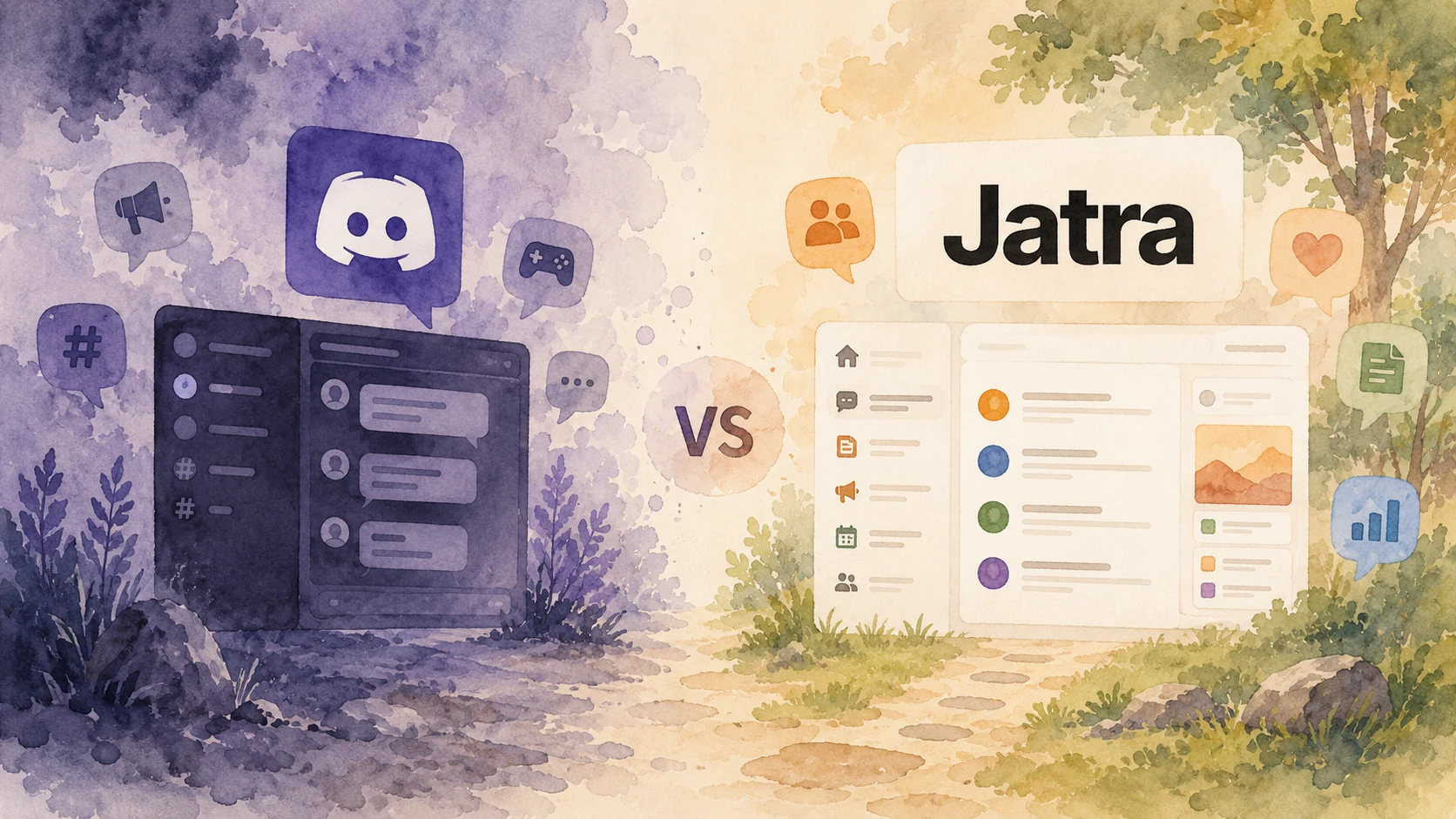

I started our community in a Slack workspace, the way most people do. When it got busy enough to need structure, I moved it to Circle, because Circle was polished out of the box, bundled courses, and let members find their way around in an afternoon. For a long stretch that was the right call.
The problem showed up later, and it was quiet. After two years we had thousands of useful threads, a stack of how-to articles, and a steady drip of answered questions. None of it was bringing in a single new member. Our best content lived at ourname.circle.so, behind a layout that search engines and AI tools could barely read, building authority for Circle's domain instead of ours. We were paying to host a knowledge base that nobody outside the login wall could find. Those notes on what I actually wanted became the blueprint for Jatra.
If you are evaluating Circle alternatives for a business community, here is what I wish I had known at the start:
- If your community is meant to be found, do not build it on Slack or Discord, however easy that looks on day one.
- Build a hybrid community. Expose most of your content, 80% or more, to Google and AI engines for organic discovery. (More on that in my guide to the best forum software for SEO.)
- Keep product feedback, changelog, and roadmap inside the community, not bolted on as separate tools you have to manage.
- Host on your own domain with server-side rendering, so the authority you build compounds for you, not for a vendor's subdomain.
- Treat the community as an acquisition and retention channel, not a closed paid product behind a login.
A bit more before the alternatives.
Community is infrastructure, not a side project
Plenty of businesses treat community as a marketing line item: a Slack group, a subreddit, a forum someone set up with enthusiasm and then forgot. I see it as part of the customer experience: a place to get an answer, share feedback, and learn from other people using the product.
The useful measures are specific to your business. Are members getting answers before opening a support ticket? Do answered questions attract new visitors? Are customers returning and contributing? Track those outcomes against your own baseline rather than assuming a community will deliver a universal retention lift.
So the platform you pick is not cosmetic. It decides whether your most invested customers come back, whether your support team keeps up, and whether the content your members create can ever be found by the next person searching for it. That last part is where my Circle story turns, so I want to be clear up front about who Circle is genuinely right for, because for a large group of people it still is.
What Circle does well
If you sell courses, run cohorts, or charge for membership, Circle deserves a serious look. Its plan comparison lists courses, live events, payments, gamification, and shared iOS and Android apps. When I ran our community there, I appreciated how polished it felt and how quickly members could find their way around. Those strengths still matter when the community itself is the product.
If your community is a paid product that lives behind a login on purpose, Circle does that job well and you can stop reading here. This article is for the other case: the business community where the community is the growth lever, where you want the discussions, articles, and answers your members create to bring in the next wave of members on their own. That is a different job, and Circle was not built for it.
Where Circle breaks for a business community
Match content types to the job
Circle offers posts alongside dedicated courses, events, and chat. The question for a business knowledge hub is whether those surfaces cover your actual workflow. Test an answered customer question, a job listing, a product suggestion, and a release announcement. Check whether members can distinguish them, whether an accepted answer stays visible, and whether public pages carry structured data appropriate to the content. A flexible post editor alone does not settle those questions.
Check how public post bodies are rendered
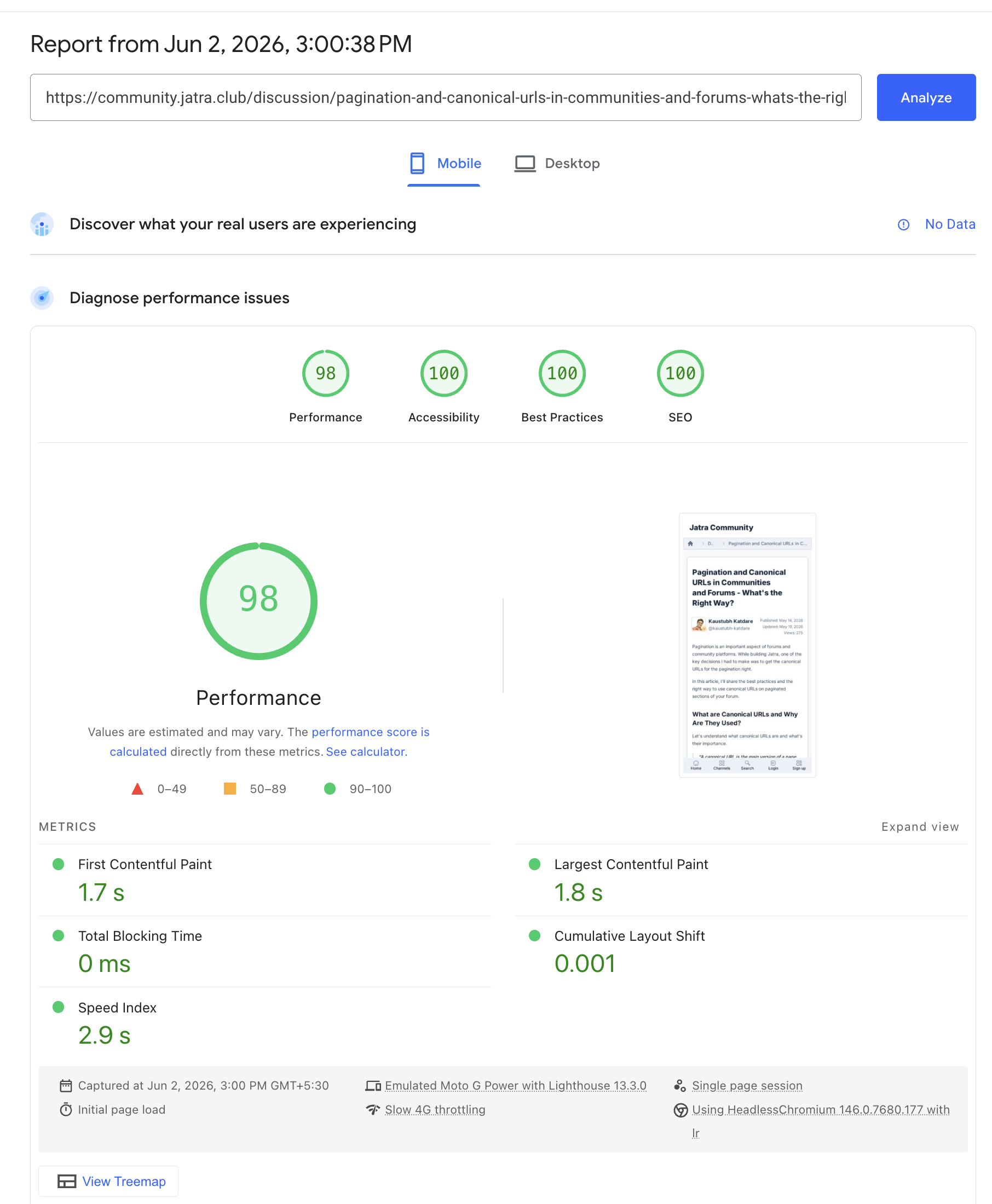
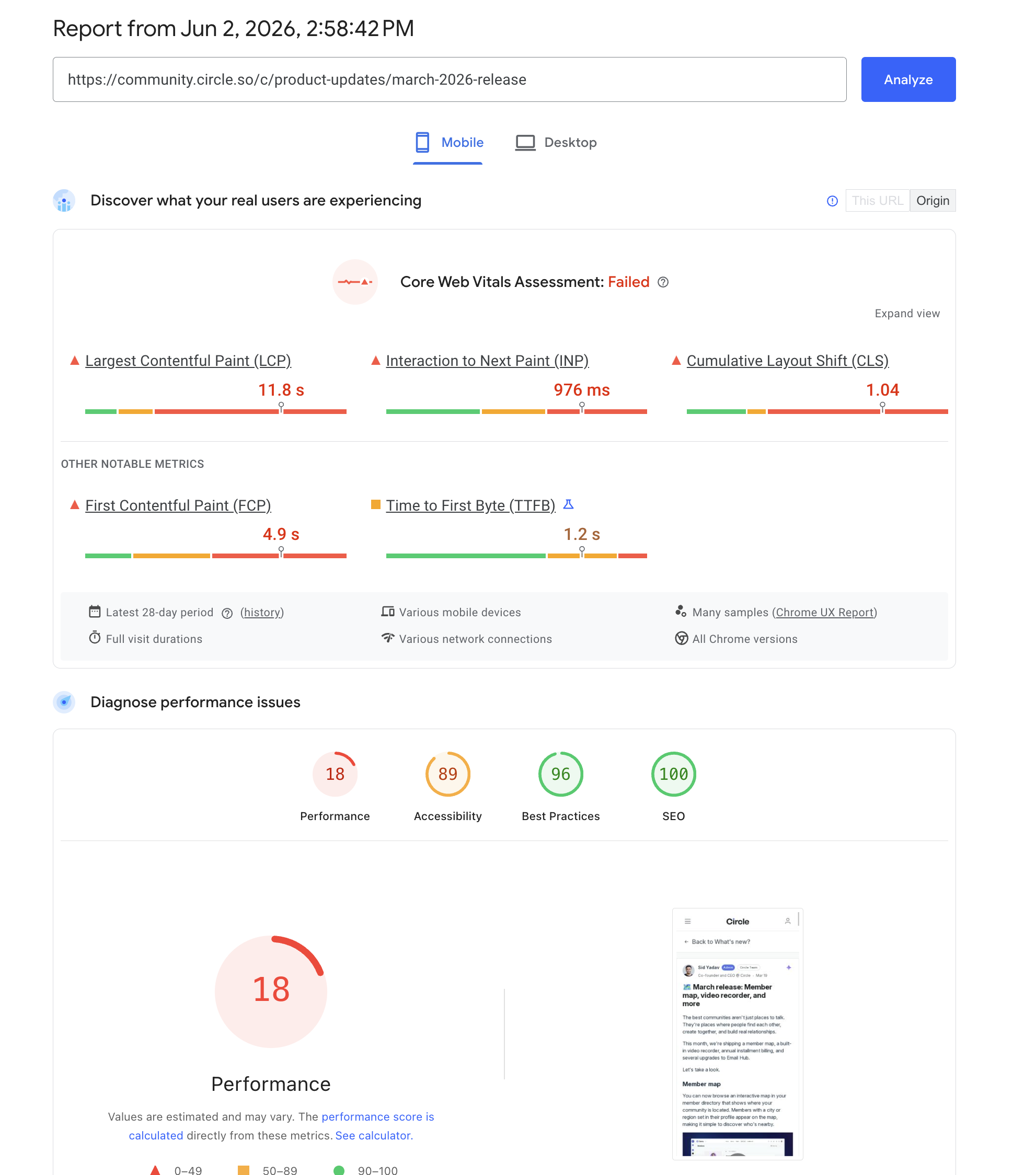
A public page title is only part of the discovery story. Before moving, inspect a representative public discussion and its replies in both the initial HTML and the rendered page. Check robots rules, canonical URLs, and any structured data against Google's current discussion forum and Q&A guidance. The June 2026 PageSpeed screenshots below show two particular pages; they do not establish that every Circle site has the same rendering or schema.
Use your own domain from the start
Circle offers a custom domain even on its Professional plan, according to its current pricing. If ownership of your public content matters, use your own domain from the start and check the canonical URLs and redirects. A vendor subdomain can be convenient, but you will have another URL change to manage if you later move. A custom domain by itself does not make a private page indexable.
The cost stack adds up
As checked on October 1, 2026, Circle's pricing lists Professional at $89 per month, Business at $199, and Scale at $419, all billed annually; Circle Plus is custom-priced. Circle charges transaction fees of 2% on Professional and 1% on Business and Scale, in addition to payment processing fees that depend on your payment setup. Email Hub is an optional add-on shown at $99 per month for 10,000 contacts. Removing Circle branding starts on Business, while extra admins, moderators, and capacity can add to the bill. Compare your actual member and payment requirements, not just the headline subscription.
Why server-side rendering decides whether you get found
This is the part most platform comparisons skip, so it is worth slowing down on.
When a page is server-side rendered, or SSR, the full content of that page is present in the HTML the server sends back before any JavaScript runs. A crawler that fetches the page sees the whole thread, every reply, the author, and the dates. When a page is client-side rendered, or CSR, the server sends a near-empty shell and the browser builds the content afterward by running JavaScript. A crawler has to execute that JavaScript to see anything, and many crawlers either do not, or do it on a delay, or do it inconsistently.
Google's JavaScript SEO guidance explains that Google crawls and renders JavaScript pages, but rendering may happen after the initial fetch. Other crawlers can have different capabilities. That is why I prefer important public content to be readable without executing JavaScript. For any platform on this list, check the exact public page and access settings you plan to use rather than assuming its whole site behaves the same way.
For a business community this matters. A thread answered well in March should still be useful to someone searching in December. Server-rendered content removes one dependency, but discovery also needs public access, crawlable links, sensible canonical URLs, and useful answers. No rendering architecture guarantees indexing or rankings.
The honest baseline: Slack and Discord
Most business communities do not start on Circle at all. They start in Slack or Discord, because both are free to spin up and the team already lives there. I have nothing against either tool for real-time conversation. They are good at chat, and chat has its place.
They are simply not a knowledge hub, and they are not trying to be. Slack's free plan limits how far back members can see message history, so your accumulated answers quietly age out of reach. Discord content lives inside the app and is not indexed by search engines at all. In both cases the conversation is behind a login or inside a client, which means none of it is findable by a non-member, none of it builds your domain, and none of it compounds. If your goal is a real-time hangout, Slack or Discord is fine. If your goal is a community that brings people in, you have the same invisibility problem as Circle, with even less to show for it.
The best Circle alternatives in 2026
I judged these on what matters for a business community: whether content types like articles, Q&A, feedback, and changelog fit the job, whether public content is accessible to crawlers, what it really costs to run, and whether someone non-technical can own it. If you want a broader buyer checklist, see my guide to the best community platform for B2B SaaS.
How I compared them: this article draws on my experience running communities on Circle and building Jatra, plus the two mobile PageSpeed reports captured on June 2, 2026. I checked current vendor pricing and documentation on October 1, 2026. Mighty Networks, Bettermode, and Discourse are evaluated from their published information; I am not claiming to have operated all three in production. The screenshots are historical snapshots, not a fresh platform-wide benchmark.
1. Jatra
I built this, so read it with that in mind. I also built it to solve the exact problems above.
Content types are native and distinct. Native events support member RSVPs and calendar downloads; Resources holds shared files, videos and links. Shop sends people to an external checkout rather than processing payments. Discussions, articles, a native jobs board, feedback, and changelog each have their own structure rather than being views of one "Posts" object, which matters both for how members navigate and for how search engines and AI engines read each surface. The feedback loop lives inside the community: Jatra has a native feedback and voting system where customers post ideas and vote in the place they already are, with no second product and no second login. When something ships, the native changelog announces it to the same people who asked. Our changelog is public, so you can click through and see it running.
It is fully managed and runs on your own domain. Jatra is white-labelled on your domain, with hosting, updates, and operations handled for you, so a non-technical community manager can own it end to end. No subdomain, no DevOps.
The screenshots give a concrete, dated comparison. On June 2, 2026, the mobile PageSpeed Insights report for a public Jatra discussion showed 98 Performance, 100 Accessibility, 100 Best Practices, and 100 SEO, with First Contentful Paint at 1.7s, Largest Contentful Paint at 1.8s, Total Blocking Time at 0ms, and Cumulative Layout Shift at 0.001. The Circle product-update page in the second screenshot scored 18 Performance in that report. Different pages, content, and test conditions can produce different results; these captures do not isolate rendering architecture as the cause or promise the same scores today.
On SEO and AEO, I will be precise. Jatra serves public community content on your own domain, server-rendered, with structured data appropriate to supported content types, including Article, QAPage, JobPosting, Event, and DiscussionForumPosting. Public access and indexing controls still matter. This makes content available for discovery; it does not guarantee rankings or citations from an AI answer engine.
The thing a competitor cannot ship in a release is the experience we bring to building a community. I have spent roughly 20 years running and growing online communities, including the ones that taught me everything in this article. Jatra's founders work with you directly on yours. Our Launch plan includes a seat at The Founders' Table for up to six months, while Growth includes an ongoing seat. Circle also offers community education and support, with recurring strategy calls and a dedicated expert listed on Circle Plus. Compare the support you actually need, rather than assuming either platform leaves you on your own.
Where Jatra is not the answer: if you are selling courses or paid memberships as the core product, Circle does that better, and if you specifically need open-source self-hosting, that is Discourse's territory. Jatra added native chat rooms in September 2026, so members can have text conversations alongside durable posts. Real-time chat is not its primary mode. Keep testing your chat workflow if it is central to the community. As checked on October 1, 2026, Jatra Launch is $299 per month, including up to 20,000 members, 5 admin seats, 100 GB storage, and 100,000 monthly pageviews. It is managed on your own domain, with feedback, changelog, and the included founder sessions; higher-capacity plans are available.
2. Mighty Networks
Mighty Networks is the closest creator-focused substitute for Circle, so if you want courses, events, paid memberships, and a mobile community it belongs on your list. Its pricing page, checked October 1, 2026, lists Launch at $79 per month, Scale at $179, and Growth at $354 billed annually. Monthly billing is $95, $215, and $425 respectively. Its shared iOS and Android apps are available across plans; custom branded apps are a separate offer. Scale adds APIs, MCP access, and third-party integrations.
For the public knowledge hub in this article, access settings matter more than the mobile app. A member-only post will not become a public search asset just because the platform supports a custom domain. Before choosing Mighty, test whether a non-member can read a representative post and its replies, and ask which indexing controls your plan includes. I would shortlist it for a creator with an existing audience and a paid membership; I would require a public-content trial before relying on it for search-led acquisition.
3. Bettermode
If you are not going to choose Jatra and your community is a B2B SaaS customer or support community, Bettermode belongs on the shortlist. Its current plan comparison, checked October 1, 2026, lists discussions, Q&A, events, polls, custom domains, and chat on Starter. Growth adds integrations such as HubSpot, Salesforce, Zendesk, and Jira, plus AI search. Its visual administration is worth testing with the person who will manage the community day to day.
The trade-off is the jump between plans. Starter is $149 per month billed annually or $199 billed monthly, with up to 10,000 members and limited API access. Growth is $1,500 per month billed annually or $1,750 billed monthly, and adds webhooks, a sandbox, and deeper integrations. Do not assume all API access requires Growth, or that a higher tier gives you every SEO control you need. Ask about sitemap generation, canonical URLs, public-page rendering, and export access using your own content. Bettermode is a serious option for a B2B customer-success team; verify the integration and access limits before judging the total cost.
4. Discourse
I want to be fair to Discourse, because it is a serious option for a public knowledge community. It is open source and offers hosted plans as well as self-hosting. Its native llms.txt documentation describes an optional feature available from version 2026.1.0. That is a documented capability, not a reason to assume the file guarantees search visibility. Its moderation tools and extensibility deserve a place in a technical team's evaluation.
Where it can lose is operating effort. Self-hosting and customization need technical ownership, while official hosting reduces that burden. As checked October 1, 2026, Discourse hosting lists Pro at $100 per month and Business at $500. Business adds events, OpenID and OAuth2 SSO, additional plugins, priority support, and standard migration services. Those hosted-plan limits should not be confused with what an engineering team can configure on self-hosted Discourse. If it is the option you are most seriously weighing, I put the two side by side in Discourse vs Jatra, and the open-source field is covered in the best Discourse alternatives.
The legacy PHP forums, vBulletin and phpBB, get a one-line mention at most: a business leaving Circle is not moving to a 2010s self-hosted forum. If you are coming from a traditional forum instead, I went deeper in the best alternatives to XenForo.
Proof, not adjectives
Mobile PageSpeed screenshots
Getting found in an AI-led world
People also ask ChatGPT, Perplexity, and Google's AI Overviews for answers, which makes accessible, useful public content worth evaluating. Start with crawl access, indexability, clear links, and accurate structured data. Google's forum markup guidance lists digitalSourceType as a recommended property, rather than a universal requirement. Its AI search guidance says AI Overviews and AI Mode need no additional AI files or special schema beyond ordinary search requirements. An optional llms.txt file is not a substitute for those foundations. I discuss the wider platform choices in the best forum software for SEO, and Jatra's SEO and AEO features explain our approach.
Circle's AI features, APIs, and MCP can help the people running or using a community. They are a separate buying consideration from whether public content is crawlable and eligible for search. Evaluate both: can your team use the platform effectively, and can a non-member find and read the answers you want to share? Neither an AI feature badge nor one PageSpeed screenshot settles the second question.
Quick decision guide
| What's pushing you off Circle | Where I'd point you |
|---|---|
| Your "community" is really a paid course or membership | Stay on Circle |
| You want a Circle-style creator platform with deeper gamification and native mobile apps | Mighty Networks |
| B2B SaaS customer or support community already in HubSpot or Salesforce | Bettermode |
| Public, technical knowledge community with engineering capacity | Discourse |
| Real-time chat is the core daily activity | Slack or Discord, alongside a real knowledge hub for anything you want found |
| Feedback and changelog scattered across separate tools | Jatra: native feedback and changelog inside the community |
| Organic search has plateaued and the community isn't compounding | Jatra: own-domain SSR with per-content-type schema |
| You want hands-on help building the community itself | Jatra: founder-led build help |
The verdict
Circle is a very good product aimed at a job that is not the same as yours if you are reading this far. For a course business or a paid membership that lives behind a login, it is hard to beat, and Mighty Networks is the substitute if you want that same creator experience with deeper gamification and native apps. For a business community whose purpose includes bringing people in, verify public access and search visibility before committing. A closed course or membership has a different discovery model from a public knowledge hub, whichever vendor hosts it. Bettermode is worth testing for a B2B support community already inside a CRM, and Discourse is worth testing for a technical team with engineering hours to spend.
I know the gap, because I spent two years in it. If you want your community to be a searchable, citable, multi-content asset on your own domain, built and supported by people who will actually help you grow it, that is what I built Jatra to be. And if it isn't, if you are the paid-course case or the open-knowledge-base-with-a-Ruby-team case, the honest answer is Circle or Discourse, and I mean that. Picking the right tool honestly is the whole point of an article like this.