

I built Jatra, one of the options on this list, so read my recommendations with that in mind. Before building it, I ran a SaaS customer community on Discourse. This is the comparison I wish I had had when choosing that platform.
Before founding Jatra in 2024, I built a community for a high-growth SaaS company in the video infrastructure space. We started on Slack, migrated to Circle, and then switched to Discourse, where I ran the community for two years. During that time, it reached approximately 3,000 registered members.
From writing the welcome post to growing the community, those two years showed me the real cost of running Discourse. Around the second year, I started writing down everything I wanted from a community platform instead. Those notes became the blueprint for Jatra, the platform I built as an alternative to Discourse and the rest of the field.
If you are shopping for a community platform for your SaaS business, start with the reason you are considering a change. I will cover why teams leave, what a replacement must do, the shortlist, and when staying on Discourse makes more sense. If you have already narrowed the choice to two platforms, read the Discourse vs Jatra comparison.
A note on coverage: I built Jatra and ran a community on Discourse for two years. The admin screenshots below are from June 1, 2026. Bettermode, Circle, and XenForo were assessed from their public documentation and pricing pages, checked on September 15, 2026. They were not tested hands-on for this article. Where documentation did not confirm a capability, I have left it as a question to check rather than guessed.
Why teams look for a Discourse alternative
Everything is a "topic"
Discourse has one content primitive: the topic. A discussion, a question, a feature idea, an announcement, all of them are topics. Categories and supported plugins can give those topics different jobs. The official Topic Voting plugin is bundled with Discourse core, so it does not need a separate installation. That can work well, but I would want to see how a customer moves from an idea to a shipped announcement before calling the workflow complete.
It shows up even at the smallest scale. In the site settings checked on September 15, 2026, the default topic title minimum is 15 characters and the first-post body minimum is 20, with different defaults for some locales. These are configurable settings, not fixed limits. Small thing, but it is the everyday texture of the platform: a quick thought still starts with a topic form. For someone who just wants to drop a thought, the form can be the friction.
For a SaaS company, the question is whether categories and plugins give feedback, questions, and announcements enough structure for customers to find and use them. A topic-based model is not automatically the wrong answer. It needs to fit the work.
The admin learning curve is steep
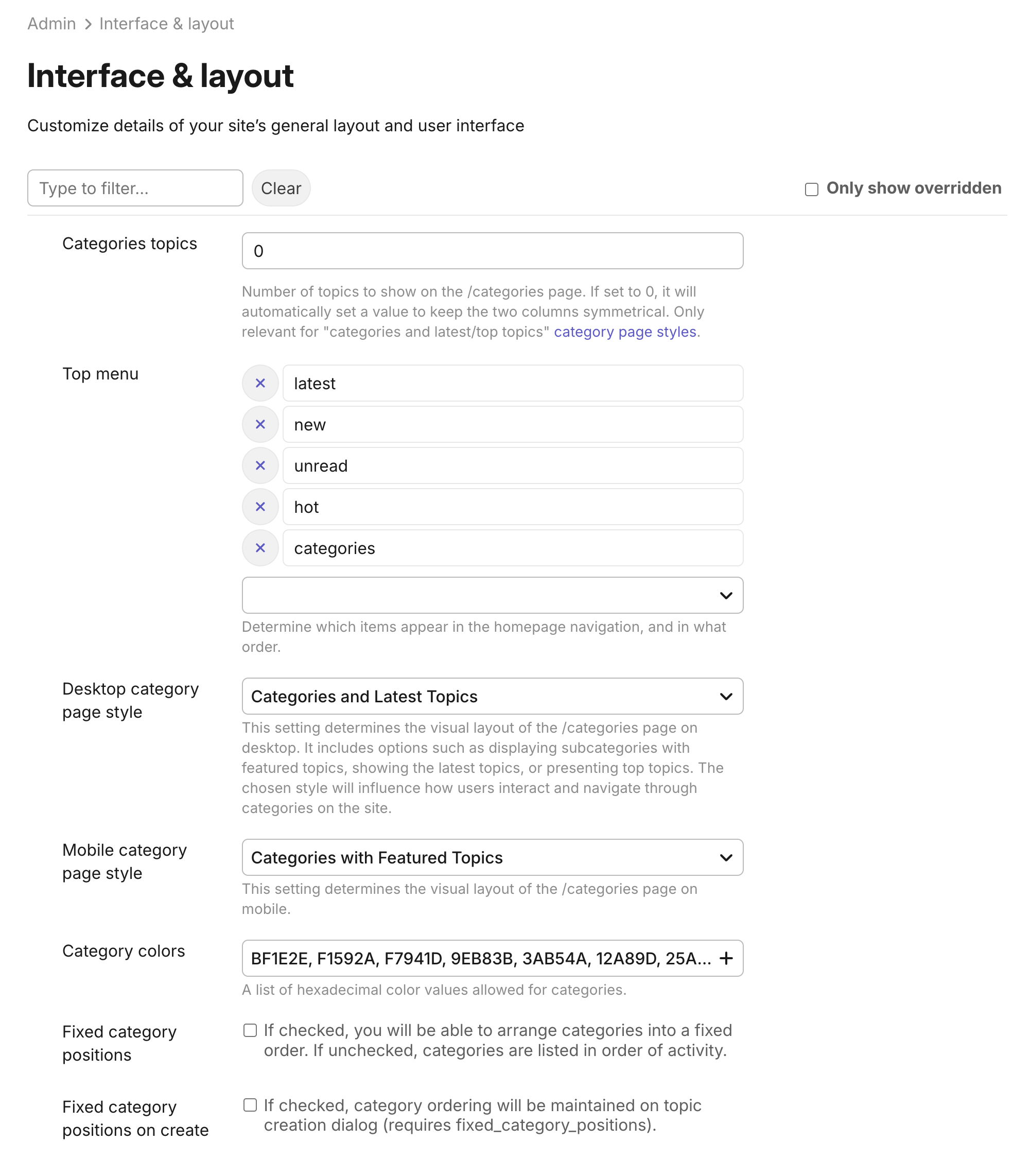
This is the one I felt every week. Discourse exposes a huge surface of site settings, and ordinary tasks (creating a category, adjusting a permission, changing a default) can feel like they need a PhD. A July 2023 thread about fuzzy settings search reflects that frustration, but staff reported improvements in August 2023 and the thread was closed. It is historical context, not evidence that the same search bug remains today.
None of this stops a technical team that lives in the tool. But the typical SaaS community is run by someone in marketing, product, or support, not an engineer. I would give that person the admin demo and ask them to do their ordinary tasks before choosing a replacement.
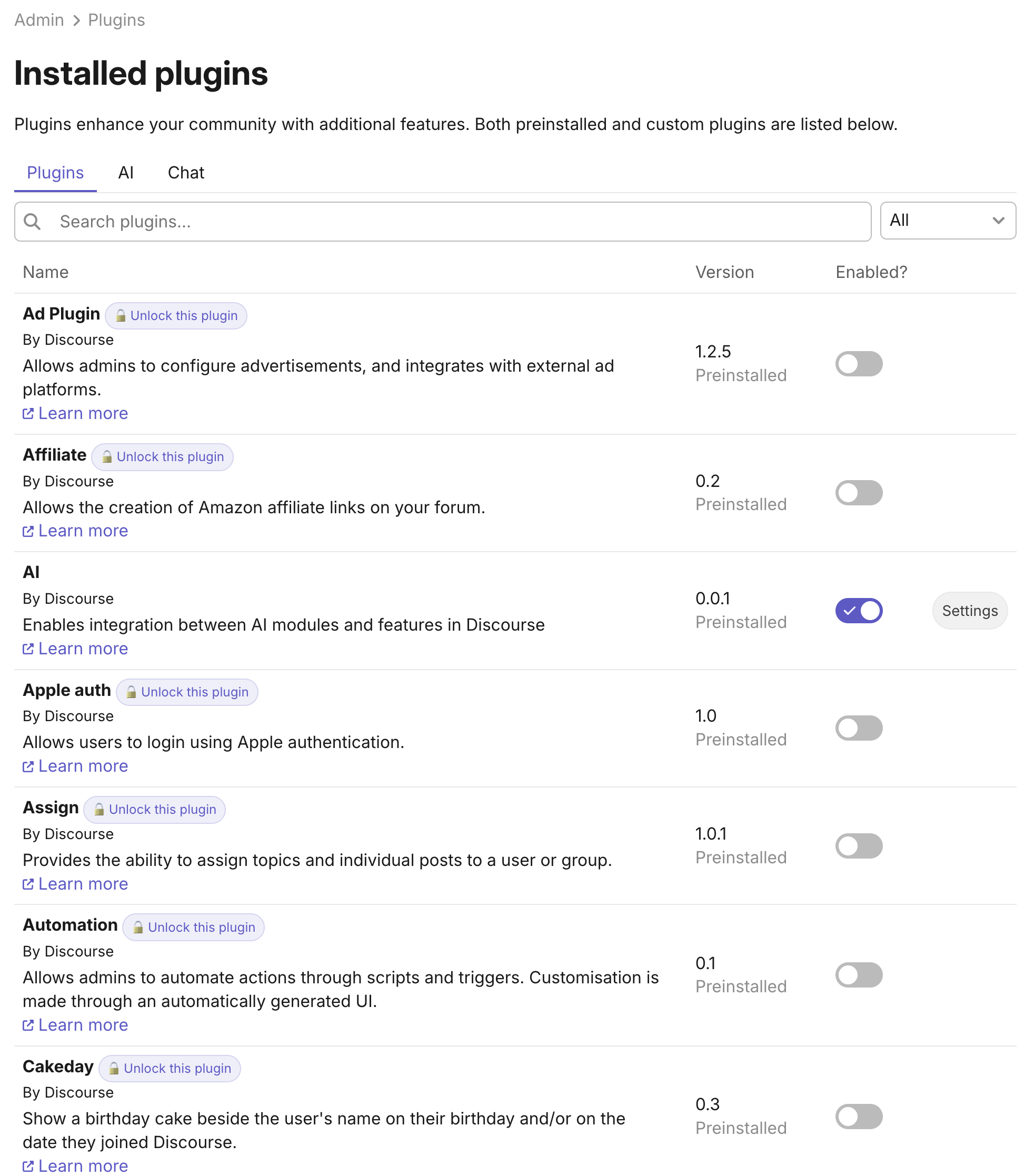
Discourse admin screenshots

Hosting is a DevOps commitment, because it isn't PHP
People assume any forum is a quick PHP-and-MySQL install. Discourse isn't. It is Ruby on Rails, with PostgreSQL and Redis, and its standard self-hosted installation uses Docker. Self-hosting means you own the operation of that stack.
When an update goes wrong, recovery can mean SSHing into the box. In a May 17, 2026 crash-recovery report, a self-hoster restored the site by running ./launcher rebuild app from the terminal. That is one reported incident, not a prediction for every update. But someone on your team needs to be able to handle it.
That is fine for a team with infrastructure engineers. If you do not want to staff that work for your community, managed hosting deserves a look, including Discourse's own hosting.
The plugin ecosystem cuts both ways
Discourse's plugins are powerful. I have also had my own share of fights keeping plugins compatible and behaving the way they should. In a third-party Cloudron support thread about Discourse 3.2.0, a participant warned that plugins could break installations across releases. That is a report from that hosting environment, not a blanket rule about every Discourse plugin.
The March 2026 reports need context, too. On March 11, a user running the development build 2026.3.0-latest reported broken components. Staff identified a third-party Journal plugin as the cause, and the reporter confirmed a resolution on April 5. A March 27 report that all plugins had stopped working was traced to CDN CORS configuration and reported resolved on March 30. Neither establishes that a stable March release broke all official plugins.
For a SaaS company, an unavailable customer community is still an incident with customers watching. The useful question is who checks compatibility, applies updates, and gets the site back when something fails.
Price the plan your community needs
As checked on September 15, 2026, Discourse's hosted pricing lists Free, Pro at $100/month, Business at $500/month, and custom-priced Enterprise. The old $20 Starter plan is not listed.
Pro includes a custom domain, API and webhooks, and five staff seats. Business adds events, automation, advanced reporting, OpenID/OAuth2 SSO, 15 staff seats, and migration services. The official Topic Voting page, also checked on September 15, 2026, lists it on Business and Enterprise hosting.
If those Business features are requirements, use $500/month in the comparison. If Pro already does the job, use $100. There is no reason to price every SaaS community as though it needs the same plan.
Feedback lives somewhere else
This is the pattern I made myself: the community in one place, then another tool, such as Canny, with another login for feedback. What happened instead was that people dropped feedback as rants in replies, where it was easily lost. A supported voting plugin or an integrated feedback tool may solve that. I would test the whole journey, including telling the customer when something ships, before adding another login.
What a Discourse replacement has to do
I would take these requirements into every demo. Start with the customer's task, then ask who maintains the pieces that make it work. A native feature and a supported plugin can both be good answers.
| Requirement | What to check with the vendor | Why it matters when you're leaving Discourse |
|---|---|---|
| R1. Managed operation | Who handles hosting, updates, plugin compatibility, and backups? Can your community owner do daily admin? Check staff seats and permission boundaries. | You want to know which work actually leaves your team, and which work follows you. |
| R2. Feedback and announcements | Show an idea, votes, a status change, and a shipped announcement linked back to the request. Is this built in, a supported plugin, or an integration? | A voting board alone does not close the loop with the customer. |
| R3. Content that fits the task | Show how Q&A, articles, events, and feedback differ in their forms, navigation, and moderation. Are these separate types or configured posts? | Different labels are not enough if customers still cannot find the right place to contribute. |
| R4. Public answers that get found | Check public content in crawler-accessible HTML, indexability, canonical URLs, sitemap controls, domain ownership, appropriate structured data, and accepted answers. | Discourse gives you a crawler-readable baseline. JavaScript or a subdomain alone does not prove poor SEO; test the actual pages and the control you retain. |
| R5. Customer-stack connections | Confirm the SSO method, API, webhooks, CRM and helpdesk connections, usage limits, and the plan that includes them. | A connection on a feature list may not be available on the plan you priced. |
| R6. Portability | Ask for a sample export covering members, content, uploads, and relationships. Can you retrieve it yourself? Can existing Discourse URLs be redirected? | Find out what you can take with you, and what requires vendor help, before you move. |
| R7. Real cost | Price the plan that meets the requirements above, plus required add-ons, services, and your team's operating time. | The cheapest advertised plan may not be the plan you would buy. |
| R8. What you give up | Compare open-source rights, self-hosting, plugin breadth, trust levels, and evidence of maturity at your scale. | A simpler admin experience can be worth a trade-off. It should be a trade-off you chose. |
Score each shortlisted platform against these eight requirements using your own must-haves. Mark anything the vendor cannot demonstrate as unconfirmed, and ask for the relevant plan details in writing. For a closer look at R4, I cover the checks in my guide to the best forum software for SEO.
What Discourse does well
In fairness, Discourse gets a lot right, and I am not going to win this by pretending otherwise. A technical reader would spot the dishonesty in a second.
It is open source under GPLv2, fully self-hostable, with no per-seat software cost. You can read the code, fork it, or run it on your own servers indefinitely, subject to the licence. Its data portability is a real strength: admin backups contain the full database, with uploads optional. On Discourse's hosting, the documentation says to contact its team before creating a backup that includes uploads. There is also a REST API, and posts retain their raw source alongside rendered HTML, so the Markdown is not lost. The exit door is open, and I respect that more than almost anything else here.
Its SEO foundation is real, too. Discourse documents crawler-rendered HTML, sitemaps, and structured data, including DiscussionForumPosting for topics and Comment for replies. Its specific llms.txt guide, checked on September 15, 2026, documents native support from v2026.1.0. That is a supported capability, not a promise that an AI service will cite your content.
Its five-level trust system is one of the smartest things in the product. Members can earn more privileges as they participate, while the highest level requires manual promotion. It gives a public community useful moderation tools; it does not remove the need for a team.
If you are a developer-tools company with a Ruby or Rails team, an open public knowledge base, and a community manager who is comfortable in a terminal, Discourse may well be your answer, and you can stop reading here. The rest is for the SaaS teams I keep meeting who do not fit that mold.
The best Discourse alternatives for SaaS communities in 2026
I would judge these against the requirements above, especially the work customers need to do and the work your team wants to stop doing. I left vBulletin and phpBB off this shortlist to keep the focus on customer-community workflows, rather than a wider survey of traditional forum software.
If you are coming off Gainsight, start with that enterprise-incumbent comparison first. It accounts for the events, groups, customer-success connections, and extraction work that a Discourse-first shortlist does not.
1. Jatra
I built this, so read it with that in mind.
Every plan includes managed hosting, backups, platform updates, and your own custom domain. The native feedback board lets members submit ideas and upvote requests. When a feature ships, you can link its announcement back to the request; both support comments.
All ten content types are available on every plan: Announcement, Discussion, Article, News, Changelog, Feedback, Jobs, Events, Quiz, and Resource.
We help from setup to momentum, including on the entry plan. New communities get onboarding and content-seeding help. For existing communities moving to Jatra, we handle migration, initial setup, and onboarding. Strategic help is available to every customer. Customers generally handle daily moderation, member management, and publishing; daily community management from Jatra is a separately priced service.
As confirmed on September 15, 2026, the entry plan costs $299/month billed monthly, or $249/month billed annually at $2,988/year. The free trial typically lasts seven days; paid pilots are also available.
Where Jatra is not the answer: if you specifically need open-source self-hosting and the right to run the code on your own infrastructure forever, that is Discourse's territory. And if your community is a public developer knowledge base at large scale with a Ruby team to run it, Discourse's maturity there is hard to beat.
See the Discourse vs Jatra comparison for rendering and schema detail, and the Jatra product updates channel for recent announcements.
2. Bettermode
Bettermode deserves a place on a B2B customer-community shortlist, especially if the community needs to connect to the customer-success team's existing tools. Its pricing page, checked on September 15, 2026, lists Q&A, discussions, events, polls, and custom domains. Growth lists HubSpot, Salesforce, Zendesk, and Jira integrations, plus API and webhook access.
Pay attention to the tier. Starter is $399/month billed annually ($4,788/year). Growth is $1,500/month billed annually ($18,000/year). Advanced Design Studio and custom CMS are listed under custom-priced Premium. I would ask for a demo of the exact content models and integrations you need on the quoted plan.
Bettermode documents automatically generated sitemaps. A Capterra reviewer, Ana, reported spending about a month seeking a fix for a sitemap problem that she said prevented Google indexing. That is one customer's historical report, not a finding that all Bettermode communities have an indexing problem today. I could not confirm a self-service sitemap override in the documentation reviewed.
Bettermode fits best if customer-stack connections and a configurable customer hub are high on your list. If public search traffic matters, check representative pages and ask who can fix indexing problems before committing.
3. Circle
Circle has a polished member experience. Its pricing page, checked on September 15, 2026, lists courses, discussions, events, live streams, and paid memberships. That mix is useful when learning and membership are part of the community's job.
A custom domain is included in Professional; removing Circle branding is listed under Business. Those are different requirements. The page lists transaction fees of 2% for Professional, 1% for Business, and 0.5% for Circle Plus. Budget those alongside payment-processing charges where applicable.
Email Hub is contact-based, not a flat $99 add-on for everyone. The pricing page shows $99/month at 10,000 contacts, on top of the community plan; Circle Plus lists 10,000 contacts included. Check the quote at your own contact count.
Circle makes sense if your community revolves around courses or paid membership. For a public SaaS support community, run the R4 checks on representative public pages, including crawler-visible content and relevant schema. Ask to see a customer question, its answer, and what a crawler can retrieve from that page.
4. XenForo
If what drew you to Discourse was self-hosting and control over the installation, XenForo is worth a look. It is licensed commercial software, not open source. Its purchase page offers a self-hosted licence with access to source code and lifetime use under the licence terms.
As checked on September 15, 2026, the self-hosted package lists a $195 licence, including one year of updates and support, with a $55 extension for the base software. Enhanced Search, Media Gallery, and Resource Manager are paid add-ons with their own costs. Enhanced Search is an optional product, not evidence that basic search is missing. Budget hosting, maintenance, and any add-on renewals as well.
Self-hosting is not the only option: XenForo also offers managed cloud plans. For either route, ask to see the question, article, feedback, and announcement workflows you need, and check actual public-page HTML and schema.
XenForo fits a technical owner who wants a traditional forum and is comfortable with commercial licensing. If it is on your shortlist, I went deeper in my piece on the best XenForo alternatives.
I would also look at Mighty Networks if paid memberships, courses, and a mobile community experience are central to the business.
When staying on Discourse is the right call
An open, public, developer-facing knowledge base is a good reason to stay. So is a team that can operate Ruby, Docker, PostgreSQL, and Redis and values open source, extensibility, and self-serve data access. Do not give those up just because another demo looks simpler.
If the pain is running servers rather than using Discourse, moving to its own hosting is a real alternative to leaving. At the September 15, 2026 listed prices, Pro is $100/month and Business is $500/month. Business adds capabilities including events, automation, advanced reporting, and OpenID/OAuth2 SSO. Price the plan your community actually needs.
Quick decision guide
| What's pushing you off Discourse | Where I'd point you |
|---|---|
| Feedback and announcements are scattered across tools | Jatra, with native feedback, upvotes, and announcements that can link back to requests; both support comments |
| Your non-technical team wants a hosted customer hub | Bettermode, with admin and integration requirements checked on the quoted plan |
| Already run customer success in HubSpot or Salesforce | Bettermode, checking the relevant Growth integrations |
| You want help getting the community started and building momentum | Jatra, with onboarding, content seeding for new communities, and strategic help included on the entry plan |
| Your community is mainly a paid course or membership | Circle |
| You specifically want self-hosted commercial forum software | XenForo, with hosting and add-ons included in the budget |
| You want to move platforms and hand off server maintenance | Jatra, with hosting, backups, and platform updates managed on every plan |
| The pain is running servers, not Discourse itself | Move to Discourse hosted Pro or Business |
| Open public knowledge base at scale, with a Ruby team | Stay on Discourse |
The verdict
Discourse is good software, and for the right team it is the right answer. If you run an open, public, developer-facing knowledge base, have the engineering capacity for Ruby and Docker, and value open-source freedom and data portability, keeping it can be a sensible decision. If hosting is the problem, investigate managed Discourse first.
Most SaaS teams I talk to want their customers' discussions, feature ideas, and shipped-it announcements in one place, run by someone who is not an engineer. If that describes your team, use the requirements above to check what a move would improve and what you would give up. Picking the right tool honestly is the whole point of an article like this.
Assess your move from Discourse. Bring your current setup, the reason you are changing, and the capabilities you must keep. The call helps us assess whether Jatra fits your community.