
Build the forecast out of numbers your own company can check. Your helpdesk holds the ticket history. Finance can help establish the cost of handling those tickets. Search Console shows some of the questions that already bring people to your site. Those records give you a starting point you can explain in a budget meeting.
You may have watched the same customer question arrive through four different channels in one week. You can see a useful role for a community. The next job is to explain what running it would require and how the business would decide whether to continue.
The proposal needs to answer three questions. What does this cost us in full? What changes if it works? How soon can we review useful evidence?
If you are still deciding whether to start, use the customer community readiness guide first. For the broader role a community can play across support, learning, and acquisition, see the B2B SaaS customer community use case.
Stop borrowing other people's numbers
A published community success story can show what is possible. It cannot tell you what your business will achieve.
Before using a benchmark, find the original source and check what was measured. Was the reported support saving a reduction in spending, or an estimate of staff time freed up? Did the retention comparison account for the fact that engaged customers may be more likely to join?
Even a well-sourced result needs context. A mature enterprise community with dedicated staff and years of content has a different starting point from a new customer forum.
Use outside examples to explain the mechanism. Build your forecast from your own baseline, with assumptions the approver can inspect. Where the evidence is missing, leave the value unclaimed or show a range. A precise-looking percentage does not become reliable because it is in a spreadsheet.
Make the cost line complete
Start with cost. You have more control over the scope you fund than over how quickly members participate.
On a small screen, scroll the table sideways to read every column.
| Line | Where the number comes from | What to include |
|---|---|---|
| Platform | Current vendor quote or pricing page | Billing period, required plan, add-ons, and taxes where applicable. Check Jatra's current pricing if it is on your shortlist. |
| Community owner | Salary bands and agreed allocation | Protected hours, employer costs, and cover during absence. Existing staff time has a cost even without a new hire. |
| Setup and migration | Written vendor scope or internal estimate | Configuration, content preparation, integration, accessibility, security review, and migration if needed. |
| Contributions from other teams | Support and product leads | Time for answering, moderation, introductions, and reviewing technical information. Avoid counting the same hours twice. |
| Ongoing operations | The proposed operating plan | Reporting, member communication, training, and a contingency based on the uncertain work. |
Do not call the platform the smallest expense before you have priced the rest. Do not assume migration is included because a vendor offers it.
The people line deserves particular attention. A community needs a named owner with protected time. That can begin as part of an existing role if the scope is realistic and the manager agrees what work moves out of the way.
Write down whose hours you need and who has agreed to provide them. If a product launch takes priority, the proposal should make clear what happens to the community work. Otherwise you are budgeting for capacity that may disappear when you need it.
Separate the cash request from the internal time commitment. Finance needs to see both, and colleagues need to know what they are agreeing to deliver.
If the platform is still undecided, how to choose a B2B community platform covers that evaluation. Keep the funding document focused on scope, total cost, and the decision you need.
A worked cost example
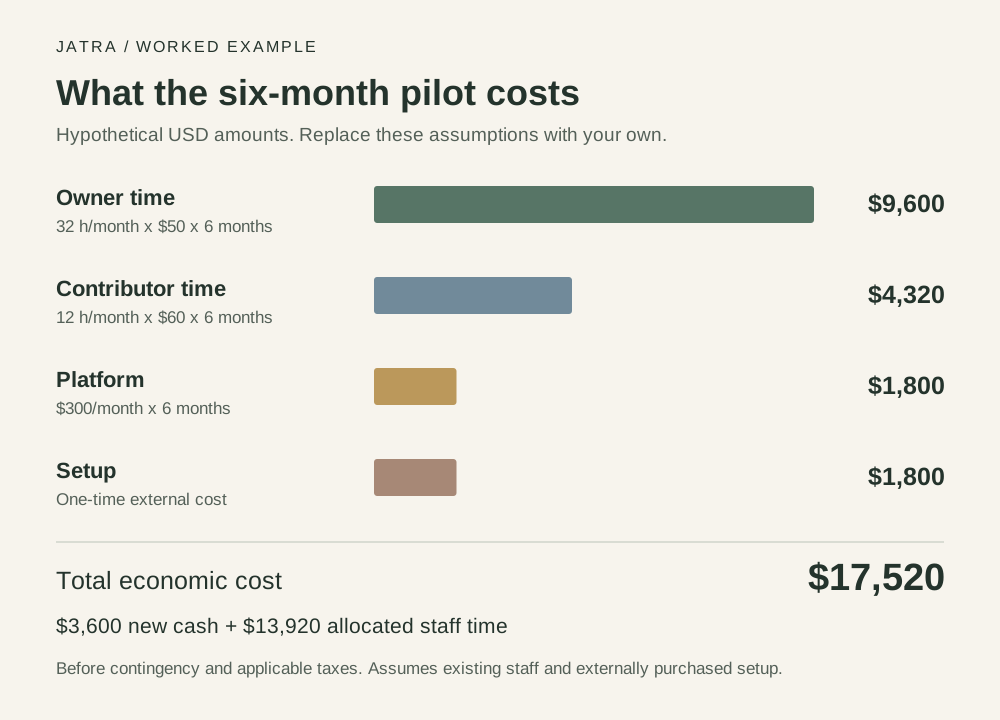
The following numbers are hypothetical USD amounts to demonstrate the calculation. They are not Jatra pricing, customer results, or recommended staffing levels.
Suppose a six-month pilot needs a $300 monthly platform, an owner for 32 hours a month at a fully loaded $50 an hour, and 12 support or product hours a month at $60 an hour. Setup costs $1,800 once.
The recurring monthly cost is $300 + $1,600 + $720 = $2,620. Over six months, that is $15,720. Add setup and the total is $17,520 before any separately budgeted contingency or applicable taxes.
If the team hours come from existing staff and setup is purchased externally, the new cash request is $3,600. The remaining $13,920 is allocated staff time. That distinction matters: a small software purchase can still commit substantial team capacity.
Three value lines, and where each one comes from
Support deflection
Begin with repeat questions that customers could reasonably resolve through an existing answer or a peer exchange. Exclude account access, billing corrections, sensitive customer details, and incidents that require your team.
Review a period that captures your normal workload and seasonality. Twelve months may be useful, but a newer business will have less history. If tags are unreliable, manually review a sample across topics, customer segments, and time periods. State how the sample was selected and what it might miss.
Agree on a cost basis with support and finance. Fully loaded support cost divided by resolved tickets gives an average. The repeat questions you are targeting may take less or more effort than that average, so use handling time by topic when you have it.
Apply an assumed deflection rate only to the eligible subset. Show a low, central, and high scenario, including a zero-benefit downside. Label each rate as an assumption and name the evidence that would replace it.
For example, 400 eligible questions a month at an assumed 10% deflection rate gives 40 potentially avoided tickets. At an illustrative $20 of handling effort per ticket, that represents $800 of monthly capacity value. Neither assumption is a benchmark. This calculation alone would not justify the $2,620 monthly pilot above.
Saved time is not automatically cash saved. If payroll stays the same, the benefit may be capacity for better support, faster onboarding, or a delayed hire. Describe that use of time. Claim cash savings only when you can identify a cost that will actually fall, and do not count those savings again as capacity value.
Deflection itself needs careful measurement. A page view does not prove a ticket was avoided. Plan to combine evidence such as resolution feedback, changes in contact rates for the selected topics, and checks for changes in product usage or ticket classification. Keep the uncertainty visible.
Also account for what your documentation would have resolved anyway. The distinction between a community, knowledge base, help center, and portal helps explain which questions benefit from peer experience and which need an official answer.
Search demand you could serve
Look at Search Console queries, sales conversations, and recurring customer questions. Ask the content team whether useful questions were set aside because they were too narrow for a standalone article. Some teams will have a list; others will need to build one from their records.
Search Console impressions describe your site's visibility, not the total size of the market. Treat them as clues. Check whether an answer already exists on your site before proposing another page for the same question.
A useful public discussion can address a specific problem in the language customers use. That creates an opportunity for discovery, provided the page is accessible and worth finding. It does not guarantee traffic. Google explains that crawling, indexing, and appearing in results are separate stages, and inclusion is not guaranteed.
Keep the base forecast at zero until you have a defensible basis for an acquisition estimate. There is no universal quarter when community pages start ranking. Show what evidence would allow you to revise that assumption.
If you model an upside scenario, state the expected pages, visits per page, time period, and evidence behind each input. Model qualified visits or trials before revenue. Community visitors may behave differently from your existing marketing audience, so a sitewide conversion rate is an assumption to test, not a rate to silently reuse.
Keep this line separate from support value. A visitor looking for an answer is not necessarily a new prospect, and an existing customer's visit is not a new acquisition.
A real example: 14 months of work in Slack
In 2021, I was hired to build a B2B SaaS community for data engineers. I ran it on Slack for 14 months and it reached 650 members. Getting people there took newsletter mentions, social posts, referrals, and other promotion. People were not finding our discussions through search.
That is the experience behind my account of 650 members and zero organic growth. There was work behind the membership number, but it was not creating the searchable resource I wanted.
For a business case, the lesson is to connect the funded work to the intended outcome. If acquisition through public answers is part of the proposal, check that those answers can be discovered. A private community can still help members; it needs a case built around that value. This experience is not a forecast of what another community will earn or save.
Retention
Keep retention out of the base financial forecast unless you already have credible evidence for an incremental effect. Propose how you will investigate it after launch.
Agree the comparison before collecting results. You might compare eligible customers who participate during a defined early period with similar customers who do not. Choose relevant characteristics such as segment, plan, account size, onboarding stage, and renewal timing.
A matched comparison still does not establish causation. Customers who join may already be more engaged or more likely to renew. Do not guess which part of a later gap the community caused.
Ask the person responsible for analysis to review sample size, observation windows, and other changes affecting those customers. Align the review with actual renewal cycles. For annual contracts, a day-90 report cannot establish an annual retention effect.
Size the ask around a useful test
Propose the smallest scope that can answer a meaningful question. Define the audience, work, owner, duration, budget ceiling, and primary outcome together.
Find the right budget holder and follow the approval process. Splitting a larger commitment into smaller requests to avoid review can conceal the real cost. State the likely ongoing cost even when the first request is for a pilot.
Then agree the conditions for continuing, changing scope, or stopping. The table below is a planning example, not a universal timetable. Set your own thresholds before approval, based on workload, expected participation, and the time needed to observe the chosen outcome.
On a small screen, scroll the table sideways to read every column.
| Review point | Evidence to bring | Decision to make |
|---|---|---|
| Early operating review, for example around day 90 | Actual hours and spend; useful questions and answers; whether the intended members are participating | Continue, narrow the audience, or fix the operating plan. Check that the owner has the capacity originally agreed. |
| Outcome review, once there is enough relevant activity | Evidence against the chosen support or acquisition hypothesis, including a low or zero result | Compare the result with the agreed threshold. Revise the assumption, change scope, or stop spending on an approach the evidence does not support. |
| Renewal review, aligned with the customer contract cycle | A sufficiently mature customer comparison, with its limitations stated | Decide whether retention belongs in the next forecast. Do not close a useful support community solely because retention remains unproven. |
A useful stop condition names the evidence and the decision. For example: if the owner cannot sustain the agreed response coverage within the time budget after a scoped adjustment, pause new invitations and review staffing before expanding.
If closure is a possible outcome, budget for member communication, preserving useful answers, and moving unresolved support requests. Ending a pilot still takes work.
Allow for a quiet beginning without making silence an excuse indefinitely. Say what useful early activity would look like for this audience and when you will review it.
The meeting is not where you win
Bring the support lead into the calculation while the numbers are still being assembled. Agree which tickets are eligible, who will answer, and what freed capacity would be used for. Do not introduce a headcount reduction that the operating team has never discussed.
Talk with the budget holder before the formal review. Find out which costs belong in the request, which assumptions need evidence, and what decision the meeting can actually make.
Include whoever owns the customer relationship. They may be concerned that complaints will be visible to prospects. Address that concern with a concrete operating plan: public feedback can receive a useful response, while account details and sensitive issues need a private route. Your team remains responsible for official answers and incident handling.
Do not promise that opening a forum will move every complaint off other websites or make every response rank. The proposal should explain where staff will respond, what they can commit to, and who handles escalation.
What to leave out
Member counts, posts per week, and daily activity as the headline return. They can help you understand whether the pilot is functioning, but the funding case must connect activity to the chosen outcome.
The competitor argument on its own. A competitor having a community tells you little about its costs or results. Use a relevant example to explain an approach, then return to your own evidence.
A long introduction to community theory. A short explanation of who will use the proposed space and what they will do there is enough to orient colleagues who are new to the idea.
Keep the proposal short enough to review
Aim for a few pages with the supporting calculations available separately. State the business problem, the full cost, the primary value hypothesis, and the next decision date. Name the largest uncertainty in plain language.
Once the community is operating, replace assumptions with evidence. Keep the original forecast so the next budget conversation can compare what you expected with what happened. Detailed post-launch measurement belongs in the operating plan; this document's job is to earn a clear, bounded decision.
For help thinking through scope, ownership, and the assumptions behind your proposal, book a free 30-minute call. For the broader business context, return to the B2B SaaS customer community guide.