Community SEO & AEO
Community SEO & AEO
Make your best answers easier to find.

Domains & metadata
Custom Domains & Social Metadata
- Custom domain mapping
- Run Jatra on your own domain or subdomain. Community pages and their canonical URLs use that address.
- Title-based post URLs
- Supported posts have their own readable, title-based URLs. Public content is available without signing in, with public Room history available where access allows.
- Open Graph & Twitter metadata
- Page titles, descriptions and social metadata describe the content when shared. A generated image fills in when a featured image isn’t available.
Rendering & crawlability
Server-Side Rendering (SSR)
- Content in the initial HTML
- Public posts and replies arrive as server-rendered HTML. This gives crawlers that don’t execute JavaScript access to the content for search and answer engine discovery.
- Server-rendered metadata & JSON-LD
- Supported pages include titles, descriptions, canonical tags and structured data in their source. Crawlers can read these alongside the page content.
- JavaScript-enhanced interactions
- Interactive controls build on the server-rendered page. Reading public content doesn’t depend on a client-side rendering step.
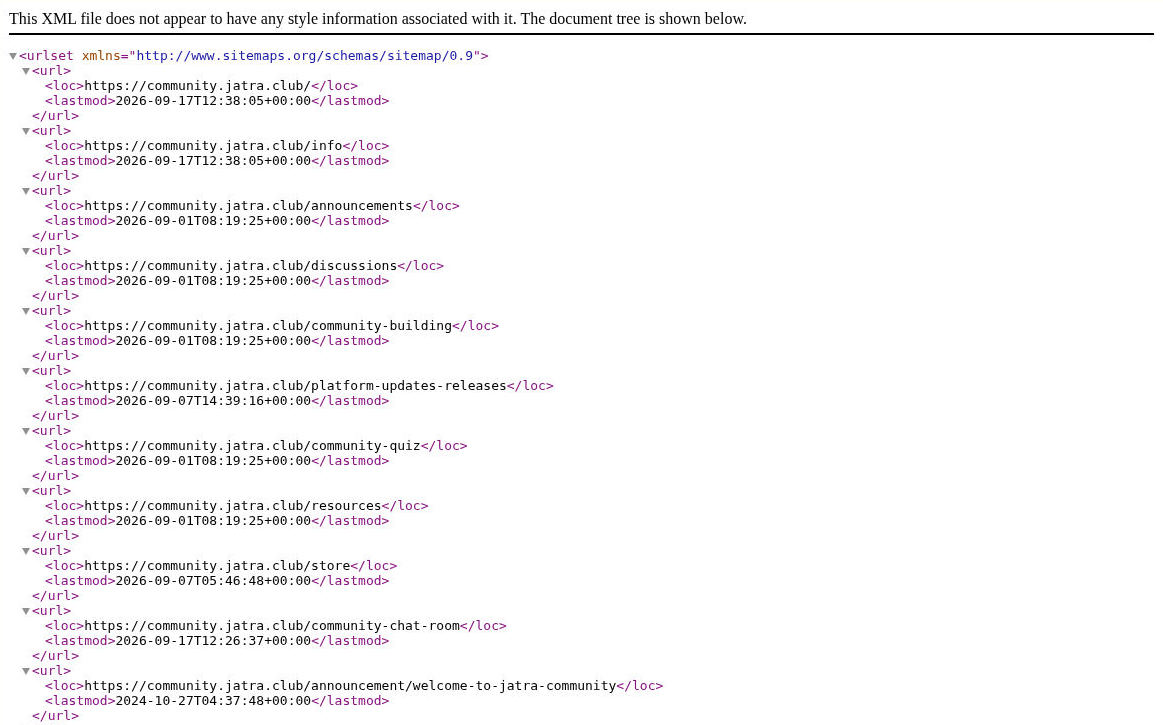
XML sitemaps
XML & News Sitemaps
- XML sitemap index
- A sitemap index connects crawlers to eligible public channels and published posts on your domain. Your
robots.txtpoints to it. - News sitemap
- Qualifying news posts from the last two days appear in a news sitemap. This provides the format; Google News decides inclusion.
- Automatic eligibility filtering
- Drafts, archived content, private channels and expired jobs are excluded. Inactive communities have their sitemap files removed.
Structured data
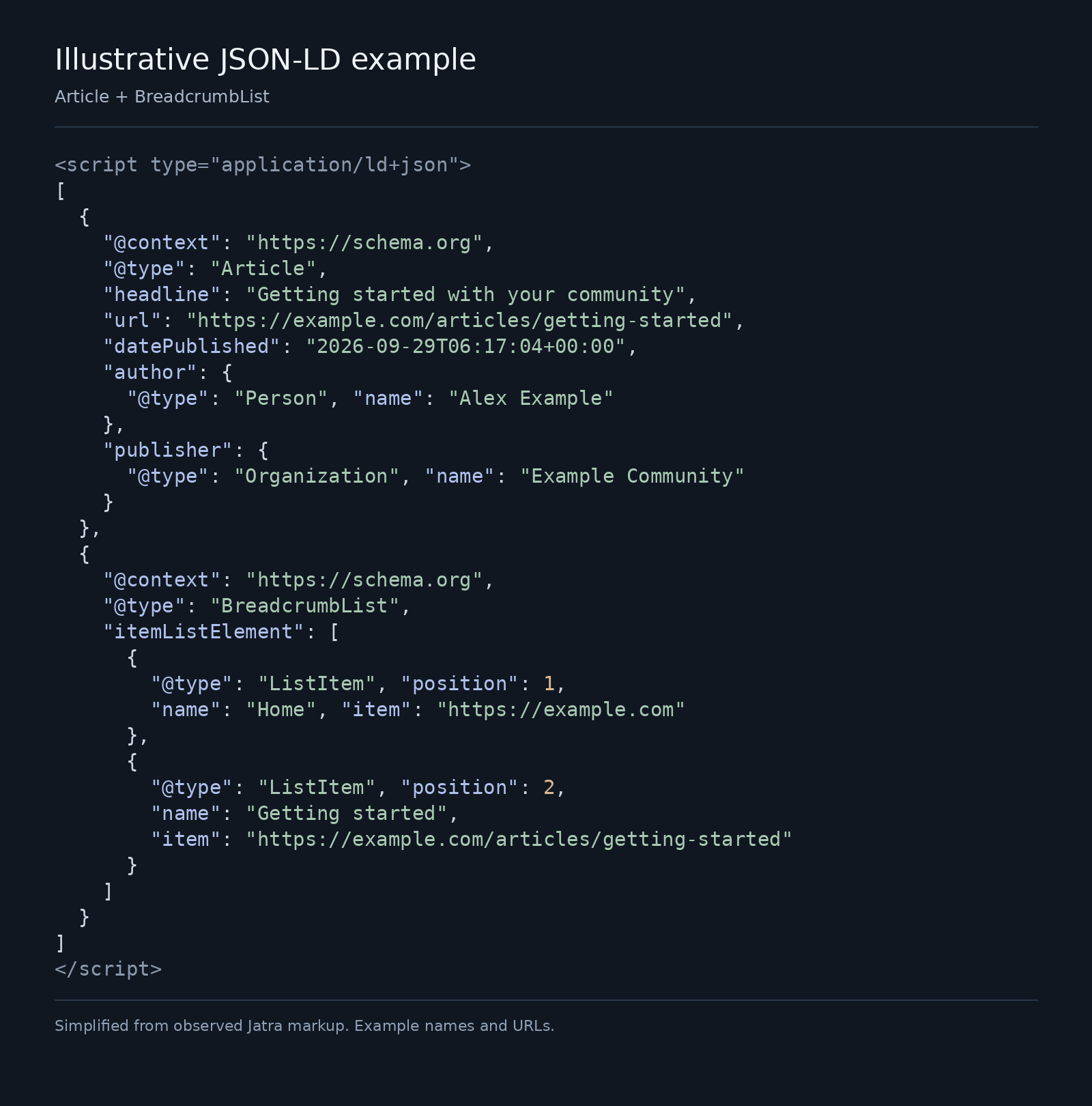
JSON-LD Structured Data
DiscussionForumPosting& article schema- Supported conversations use DiscussionForumPosting. Articles and news posts use schema for their respective formats.
- Event, job & product schema
Event,JobPostingandProductorServicedata reflect the listing. Expired jobs omit JobPosting markup.- Media & format-specific schema
- Resources use data appropriate to their media type. Changelogs, quizzes and interviews have their own supported markup.
BreadcrumbList- Breadcrumb structured data describes the page’s place in the community when the breadcrumb trail is populated.
For answer engine optimization, readable public content and clear page context are the foundation. Search engines and AI providers decide what they index, rank or cite.
Canonical URLs & pagination
Canonical URLs & Pagination
- Automatic
rel="canonical" - Canonical tags identify the intended address. Filtered feeds point back to the main feed; search and activity pages use stable base URLs.
- Page-aware canonicals & pagination
- Feeds and channels have pagination links and page-aware canonicals. Their paginated views use
noindexpolicies to keep indexing focused. - Public Room history pagination
- Eligible public Rooms serve readable message history with older-page links and explicit canonical URLs.
Smart link handling
Automatic Link Attributes
- Automatic link-title enrichment
- URL-like anchor text in supported published posts can be enriched with the destination’s page title.
- Internal link detection
- Internal links are identified separately from external destinations, including links on the community’s domain and subdomains.
- Automatic
rel="ugc nofollow" - External links from ordinary members receive user-generated content and nofollow attributes. Privileged authors’ links can remain followable.
- Shop
rel="sponsored nofollow" - Shop destination links are marked as sponsored and nofollow to distinguish commercial listings.
noopener&noreferrer- New-tab links include protective attributes that restrict access to the originating tab and referrer information.
Page loading & media
Image Optimization & Lazy Loading
- WebP image conversion
- Supported uploaded images are converted to compressed
.webpfiles to reduce transfer size. Animated GIFs are preserved in the formats that support them. - Automatic
loading="lazy" - Supported images and embeds use native lazy loading. Below-the-fold media can wait until the reader approaches it, reducing initial network requests.
- Image
decoding="async" - Supported image elements use asynchronous decoding so the browser can display other content without waiting for image decoding.
- Image
alt&title - Supported image captions can supply alt text and image titles. These describe the image for assistive technology and provide context for search engines.
Access & indexing controls
Robots & Indexing Rules
- Private content access control
- Private communities, channels and Rooms remain behind their access rules.
- System-page
noindex - Compose, settings, search and member-directory pages carry noindex instructions.
- Low-activity profile
noindex - Low-activity profiles use noindex policies, rather than exposing thin pages to search.
- Sitemap publishing-state filters
- Sitemap eligibility considers visibility, format and publishing state. Not every post belongs in it.
Good to know
Community SEO & AEO Questions
Does Jatra guarantee rankings or AI citations?
No. Jatra supplies the technical foundations. Search engines and AI providers decide what they crawl, index, rank and cite. Your content and their policies still matter.
Do I need to install an SEO plugin?
No extra plugin is needed for Jatra’s built-in sitemaps, canonical tags, social metadata and supported structured data.
Is every post included in the sitemap?
No. Eligibility depends on the community, channel, content format and publishing state. Private content, drafts, archived posts and certain formats are excluded.
See it in Jatra
Explore Jatra’s SEO & AEO Features
Let’s walk through your domain, your content and the SEO features behind it.