

Back in 2011, I started a second community and then shut it down.
CrazyEngineers was getting so many questions about mobile phones that I thought, why not give them their own place? So I launched mobilesforum.in, a community for Indian buyers of budget phones. Should I buy this one or that one? Is this phone worth ₹8,000? That kind of thing.
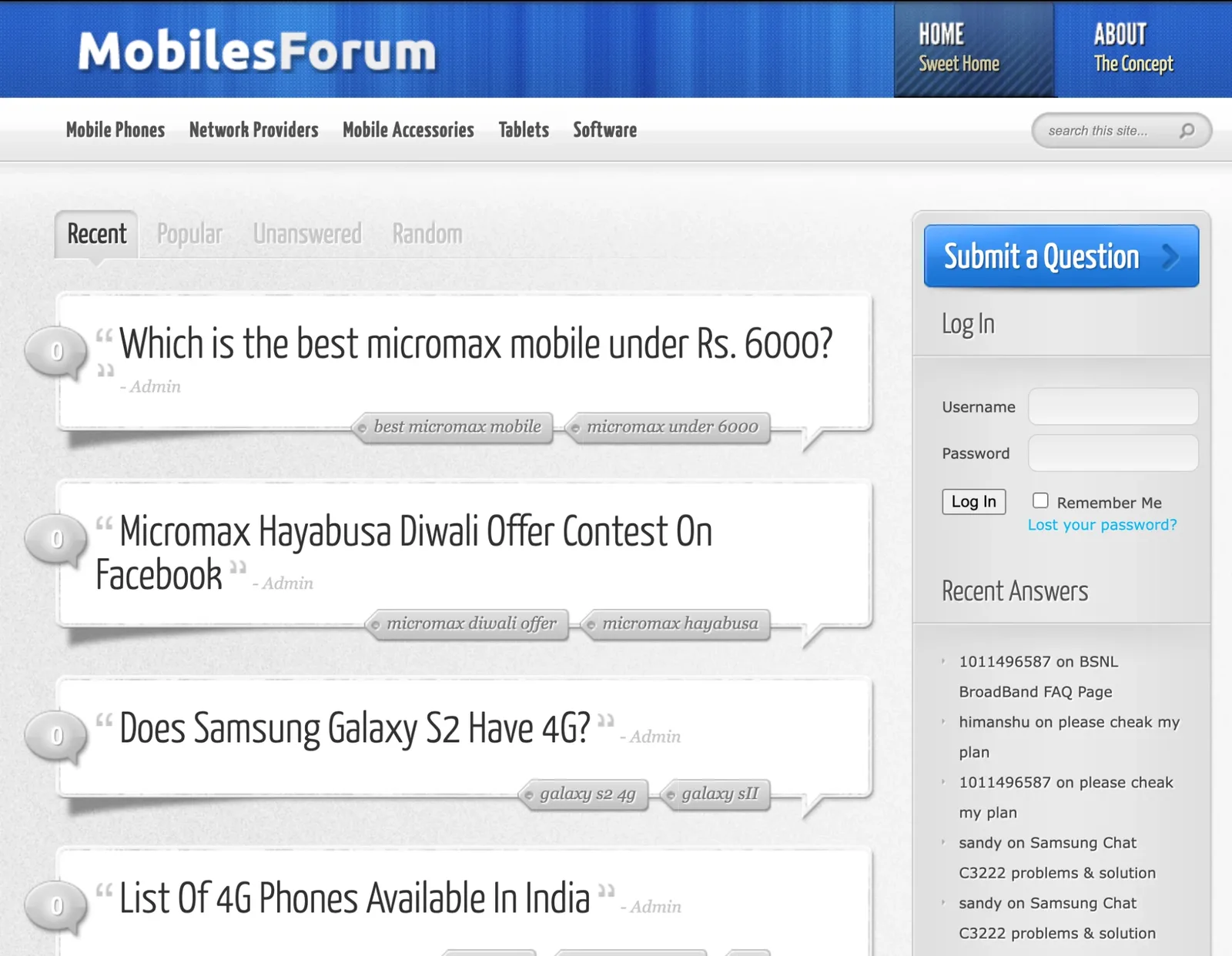
It worked. Before long it was getting about 1,000 visitors a day.
And that's when the trouble started. Both communities were growing at the same time, and I couldn't moderate the new one properly. A lot of the questions were very low value, from people who had no plan to buy anything and were just messing around. The quality kept getting worse.
Frankly speaking, I wasn't excited about mobile phones either. It became overwhelming. In the end, around 2014, I decided it wasn't worth my time and deleted the whole thing.
That taught me something I still tell every founder: building a community is the exciting part. Managing it is the actual job. And if you don't care about the topic, you won't do the job for long.
I've run online communities for twenty years now. CrazyEngineers has 400,000+ members, and today I build Jatra, a community platform. This guide is about the part after launch: how to manage an online community day to day, week to week, without burning out.
Still at the start? Read how to build an online community first. This guide picks up where that one ends.
Managing is a different job from building
When you build a community, you're the main character. You seed the content, invite people one by one and reply to everything yourself.
Managing is different. Your job is to keep the place useful and safe, and slowly get out of the way so members carry it.
That means a handful of things done every single day, a few done every week, and a few done every month. None of them is hard. The hard part is doing them when nobody's watching and nothing exciting is happening.
Give it one owner
A community with three part-time owners has no owner.
Pick one person who's accountable. Inside a company, that's usually marketing, or product. If you're a small company, the founders and senior people should still show up for five to ten minutes a day: react to posts, reply, share a view. Members notice when the people behind the business are actually there.
If you're still deciding between doing it yourself, hiring someone or getting outside help, I've walked through the options in who should run your community.
Tip: Keep the decisions with the owner. At CrazyEngineers, moderators moderated, but decisions stayed with me or a few of us together. We had very few internal fights over the years, and I put that down to the culture we set from day one.
Set one rule: every thread gets a reply the same day
If you only remember one thing from this guide, make it this.
The clearest early sign that a community is dying is threads that don't get a reply the same day. I've seen it again and again. Someone asks a question, it sits there, and they don't come back. Neither do the people who saw it sitting there.
So make it your service level. Every new thread gets a reply on the same day. Not necessarily the answer. Sometimes it's a member answering, sometimes it's you tagging the one person who knows, sometimes it's "good question, let me find out." But nobody gets silence.
Inside a company, write it down and give it an owner, the same way your support team has a response time. It's the cheapest promise you'll ever make, and the one members feel most.
Your daily, weekly and monthly rhythm
Here's the rhythm I'd follow. Adjust it to your niche.
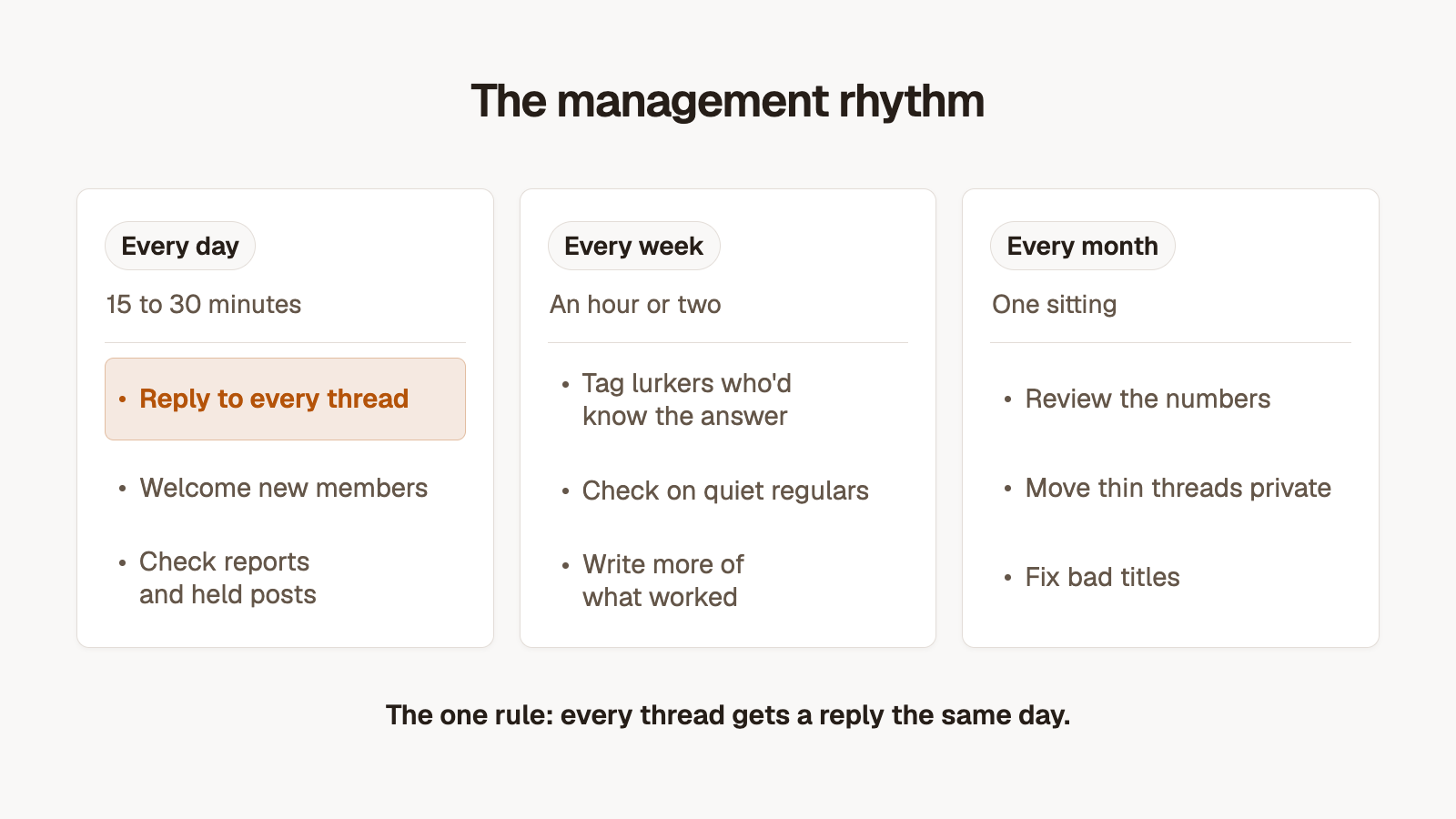
Every day (15 to 30 minutes):
- Check every thread from the last 24 hours has a reply.
- Welcome new members. A like on a first post or a simple "hey, welcome" goes a long way.
- Look at anything reported or held for review, and act on it.
Every week (an hour or two):
- Tag lurkers in threads they'd know something about. People visit for weeks without posting because they don't know what to say. A tag fixes that more often than you'd think.
- Check on your regulars. If someone active has gone quiet, message them right away: "Hey, what happened? You were active. Is there anything we could do?"
- See which posts people actually read and replied to, and write more like those.
Every month:
- Look at the numbers (more on that below).
- Move thin threads and off-topic chit-chat into a private section, so the public side stays useful.
- Rewrite bad titles on important threads. Members will write "help, please." Change it to the actual question.
How much time does all this take? It depends on the niche. Some communities do fine on an hour a week, others need five to ten. Once you have momentum, you'll want to give it more anyway, because it's where you hear what customers really think.
Know your 1% by name, but don't depend on them
In most communities, about 1% of members do most of the talking.
Know those people personally. Message them. Thank them. Ask what they'd change. In CrazyEngineers' growth years, about 100 to 150 active members were doing most of the contributing.
But be careful. One of the most common reasons communities die is that they depend too much on that 1%, the people who have all the time in the world, answer every question first and basically occupy the forum. When they get busy or lose interest, activity falls off a cliff.
So keep bringing new people into the conversation. Tag newer members. Leave some easy questions for them to answer. Recognise a new helper as loudly as you recognise an old one.
Step back as it grows
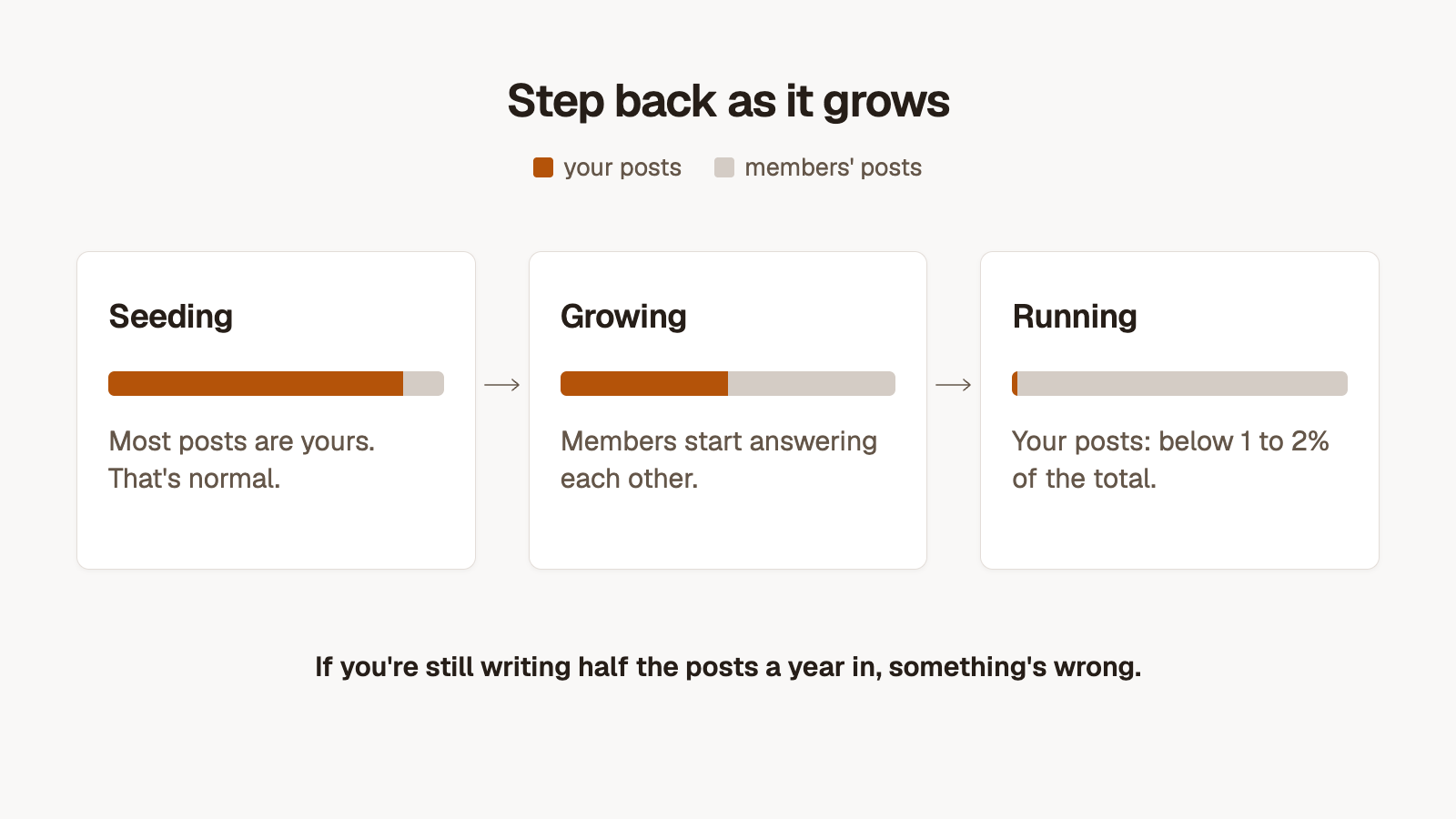
In the beginning, most posts are yours. That's normal. You're seeding.
As the community grows, your share should shrink. My rule of thumb: once you're past the early phase, your own posts should be below 1 to 2% of the total.
If you're still writing half the posts a year in, something's wrong. Either members don't feel they can post, or you're answering so fast nobody else gets a chance.
Keep the rules short and moderate the culture
Written rules never do any real work. That's one of the most common myths I see.
Owners love writing a detailed rule book, and nobody ever reads it. You need two or three lines: no advertising, spamming or trolling. Respect each other. Speak freely on the topic, and constructive criticism won't get you punished. That's it. Our community guidelines generator will draft a short version for you if you want something written down.
Culture isn't learned from a rule book anyway. People learn it by being in the place and watching how others behave. People are good by themselves. When someone crosses a line, talk to them like an adult, privately and professionally. Almost everyone comes around.
Give second chances too. In the early, strict days of CrazyEngineers, we banned a member within a day or two of joining. A week later they came back with a new email, a new avatar and a new username, "Godfather." They turned into one of our best contributors, became a moderator and even organised the first CrazyEngineers meetup on their own. I only found out it was the same person years later, when they told me over a casual chat.
Moderators make mistakes as well. A really good moderator of ours once deleted a few posts from a member they personally disliked. I opened a group chat with both of them, and we talked it through like professionals. Because the deletes were soft deletes, we restored the posts, and both of them were relieved. I didn't take the moderator's powers away. They'd learned the lesson.
Tip: Make sure your platform keeps deleted content recoverable for a while. You'll need it more than once.
Spam is now a daily job
Spam used to be easy. Someone signed up and dropped a link. You banned them.
Now a lot of it comes from real people, hired in large numbers, who use AI to write a few useful-looking posts first to build trust, and then start adding links.
We saw exactly this on Jatra. A new member joined and wrote six or seven genuinely useful posts over about two weeks. Nobody suspected anything. Then, around day 17, they logged in overnight and posted several spammy links. Because they were still inside their first 30 days, their posts were still being screened. The links were caught, flagged to me, and the account was banned.
So watch new members' posts closely for their first few weeks, not just their first day. On Jatra, new members' public posts are quietly screened for their first 30 days, and likely spam is held for review before anyone sees it. More in moderation and security.
Report the numbers that matter
Sooner or later someone will ask, "Is the community working?"
Don't answer with the member count. It's the biggest vanity metric there is, just the number of records in your database.
Here's what I'd put in front of leadership, and what I'd leave out:
Swipe sideways to see every column.
| Number | Report it? | Why |
|---|---|---|
| Member count | No | It's just records in a database. It goes up even when nobody's talking. |
| Returning members | Yes | The one I trust most. Get about 10% of registered members coming back and you're building something useful. |
| Same-day reply rate | Yes | Your service level. If it slips, everything else slips after it. |
| Organic visitors | Yes | People finding you on Google and AI tools before they've ever heard of you. |
| Page views | Yes | They usually mean the content is useful to someone. |
| Posts | Only if they're real | Lots of posts on one topic show you're heading the right way. Spam and "hi, hello" posts don't count. |
| What members told you | Yes | Feedback, feature requests, why they picked you over a competitor. You won't hear these anywhere else. |
And tell leadership up front that community growth compounds. It's slow at first, then content gets indexed, new people arrive, and it snowballs. If you need to make the case from scratch, start with the community business case.
Jatra's analytics show a community health score built from returning members, returning rate, engagement rate and replies per post, so you don't have to work it out by hand.
Notice when it's slipping, and find out why
Communities rarely die overnight. They fade.
Threads stop getting same-day replies. Tagging people doesn't bring them back. When you talk to a few regulars, there's little enthusiasm, or maybe fake enthusiasm.
When you see that, don't throw more content at it. Find the root cause first. Here's how I'd read the signs:
Swipe sideways to see every column.
| What you see | What it usually means | First thing to do |
|---|---|---|
| Threads go a day or more without a reply | Nobody owns replies, or your few regulars got busy | Name an owner and bring back the same-day rule |
| Tagging people doesn't bring them back | They've lost interest in the topic, or in the place | Talk to five regulars one on one and ask what changed |
| Regulars sound flat, or fake-enthusiastic | The culture has shifted and nobody noticed | Ask them directly, then fix what they tell you |
| New members join and never return | The old content doesn't speak to them anymore | Refresh your most-read threads and write for newcomers |
| A handful of people write almost everything | You depend on your 1% | Tag newer members and leave easy questions for them |
At CrazyEngineers, activity slowed when traffic fell and the original members got busy with their jobs and families. But the community still sustains itself, because tens of thousands of old discussions are evergreen and keep pulling in new people from search. That's the quiet payoff of keeping the public side clean all those years.
If your community lives in Slack and it's gone quiet, I've written about that case specifically in how to revive a dead Slack community.
Expect some flak
One last thing nobody tells you.
As the person running the community, you'll get attacked personally, a lot of times, mostly for no reason. Somebody's thread got locked, somebody's link got removed, somebody had a bad day.
Don't take it personally. Reply calmly, or don't reply at all. It comes with the job, and it gets easier.
Frequently asked questions
How much time does it take to manage an online community?
At launch, about an hour a day for the first couple of weeks. Once it's running, anywhere from an hour a week to five or ten hours, depending on the niche and how fast it's growing. The daily part, making sure every thread gets a reply, takes 15 to 30 minutes.
What does a community manager do every day?
Makes sure every new thread gets a reply the same day, welcomes new members, and deals with anything reported or held for review. Weekly, they nudge lurkers, check on quiet regulars and look at what content worked.
Do you need community guidelines?
Two or three lines is enough: no spam or trolling, respect each other, speak freely on the topic. Long rule books don't change behaviour. How you handle the first few problems does.
What's the most important metric for an online community?
Returning members. Member count looks good but means very little. If about 10% of your registered members keep coming back, you're on the right track.
How do you keep an online community active?
Reply to every thread the same day, tag people who'd know the answer, message regulars who go quiet, and keep bringing new people into the conversation so it doesn't depend on a few power users.
Where I'd start
If I were taking over a community tomorrow:
- Name one owner.
- Promise every thread a reply the same day.
- Spend 15 to 30 minutes a day on replies, welcomes and reports.
- Get to know your 1%, and keep bringing new people in.
- Write two or three lines of rules, then moderate the culture.
- Report returning members and organic visitors, not member count.
That's it. No magic. The communities that last are the ones where someone keeps showing up.
If you'd like a second pair of eyes on yours, book a call and tell us how it's going.