

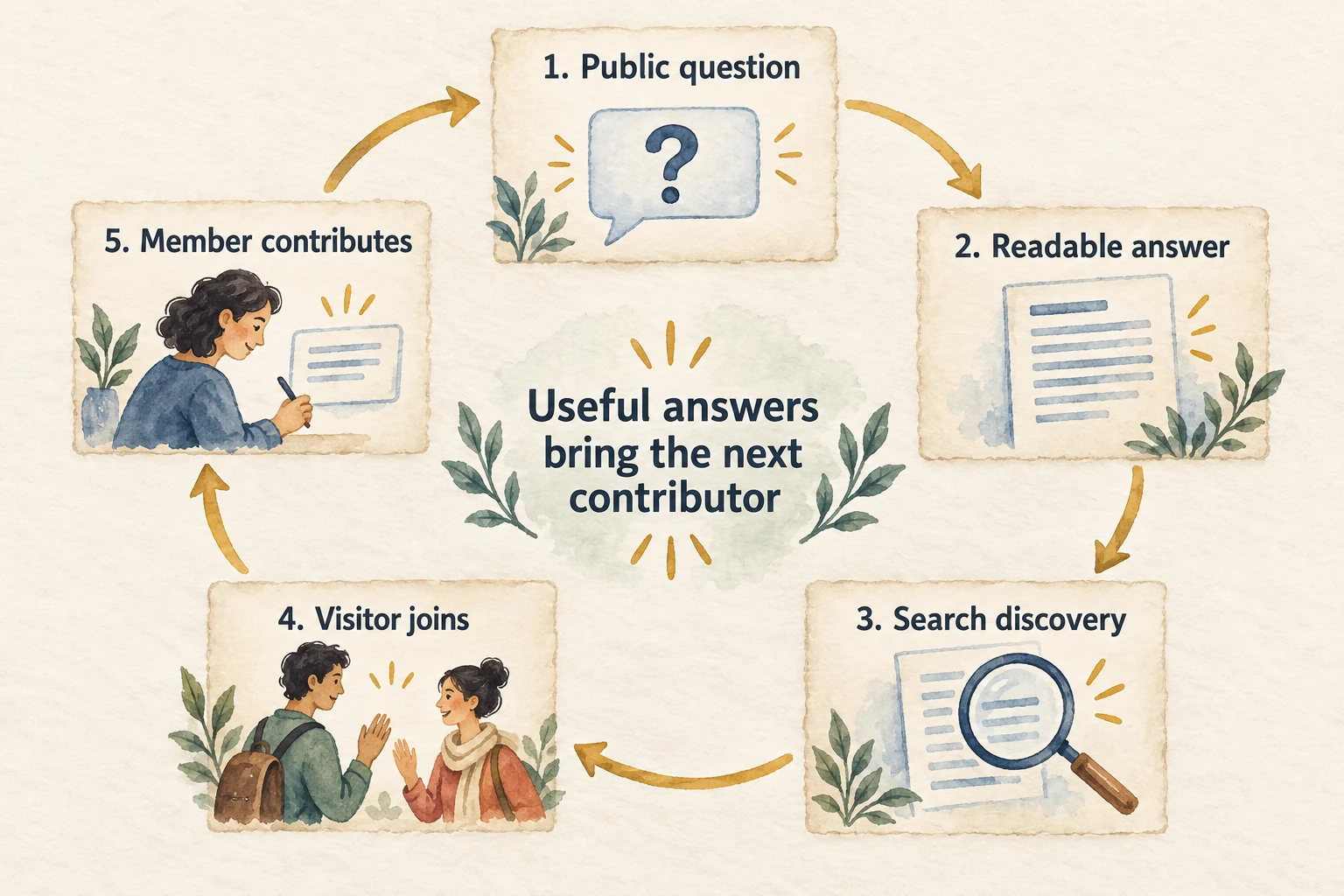
A funnel tracks someone's progress toward a purchase. A loop adds something that keeps bringing the next person in. In a community-led acquisition loop, that reusable part is a useful answer. A customer asks a question in public. Someone answers. A stranger with the same problem finds the answer through search, and some of those strangers join and contribute the next question.
I started CrazyEngineers in 2005. It grew past 400,000 members without ad spend. We never called it a loop at the time. Looking back, public questions and answers gave search engines something useful to show the next person.
For a B2B customer community, the same mechanism can attract people who have the problem your product solves. A private Slack or Discord workspace can help with retention, referrals and relationships. Its conversations alone do not create this public search loop. Reusable answers need a public home.
Check you have fuel first
The loop runs on questions your buyers and customers already ask: in support tickets, sales-call notes and onboarding emails. If you are still looking for your first customers, talk to buyers before investing in the community. Their questions will tell you whether there is enough shared demand to build around.
Separate two kinds of question. "How do I reset my account settings?" mostly helps people who already use your product. "How should a remote team organise customer feedback?" can also help someone who is evaluating how to solve that problem. Both belong in a useful community, but they do different jobs.
Start with questions close enough to your product's purpose to attract relevant buyers, without requiring them to be customers already. If you are unsure whether you have the demand, time and owner for this, use the customer community readiness guide first.
Stage 1: Get real questions asked in public
Start with a question someone actually asked, using the language they used. Your support queue is a good source, alongside questions from sales calls and customer interviews. A general answer delivered privately can become useful public knowledge when you have permission to share it.
Decisions to make at this stage:
- Which questions belong in the community and which stay in support. Billing, personal data, credentials and account-specific issues stay private.
- What happens after a support agent answers a reusable question. The agent can publish an anonymised version under their own name, or invite the customer to ask publicly.
- Who writes the first threads. Seed them from real questions, with clear authorship. Get permission before republishing a customer's wording or contribution, and remove confidential or identifying details.
A public thread does not replace your support process. The customer community vs. knowledge base guide explains where conversations and maintained documentation each fit.
At CrazyEngineers, I seeded the first threads myself. A few friends joined in, and together we posted frequently in the early months. The lesson for a B2B team is to create useful conversations before inviting strangers into an empty space. Your team can do that under their own names.
Choose a publishing rhythm you can sustain, and make sure questions get answered. A small archive of useful, current answers is a better starting point than a busy feed of filler.
Stage 2: Put every answer on a page search engines can read
A useful answer in a private workspace helps the people who can access it. To make it discoverable through public search, publish it on a page with its own URL that loads without a login.
A few habits make that page useful to a stranger:
- Keep one main question per thread. Focus makes the answer easier to understand and the title easier to write.
- Use a specific title in the asker's words. "Webhook retries stop after an hour" is more helpful than "Integration issue."
- Make the best answer easy to find, near the top or clearly marked.
- Use screenshots and diagrams when they explain the answer. Give them descriptive filenames and useful alt text.
- Keep answers accurate as your product changes. An outdated solution can waste the next visitor's time.
You can keep Slack for conversation and publish reusable answers elsewhere. The Slack community revival guide describes that hybrid approach. Public discovery depends on the answer's public home, not on moving every conversation into the open.
Stage 3: Let search and AI answers do the distribution
Threads can cover specific questions that a broad marketing page leaves unanswered. Someone searches for the problem, finds a relevant thread and gets an answer from your customers or your team.
Public pages can also be sources for AI search answers. Access makes that possible; it does not guarantee indexing, a citation or a visit. An AI answer may satisfy someone without sending them to your site. Treat referral traffic and qualified interest as outcomes to observe, rather than assuming every citation brings a buyer.
Our own community illustrates the difference. As of 29 September 2026, one public discussion appeared in Google Search Console as "Discovered - currently not indexed." The SEO-friendly community platform guide shows the evidence and separates crawler access, indexing, citation and referral.
Check indexing and organic clicks for your public thread URLs. If pages are accessible but not indexed, review whether the answers are useful, distinct and easy to find through internal links. Publishing is the start of distribution, not proof that it happened.
Stage 4: Turn a visitor into a member
Someone landing on a thread from search came for an answer. Give it to them first, in full, without requiring signup.
If the answer is behind a login that crawlers cannot access, it cannot serve this search acquisition loop. Even when someone reaches the page through another channel, a signup wall adds friction before they have seen its value.
Invite signup when the visitor wants to do something: ask a follow-up question, reply or follow the thread. Around the answer, show related threads and a short explanation of who the community is for.
Measure how many relevant visitors take that next step. Membership is useful, but it is not a product conversion and should not be reported as one.
Stage 5: Get a first contribution
The next turn of the loop needs another useful question or answer. Make that contribution small: the question someone arrived with, a follow-up explaining their situation, or an answer based on their own experience.
An introduction can help someone feel welcome, but it does not automatically create a page that attracts the next visitor. Track first participation separately from contributions that add reusable knowledge.
When someone who arrived from search starts a relevant thread, and that thread gets a useful public answer, the loop has completed another turn.
At CrazyEngineers we had no strategy for first posts. Members started posting because the content already there was useful and interesting to engineers, and they had something to add. Onboarding helps, but it cannot make up for threads nobody wants to read.
Where the money comes in
The community loop brings relevant people into your orbit. Becoming a product customer is a separate path that may happen before or after joining the community.
For example, imagine a company selling customer-feedback software. A prospect searches for "how to prioritise feature requests from enterprise customers" and finds a public thread comparing approaches. They ask how to account for contract value, and a named team member answers. If the prospect then asks to see how the software handles that workflow, invite them to a demo. That is a hypothetical acquisition path, not a reported customer result.
Notice the distinction: answering the question creates value; the prospect's request creates a sales opportunity. A community signup alone is not a reason to send someone to sales.
Keep threads about the problem. Let your team answer as named people, with a product link on their profiles, and mention your product when it is relevant to the answer. Offer a clear next step when someone expresses product interest.
Track community-sourced qualified leads, trials or demos, and paying customers separately. Where you can connect the journey, distinguish a first visit through a thread from a community visit later in an existing sales process. Attribution will have gaps; record what you can observe rather than treating every community touch as the source of the sale.
Expect this to take sustained work. My experience with CrazyEngineers shows how public knowledge can build an audience over time; it does not give your SaaS business a guaranteed payback period. Use your own evidence and costs when building the community business case.
Where loops break
Unanswered threads. A visitor who finds no answer has little reason to continue. Until members answer each other reliably, give your team responsibility for unanswered questions. Pick a time-to-first-answer target you can meet.
No owner. Name the person responsible for the loop and protect time for the work. That role need not be full-time at the beginning, but answering, welcoming and reviewing results cannot depend on whoever happens to be free.
A private-only archive. Conversations behind a login do not provide a public search destination. Publish reusable answers in a public space while keeping sensitive conversations private.
Gated answers. Asking for an email before delivering the answer weakens the experience that should make someone want to join.
One traffic source. CrazyEngineers depended heavily on Google. A search update in 2012 hit the site. Give members reasons to return directly, such as email digests and threads they follow, so a change in search traffic does not end the conversation.
Technical breakage. In 2014, a plugin on CrazyEngineers generated a large number of broken links returning 404 errors. After platform or theme changes, check important public URLs and Search Console for unexpected indexing changes.
Counting members instead of outcomes. Member count can rise while questions go unanswered and product interest stays flat. Measure each stage and the customer path separately.
What to measure at each stage
On a small screen, scroll the table sideways to read every column.
| Stage | Measure | Where to find it |
|---|---|---|
| Questions | Relevant new threads per week; questions from customers and prospects | Community analytics and a simple source log |
| Answers | Share of threads answered; median time to first answer | Community analytics |
| Discovery | Public thread pages indexed; organic clicks to thread URLs | Search Console Pages and Performance reports |
| Visitor to member | Search visitors who sign up; signup rate for that group | Web analytics connected to signup events |
| First contribution | Share of new members who contribute within 30 days | Community analytics |
| Loop closed | Useful threads started by members who first arrived from search | Community activity connected to recorded acquisition source |
| Product interest | Qualified demo requests or trials sourced through threads | Web analytics and CRM |
| Customers | Paying customers sourced through threads; community-assisted sales recorded separately | CRM |
These measurements need some setup. Record the landing thread and acquisition source when available, connect signup to subsequent activity, and keep the same source definition in your CRM. Do not assume the community analytics dashboard can reconstruct the whole journey on its own.
I do not use cross-community benchmarks for these numbers. Communities differ too much. Set your own baseline and watch whether useful answers, relevant visits and qualified interest improve.
A small way to start
Pick one category of question your team answers every week that is useful to prospects as well as existing customers. For a month, publish reusable questions and answers in that category, aiming to answer within one working day.
Review answer quality, response time, indexing and any visits or follow-up questions. A month is a useful operational checkpoint, not a deadline for search traffic or revenue. If discovery is still low, diagnose it before scaling; if the first category is useful and manageable, add another.
For the broader rollout around that pilot, use the 90-day B2B SaaS community launch plan.
Where Jatra fits
Jatra's community features give public discussions their own readable pages, alongside private spaces for sensitive conversations. That supports the publishing foundation of this loop. Search engines and AI providers still decide what they index, rank or cite.
When configured, Jatra AI screens eligible public contributions for spam and promotional links. Suspicious submissions are held for human review. Your team still owns answer quality, moderation and the relationships that keep members contributing.
We can help you plan the first public question category, set up the community and work through migration if you are moving from another platform. Bring the questions your customers and prospects already ask, and we can discuss a useful way to start.