

Most community platforms are built for people who have already logged in. Google doesn't log in to read your community. Neither do AI search crawlers.
I built Jatra around that gap. I ran CrazyEngineers for close to 20 years. It grew past 400,000 members with zero ad spend, and the reason was simple. The threads were public, so search engines could read them.
This page covers what Jatra does to make public community pages reachable by search engines and AI search, what I tested, and what no platform can do for you.
What I tested
On 29 September 2026 I fetched a public discussion on our own community while logged out: Should customer questions be hidden from public?
The first HTML response contained:
- the full post, author name and publish date
- a canonical URL pointing to itself
- a robots tag set to
index,follow,max-image-preview:large - a title tag, meta description and Open Graph tags generated from the post
- plain links to the channel, the homepage and other public channels
Everything on this page builds on that test.
Public pages load without a login
A stranger can read that discussion in full. No signup wall and no "log in to see replies."
Jatra renders pages on the server. The text is in the HTML the crawler receives, so the crawler doesn't have to run a JavaScript app to find the answer. Open any public Jatra post in a private window and view the source. The content is there.
Each public post gets its own URL
Discussions live at /discussion/.... Articles live at /article/.... Announcements live at /announcement/....
Each public post has its own address that can be linked to and discovered independently. Compare that to Slack or Discord. A great answer in a Slack channel has no public URL a search engine can visit. It helps one person and then scrolls away.
Canonical and robots tags
Communities create a lot of URLs. Sorting, filters and pagination can produce many versions of the same content. These tags tell search engines which version is the real one and whether to index it.
On the public discussion I tested, Jatra returned a self-referencing canonical URL and an index,follow robots directive.
You decide what stays private
Public doesn't mean everything is public.
In September 2026 I moved two channels on our own community to private: official support, and feedback and feature requests. Most posts there were about one account's bug or one feature request. That's useful to the customer and noise to Google. Our educational channels stay public.
That's the pattern I'd recommend. Public knowledge gets indexed. Account-specific context stays behind a login. I made the full argument in Closed vs. Open Community.
AI search: access is the only part a platform controls
AI answers add a new layer, but the first question is the same. Can the crawler read the page?
Each AI provider runs its own crawlers. OpenAI, for example, uses OAI-SearchBot for ChatGPT search and a separate crawler, GPTBot, for model training. Allowing one doesn't allow the other. Check your robots.txt and your CDN or firewall rules for the provider you care about.
Separate four things when you evaluate any platform:
- Access. Can the crawler fetch the public page?
- Indexing. Did the provider store it?
- Citation. Did an answer use it as a source?
- Referral. Did anyone click through?
A platform controls the first one. The provider decides the other three. For the content side of this, read the Community AEO guide.
What Jatra can't do
Jatra can't make Google rank a page. It can't make ChatGPT cite one.
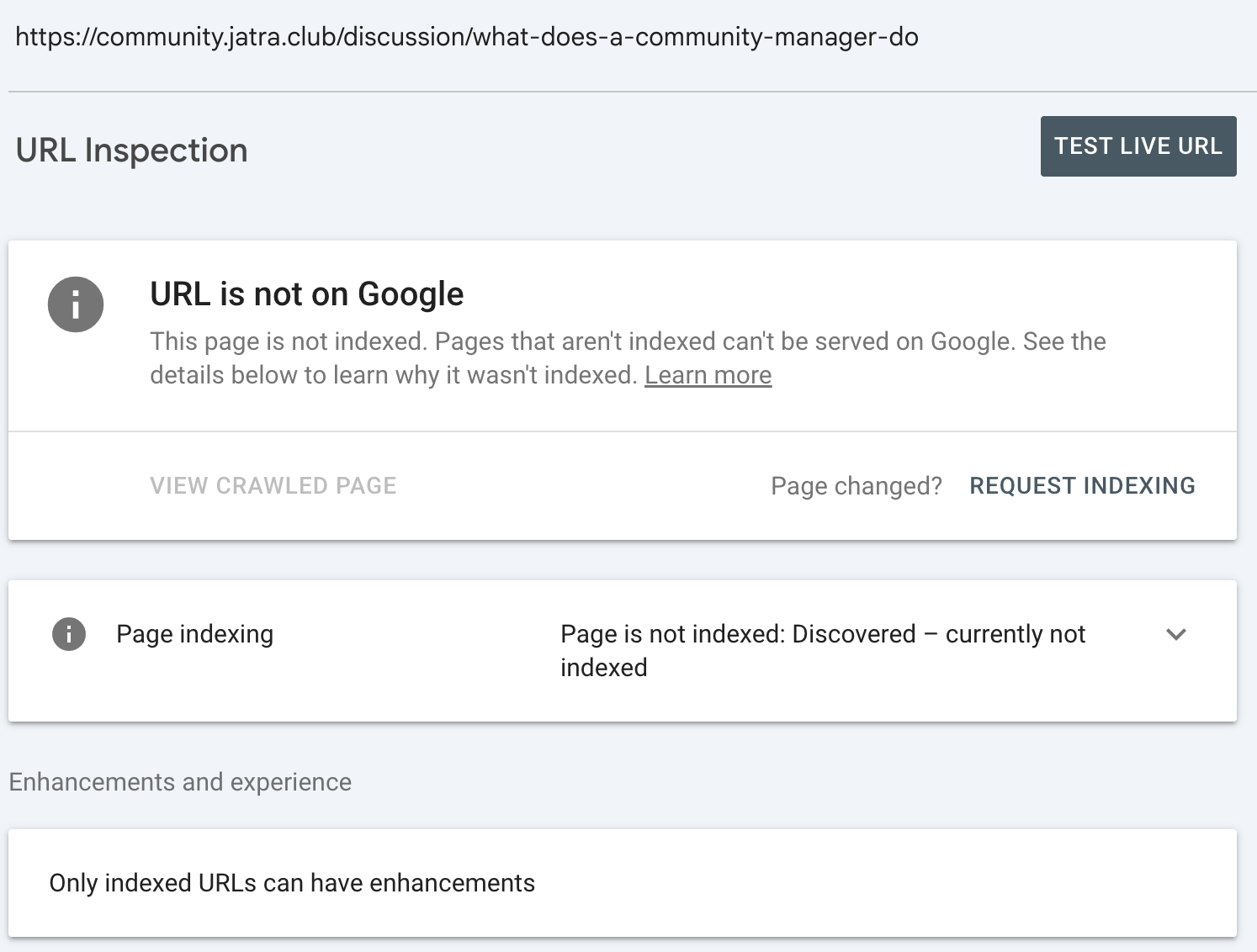
Our own community proves it. As of 29 September 2026, one of our public discussions still shows in Search Console as "Discovered, currently not indexed." It's crawlable, canonical and marked index,follow. Google still hasn't indexed it. Access is necessary. It isn't enough.
A community full of thin or unanswered threads won't earn search traffic on any platform. The software removes the technical obstacles. Your members still have to ask real questions, and someone still has to answer them well.
Check it yourself
Don't take my word for it. Open community.jatra.club in a private window, pick any public post and view the source.
For a quick way to run this check on any platform, see How to Choose a Forum Software in 5 Minutes by Scanning Public Pages.
If you're comparing several vendors, use Best forum software for SEO: what to test before buying.