
Let me start with something uncomfortable: nobody cares about your brand.
Nobody wakes up wondering whether your brand is good or bad. They wake up with their own stuff. A breakout three days before a wedding. Coffee that tastes burnt no matter what they try. A goal they keep missing. A worry they can't shake.
That's what people care about. Their pains, their problems, their dreams and ambitions.
Obvious, right? But then why do most brand communities, especially the ones that fail, look like a product catalogue? New launch. Offer of the week. "Tell us what you think about our new flavour!" A few replies, mostly from people hunting for a discount code. Then silence.
Build the community around what people actually care about, and your brand becomes the place where it happens.
I've been running online communities for twenty years. CrazyEngineers has 400,000+ members, and brands like Siemens and Texas Instruments came to us to reach those members. We never chased them. They came because the engineers were already there, talking about engineering. Not about Siemens.
Today I build Jatra, a community platform, so yes, I'm biased about platforms. I'll tell you when that matters.
New to communities in general? Start with how to build an online community. This guide is about what's different when a consumer brand builds one.
Your brand is the sponsor, not the topic
This is the shift most brands struggle with.
You don't have to always talk about your brand. The brand can be the sponsor, the owner, the maintainer of the community. It pays for the place, keeps it clean and makes sure good answers get written. Members talk about what they care about.
What you get back is the data. If your coffee community keeps saying they prefer Arabica over Robusta, that's an insight you won't find anywhere else. Not in a survey, not in your ad dashboard. You see what people really want, in their own words, every single day.
This isn't a new idea. Harley-Davidson nearly went under in 1983. A big part of how it came back, as Harvard Business Review wrote in 2009, was a community of riders organised around the lifestyle and the activities, not just the motorcycle.
Pick one problem, not your whole category
"Skincare" is not a niche. Neither is "coffee".
There are already huge communities, subreddits and influencers covering every broad category. A new brand community can't win by being general. It wins by going deep on one thing nobody covers properly.
Take a skincare brand. Don't start a community about skincare. Pick one skin problem, blackheads maybe, and cover it in its full length, breadth and depth. Every complaint, every home remedy that doesn't work, every product question. It's easier too: you can find everything people say about that one problem, instead of trying to cover everything on day one.
A coffee brand? Pick one thing about coffee. Brewing at home. Espresso machines. Roasting. One bean origin. Niche down as far as you can, then cover that niche in its full glory.
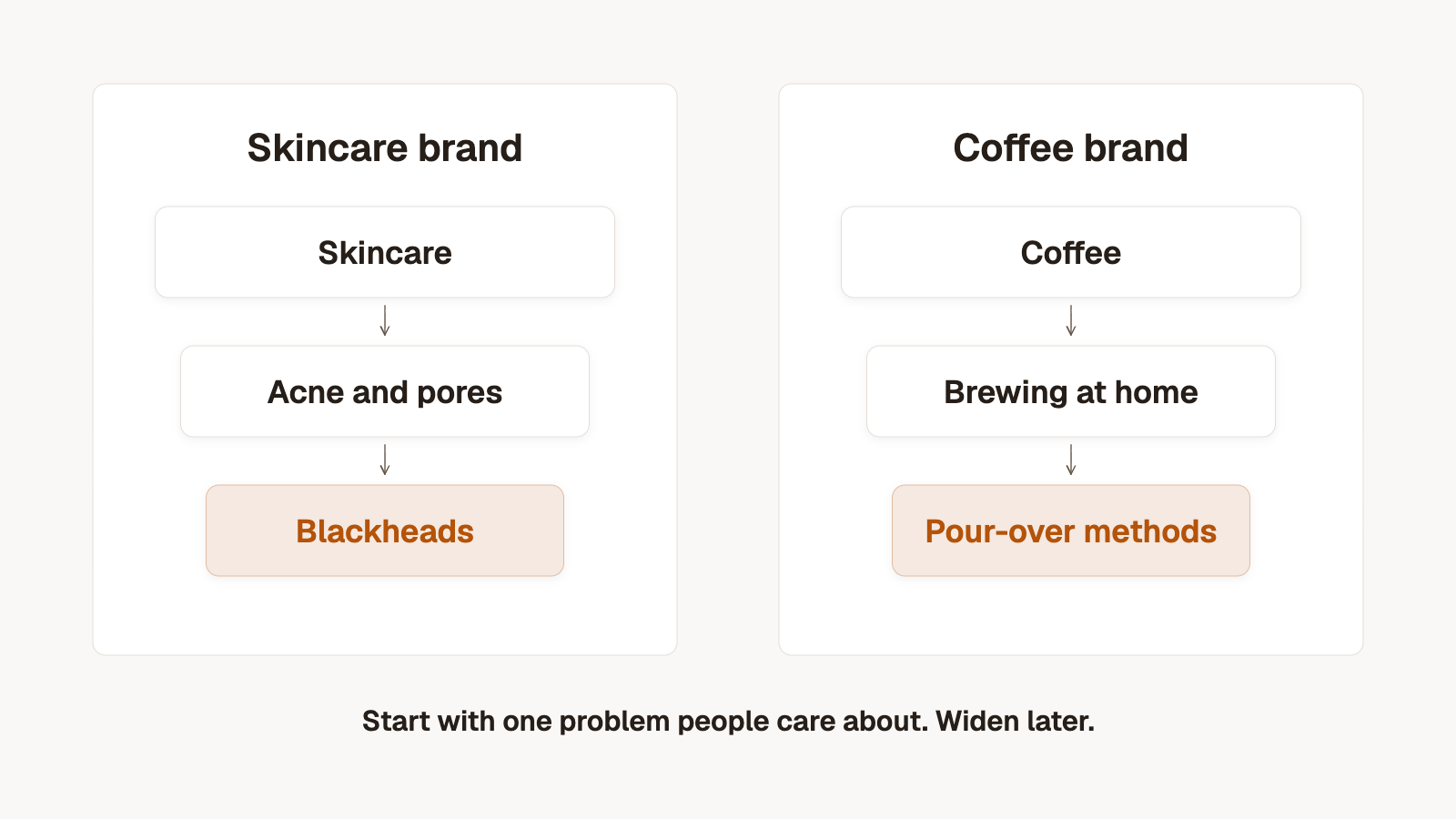
Then expand from there.
Tip: Communities aren't social media. You won't see people talking about blackheads day and night. You don't need that. You need enough people who really care, and a place where their answers stay findable.
Know who's buying, and what keeps them up at night
Before you pick a platform, write down who your members are.
Not "women 25 to 40". Real people. What are they trying to achieve? What have they already tried? What are they afraid of getting wrong? What do they Google at 11 PM? Half a page is enough.
Your customer support inbox is a gold mine here. So are your product reviews, the comments under your Instagram posts, and the questions people ask on Reddit about your category. Read them. Copy the way people describe their problems. The words, not just the topic.
Keep complaints private and the niche public
Every brand worries about this, and fairly so: what if people complain in public?
My answer is a hybrid community. Keep support and complaints in a private section. Keep the niche discussions public, where Google and people can find them.
An unhappy customer isn't looking for an audience. They want to be heard, by a real person from your brand who listens and helps fix it. Public or private doesn't matter to them. So give complaints a private space, answer fast, and keep the public side about the thing your customers love.
On Jatra you can make any channel private, so this is a settings decision, not a second tool. More on the trade-offs in public vs private communities.
Pick a platform you'll still be happy with in three years
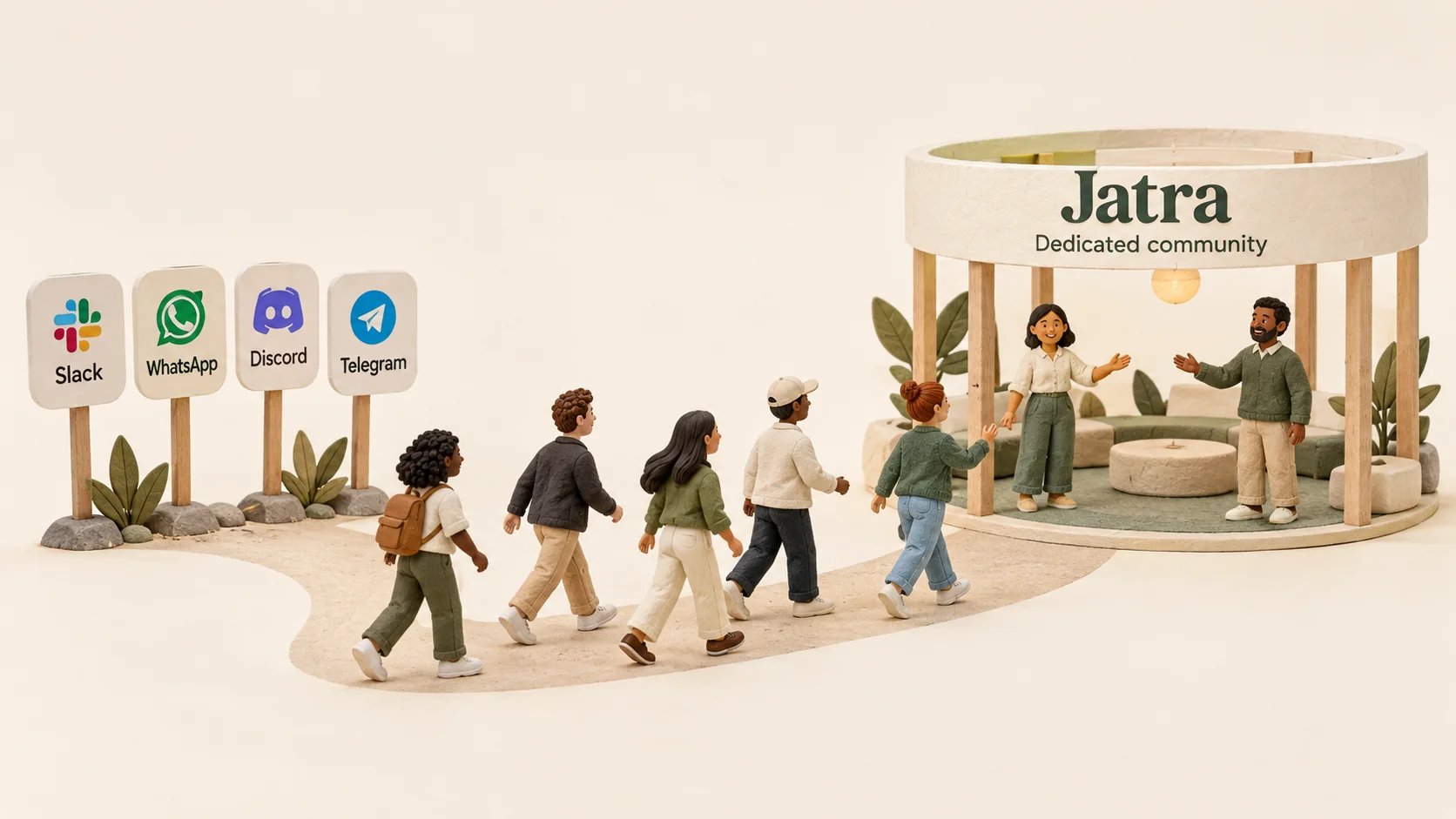
A Facebook group or a WhatsApp group feels like the easy choice. Your customers are already there.
But think about what happens next. The good answers get buried in a feed. Nobody outside the group can find them. You don't own the member list, and you can't put the community on your own domain, next to your store.
For a brand, three things matter more than anything else. The community should live on your domain, look like your brand, and keep your best content public so Google can find it. Also check that you can run more than discussions: guides, how-to-use articles, launches, events, polls and feedback, all in one place. I've written about this in multi-content communities.
If you're comparing options, I've put the main ones side by side in Facebook Groups alternatives.
Seed it with answers before anyone arrives
No one likes to be the first person in an empty room.
So before you invite anyone, fill the community with answers worth finding. Start with the 20 or 30 questions your customers already ask. Answer each one properly, in public, as its own page. Have your product team, your in-house experts, even your founder write some of them.
I usually recommend about 50 pieces of content in the first 10 to 15 days. Depth matters far more than volume. The full method is in how to seed a community.
Tip: Don't write product pitches and call them answers. People can smell it. If the honest answer to "how do I get rid of blackheads?" doesn't need your product, say so. That's how you earn trust.
Bring in your best customers first
Don't announce the community to your whole mailing list on day one. Invite in batches.
Start with people you can actually talk to one on one: repeat buyers, people who left detailed reviews, people who emailed you with good questions, your loyal Instagram commenters. Give them early access and make them feel special. They are.
Then watch. Which answers did they read? What did they ask next? Who came back a second time? Write what's missing, then invite the next batch. Keep this loop going for the first few weeks. That's how you build a solid foundation.
Give your founders and senior people five to ten minutes a day in the community. React to posts. Reply. Share a view. Members notice when the people behind the brand show up.
Give members a reason to make things
The best brand communities let members create, not just comment.
LEGO is the famous example. On LEGO Ideas, fans submit their own set designs, other fans vote, and ideas that reach 10,000 supporters go to a LEGO review board. Some of them become real sets on shelves. The fans do the creative work, and LEGO learns what people actually want to buy.
You don't need a review board. Start small. Ask members to share their routine, their recipe, their setup. Run a poll before a launch. Let your regulars test a new product first and post what they think. Have sections for launches, reviews and how-to-use guides.
There's no hard rule that a brand community only covers problems. You can build a fun community, a reviews community, or one where you ask customers for feedback. Just find out what your members want to talk about.
Let Google and AI bring the rest
This is the part a Facebook group can't do for you.
Every good answer in your community is a page. When someone types "how to get rid of blackheads on nose" into Google or ChatGPT, your community's answer can show up. They land on your domain, read something useful, and see your brand behind it. That's a new customer you didn't pay an ad platform for.
And it compounds. Discussions we wrote on CrazyEngineers back in 2010 still bring in hundreds of visitors every month.
Think of your community as a knowledge base your customers build together. It gets more valuable every month, which is the opposite of an ad.
Frequently asked questions
What is a brand community?
A brand community is a group of people who come together around a brand, or around something the brand stands for. The strongest ones aren't about the brand's products at all. They're about a problem, hobby or lifestyle the brand's customers share, with the brand as the host.
Should a D2C brand build a community or just use social media?
Use social media to reach people. Use a community to keep them. Social posts disappear in a day. A community answer keeps working for years, brings in visitors from Google, and lives on your own domain where you own the relationship.
How do you stop a brand community from becoming a complaints board?
Give complaints a private place and answer them fast. Keep public sections about the niche your customers care about. People mostly want to be heard by a real person, so make sure someone from your team is listening.
How long does it take to build a brand community?
Longer than a campaign. Expect a few weeks of hard work seeding and inviting in batches, then months before members answer each other without you. The upside: unlike ads, the work doesn't stop paying off when you stop spending.
Where I'd start
If I were building a brand community tomorrow:
- Pick one problem your customers care about, not your whole category.
- Choose a platform on your own domain where the best content stays public.
- Keep complaints and support private.
- Write about 50 deep answers before inviting anyone.
- Invite your best customers first, in small batches you can talk to.
- Let members create, then let Google and AI bring the rest.
Your brand doesn't need to be the topic. It needs to be the reason the place exists.
If you'd like help building yours, see how Jatra works for eCommerce and D2C brands, or book a call and tell us what you're building.