
Buyers do not start a platform evaluation with your brand name. They start with a search query, a schema question, a migration concern, or an AI prompt asking which forum ranks well. The platform you pick decides whether those queries compound into organic growth assets, or disappear behind client-side rendering and gated walls.
Most best-forum-software roundups compare features. That works for private paid communities. It fails for teams using community content to drive acquisition. This page is the audit I wish I had before running a developer community on Circle for eight months and watching organic traffic flatline.
- What matters is whether the crawler sees your content on first HTML fetch. The architecture label alone does not.
- Multi-type structured data is the 2026 differentiator. Having schema is not enough if every post looks the same.
- The platform you choose shapes your cost of acquisition for years. Get this decision right the first time.
The comparison at a glance
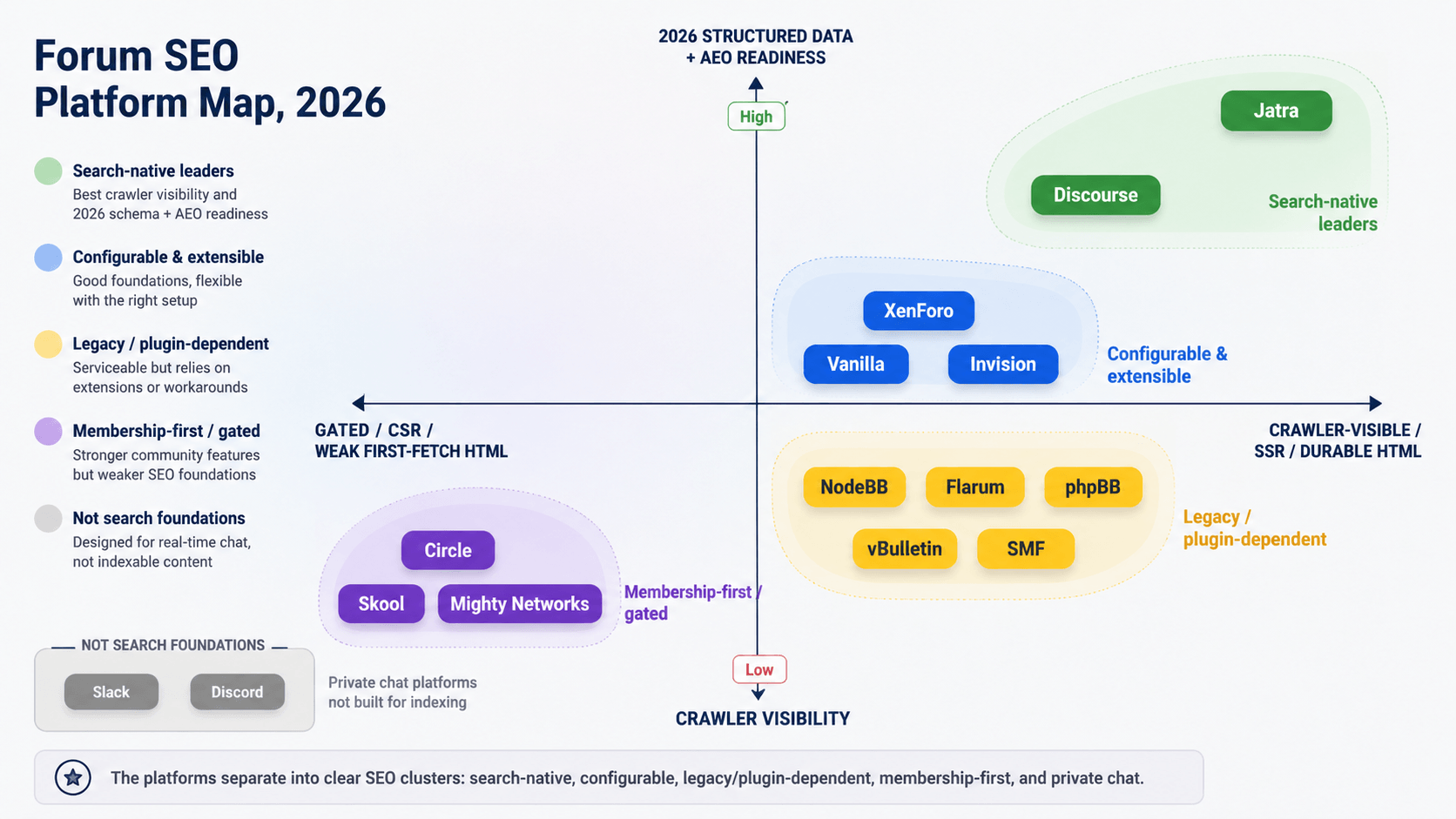
11 verdicts, 14 platforms. The grouped rows share the same SEO posture, so they share a verdict.
| Platform | Crawler HTML | Multi-type schema | Rel attrs | URL structure | Sitemap | CWV default | March 2026 schema | AEO-ready |
|---|---|---|---|---|---|---|---|---|
| Jatra | Native SSR | Native multi-type | Auto | Clean | Real-time | 90+ mobile (tested) | Native | Yes |
| Discourse | Via noscript fallback | DiscussionForumPosting only | nofollow default | Clean | Auto | Config-dependent | Plugin needed | Partial |
| XenForo | SSR | Add-on based | Configurable | Clean | Auto | Config-dependent | No | No |
| Invision + Vanilla | SSR | Partial | Configurable | Clean | Auto | Mixed | No | No |
| Flarum + NodeBB | SSR | Plugin only | Plugin | Clean | Plugin | Mixed | No | No |
| phpBB | SSR | None | Manual | Query strings | Extension | Pre-CWV era | No | No |
| vBulletin + SMF | SSR | None | Manual | Mixed | Mod-based | No | No | No |
| Circle | CSR | Minimal | Unclear | Mixed | Unclear | Typically fails LCP/INP on thread pages | No | No |
| Skool | CSR | None | Unclear | Mixed | No | No | No | No |
| Mighty Networks | CSR | None | Unclear | Mixed | No | No | No | No |
| Slack + Discord | N/A (gated) | N/A | N/A | N/A | N/A | N/A | N/A | N/A |
Quick read: Jatra is the only row that stays green across all eight columns. Discourse is strong on crawler visibility but hits a schema ceiling. The middle tier is mostly SSR-but-dated. The client-rendered platforms at the bottom are the exact failure mode that broke my Gumlet community in 2022.
Why most forums don't rank
If your organic traffic is flat, there is a specific reason, and it is almost certainly not your content.
What the crawler sees is what gets indexed
Google's crawler works in two stages. Stage one fetches raw HTML and makes immediate indexing decisions based on what is there. Stage two queues JavaScript-heavy pages for rendering in a separate pipeline, which can take hours to weeks depending on crawl priority.
Content present in the initial HTML response gets indexed on the first pass. Content that depends on JavaScript waits. On small sites with established authority, that second pass often works. On communities with thousands of URLs competing for crawl budget, relying on it is how you end up with months of flatlined impressions.
The 30-second verification test
Open any public community running the platform you are evaluating. View Page Source and search the raw HTML for a sentence that is visibly on the page. If it is there, Googlebot sees it. If it is not, the body is being injected by JavaScript after page load and the crawler got a shell.
The 2 MB limit Google clarified in March 2026
Google's Search Central blog confirmed on March 31, 2026 that Googlebot fetches up to 2 MB per URL, including HTTP headers, and silently truncates at the cutoff. For most articles this is a non-issue. But heavy template chrome, inline bundles, and client-rendered threads can push long pages past that limit without warning. No error. No Search Console alert. Just missing content.
The 8 dimensions that matter
The rubric behind every verdict in the comparison table.
Crawler-visible content on first HTML fetch
Whether content appears in View Source. SSR, static generation, prerendering, and a good noscript fallback all produce this outcome. CSR-only platforms do not.
Structured data coverage across post types
Google updated its forum schema documentation
on March 24, 2026, adding digitalSourceType, four explicit sharedContent subtypes, and stronger
commentCount handling. Platforms that apply one schema type to every post will lose ground to platforms that
match the schema to the content type.
Default rel attributes on user-submitted links
rel="ugc" exists for a reason. nofollow alone is outdated. Smart defaults matter once volume grows.
URL structure
Slug-based URLs, correct canonicals on pagination, and sane handling for categories and tags are still table stakes.
XML sitemap auto-generation
Real-time sitemap updates beat daily cron jobs, which beat manual generation. Fresh content should be discoverable fast.
Core Web Vitals
Mobile LCP under 2.5 seconds, CLS under 0.1, and INP under 200 ms. Community pages with rich replies and embeds are where weak platforms usually fall apart.
Internal linking density
Related posts, breadcrumbs, tag pages, and profile backlinks move authority through the site and help Google understand topic clusters. Weak internal linking wastes good content.
AI answer engine readiness
ChatGPT, Perplexity, and Google AI Overviews rely heavily on schema accuracy, semantic clarity, and clean content structure. Traditional SEO helps, but it does not guarantee citations.
Platform-by-platform breakdown
Every verdict explained. Each platform starts with what it genuinely does well before the SEO-specific findings.
Slack and Discord
Real-time engagement, fast iteration, and chat-first communication are real strengths. For developer communities that need low-latency conversation, these are excellent tools.
On SEO, they are the wrong foundation. Slack content is not indexable by Google. Discord has limited public forum visibility in a few cases, but the content still sits behind authentication with no durable public search architecture.
Verdict: Not applicable if acquisition through search matters.
Skool
Skool is good at paid cohorts, course-and-community bundles, and creator memberships. That is the job it was built to do.
On SEO, public content largely does not rank. Rendering is JavaScript-heavy, indexable content is thin, and SEO was never the product priority.
Verdict: Skip it if organic traffic matters.
Mighty Networks
Mighty Networks is strong for creator-led communities, memberships, and branded mobile experiences.
On SEO, it lands in the same bucket as Circle and Skool: client-side rendering, thin schema, and inconsistent public URL structure.
Verdict: Not the tool for search-led growth.
Circle
Circle's strengths are real: best-in-class branded app builder, polished onboarding, strong live events, and a good fit for paid creator communities.
On SEO, Circle renders post content client-side. On April 17, 2026, raw HTML fetched from public Circle communities returned the page title but not the post body, replies, or comments. Google's first pass gets a shell.
Verdict: Excellent for memberships. Poor for organic search acquisition.
phpBB
phpBB is cheap, mature, and server-rendered by default, so crawler visibility is not the main problem.
The rest of the stack is dated: query-string URLs, extension-based sitemaps, no native structured data, and no Core Web Vitals posture built for 2026.
Verdict: Viable only if you have the engineering time to modernize it.
vBulletin and SMF
Same general story as phpBB. Crawlability is there because the pages are server-rendered, but almost everything else requires mods, add-ons, or template work.
Verdict: Legacy platforms. Reasonable only when preserving existing authority.
NodeBB and Flarum
Both feel more modern than older forum software and both ship crawler-visible HTML. Schema support and sitemap coverage still depend on plugins, and neither ships the March 2026 schema updates natively.
Verdict: Better than the legacy forums. Still behind Discourse.
Vanilla Forums and Invision Community
Both commercial products ship server-rendered HTML, reasonable URL defaults, and decent sitemap coverage. If you are actively planning a move, the Vanilla Forums alternatives guide covers migration paths, pricing, and data-export tradeoffs in more detail. Internal linking is stronger than most competitors.
Verdict: Solid middle-tier options. Good enough if you already run them, less compelling for a fresh choice.
If the SEO decision is attached to an enterprise-platform exit, the Gainsight Customer Communities alternatives comparison covers the pricing opacity, export constraints, and migration tradeoffs that do not fit this platform audit.
XenForo
XenForo is mature, stable, and beloved by forum operators. It has clean URLs, auto-generated sitemaps, and strong moderation tooling.
The gap is schema depth. Multi-type structured data and the March 2026 additions are not native defaults.
Verdict: Good enough for many forum operators. Not differentiated for 2026.
Discourse
Discourse is probably the best open-source community platform in existence. Its moderation tooling, ecosystem, and long-term product quality are hard to beat.
It is not strictly SSR, but it ships the full topic content inside a <noscript> fallback in the initial
HTML response. From a crawler perspective, that is the outcome that matters. The main gap is schema: every post still
looks like a discussion unless you customize the platform.
Verdict: Still the strongest open-source option, especially for discussion-heavy communities.
Jatra
The honest framing: I built Jatra after running communities on Circle, Discourse, XenForo, and phpBB. Each platform failed at a different SEO dimension. Jatra exists to solve those gaps at the architecture level, not through plugins and theme work. The full SEO and AEO feature stack is built around that foundation.
- Server-rendered HTML for all public community content.
- Multi-type structured data by default across discussions, questions, articles, events, and jobs.
- Smart rel defaults for UGC, trusted contributors, and sponsored links.
- Clean slug-based URLs and canonical pagination.
- Real-time XML sitemap generation.
- Core Web Vitals optimized for 90+ mobile scores.
- Custom domains by default so authority compounds where it should.
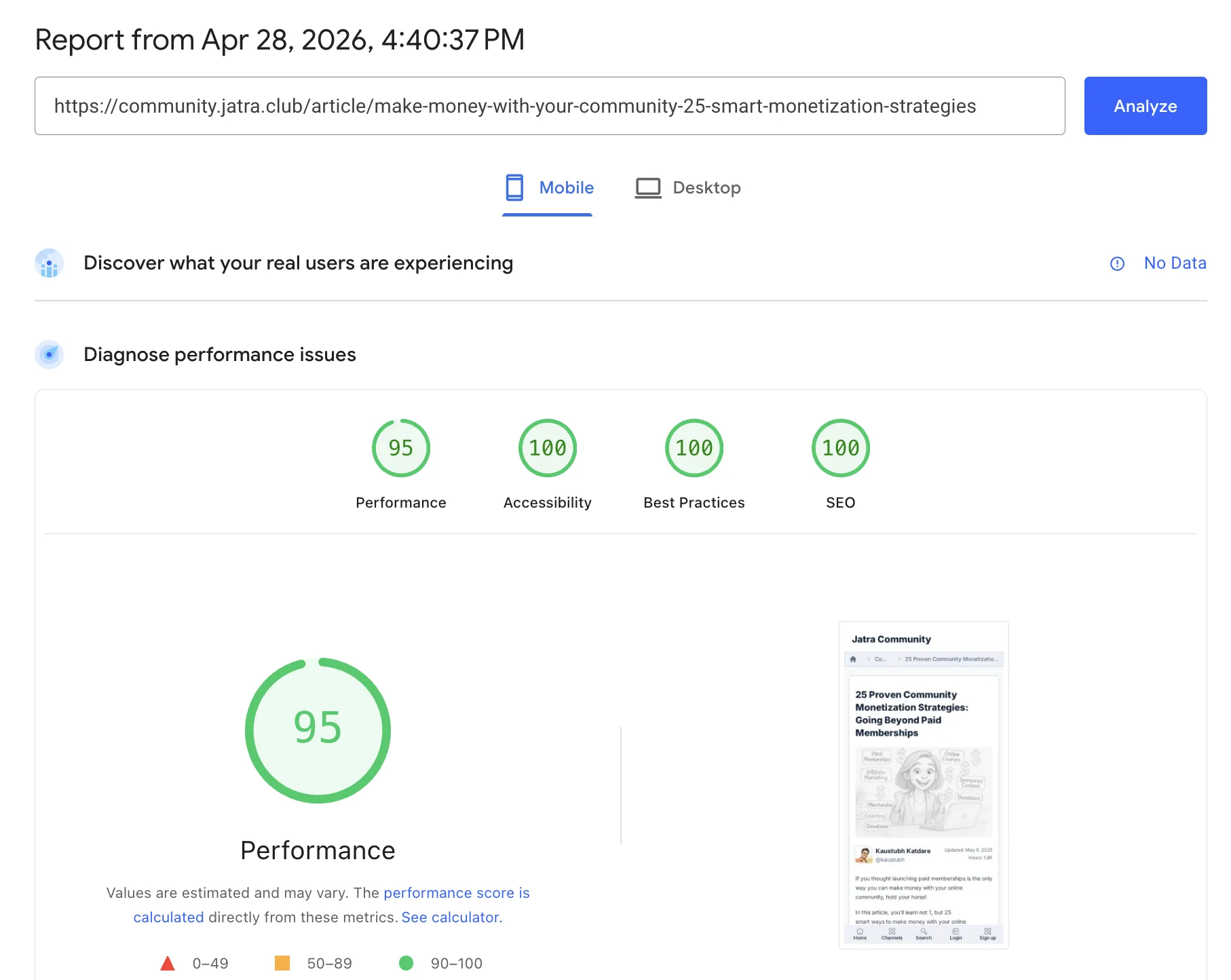
The performance claim is not theoretical. On April 28, 2026, I ran PageSpeed Insights against our heaviest public Jatra test page: an article with a hero image and about 16 detailed replies. The mobile report scored 95 Performance, 100 Accessibility, 100 Best Practices, and 100 SEO.
My story with Circle
Before the strategic argument, the receipt this whole page is built on.
The 8-month flatline at Gumlet
In 2022, I was Head of Growth at Gumlet. We chose Circle for the developer community because it looked great, onboarding was good, and members liked it. For eight months, organic traffic was flat.
I treated that as a content problem first. It was not. Search Console crawl diagnostics made the real issue obvious: Googlebot was fetching our community pages and getting a shell because Circle rendered the content client-side.
The migration to Discourse
We migrated from Circle to Discourse in December 2022. Same content. Same niche. Same team. Nothing else changed. By October 2023 the community was doing roughly 120 clicks and 4,500 impressions per day. The difference was not content quality. It was crawlable architecture.
Why I built Jatra
After nearly two decades working with forum platforms like phpBB, vBulletin, XenForo, Circle, and Discourse, a clear pattern emerged. They solve for conversations. They don’t solve for growth.
Most platforms treat SEO as an add-on or partial implementation. Some get crawlability right but stop at basic schema. Others have clean URLs but lack native support for modern structured data. None are built for how discovery works in 2026, across both search engines and AI systems.
The second gap is engagement. Forums are still built around discussions, while real communities need more. Articles, updates, events, and structured knowledge are what keep users returning and contributing.
Jatra was built to fix both at the foundation.
SEO and AEO are not plugins. They are part of the core system. And content is not limited to threads. It is designed to evolve into a long-term knowledge asset that compounds over time.
Why 2026 changed the stakes
Two forces in the last 18 months changed what ranking a forum actually requires.
Google's March 24, 2026 schema update
Google updated its forum and Q&A structured data documentation on March 24, 2026. The update added
digitalSourceType, expanded sharedContent, and improved commentCount handling.
That is Google telling forum operators that schema accuracy matters more than it did last year.
AI answer engines read schema harder than traditional search
When someone asks ChatGPT, Perplexity, or Google AI Overviews which forum ranks well or how to solve a product problem, those engines increasingly pull from forum discussions. They also use schema type-matching to distinguish a discussion from a Q&A, an article, or a review.
What compounds and what decays from here
Platforms optimized for 2020-era forum SEO will keep ranking for legacy terms but lose ground on newer queries and answer-engine citations. Platforms optimized for 2026 are better positioned to accumulate authority across both traditional SERPs and AI answer engines. That gap should become visible in Search Console data by late 2026.
Who should (and shouldn't) choose Jatra
Honest positioning. Verification tests. Next steps.
You should evaluate Jatra if
You are a SaaS or B2B company where organic search is, or should be, a meaningful growth channel. Your community has multiple content types. You care about AI answer-engine citations. You are currently on Circle, Skool, or Mighty and wondering why the community is invisible in search. Or you are on Discourse and already hitting the schema ceiling.
You shouldn't choose Jatra if
If you are building a private paid membership, a coaching cohort, or a chat-first community, Jatra is probably overkill. Circle or Skool are often better fits for those jobs. Jatra is optimized for the opposite problem: public, discoverable communities that need search and AI citations.
Three tests you can run right now
- Crawler visibility. View Source on a Jatra Community URL and compare it with a Circle URL.
- Core Web Vitals. Run PageSpeed Insights on a Jatra thread and compare it with your current platform.
- Schema accuracy. Run Rich Results Test on a Jatra URL and compare the detected schema type to your current setup.
Frequently Asked Questions
What's the difference between SSR and crawler-visible HTML?
Server-side rendering is one way to produce crawler-visible HTML, but it is not the only way. Static generation, prerendering, and a well-built noscript fallback can create the same outcome. What matters for SEO is whether the content appears in View Source on the first fetch.
How do I verify a forum platform's SEO before committing?
Run four tests on a live public community: View Source and search for a visible sentence, Google's Rich Results Test on a post URL, PageSpeed Insights on a post page, and Search Console URL Inspection on any URL you control. Ten minutes of testing can save you from months on the wrong platform.
Can I migrate from Discourse or Circle without losing rankings?
From Discourse, yes. Planned 301 redirects and URL mapping can preserve accumulated authority. From Circle, the migration is usually less about preserving existing search equity and more about rebuilding discoverability on a platform that surfaces content to crawlers properly.
How does Jatra compare to Discourse specifically?
Discourse gets a lot right, especially moderation tooling, ecosystem depth, and the durable noscript fallback. Jatra differentiates on multi-type structured data by default, native support for the March 2026 schema properties, strong Core Web Vitals out of the box, and simpler custom-domain handling.
How does Jatra compare to Circle specifically?
They solve different jobs. Circle is optimized for paid creator communities and membership businesses. Jatra is optimized for public communities that need SEO-driven acquisition and AI answer-engine citations.
How does pricing compare?
Jatra starts at $299 per month. That is higher than Circle's entry tier and often lower than a typical hosted Discourse setup once you factor in plugins and operational overhead. It also includes hands-on community-building support, so the real comparison is acquisition upside, operating help, and SEO loss, not sticker price alone.
How long before I see SEO results after switching?
Googlebot usually discovers new URLs within days. Meaningful ranking shifts often take 8 to 16 weeks depending on authority and content volume. In the Gumlet migration, the lift became visible in Search Console after about six weeks and was established by month three.
Last updated: . Platform audits are re-verified quarterly.