

Before you read any further, a disclosure. I founded Jatra, and Jatra appears on this list. I built it specifically as an alternative to XenForo, Discourse, and the other platforms reviewed here, because each of them leaves gaps that only become visible after you have operated a community on them for years. That is the conflict of interest. You should weigh everything that follows knowing it.
What I have tried to do is write the article I wish had existed when I was the one looking for alternatives. That means being harder on Jatra in the places it falls short than a marketing page would be, and being fairer to XenForo than a competitor's roundup usually is. XenForo is a quality product. A lot of what I built into Jatra is direct inspiration from the parts of XenForo that worked. If you prefer the legacy forum UI, are comfortable with a release cadence measured in years rather than weeks, and have the technical chops or the team to manage the server and the add-on portfolio, you should stay on XenForo. That is a serious recommendation, not a throwaway one.
Most XenForo alternatives roundups are written by people who have never owned a license, never paid for a Resource Manager renewal, and never sat on the support forum at midnight waiting for a quality developer to respond to a custom add-on quote. This is not that page.
I bought my first XenForo license in 2011, weeks after its public 1.0 release. I migrated CrazyEngineers off vBulletin onto it and ran the community there until 2017, when I left to build what eventually became Jatra. In six years on the platform I shipped templates, hired add-on developers from three continents, survived two major version upgrades, and watched the product mature into one of the most polished commercial forum products in the category.
It still is. That is not the question this page answers. The question is whether XenForo is the right foundation for the community you are building in 2026, and if not, where to go.
Three things to know before you start:
- XenForo is still a strong product. The reasons to leave are usually about scope, not quality. If your community is a discussion forum and will stay one, XenForo remains a defensible choice.
- The add-on ecosystem is the trap. Most XenForo operators stay too long because too many features they paid to extend are wired through paid third-party add-ons. Replatforming means rewriting all of that.
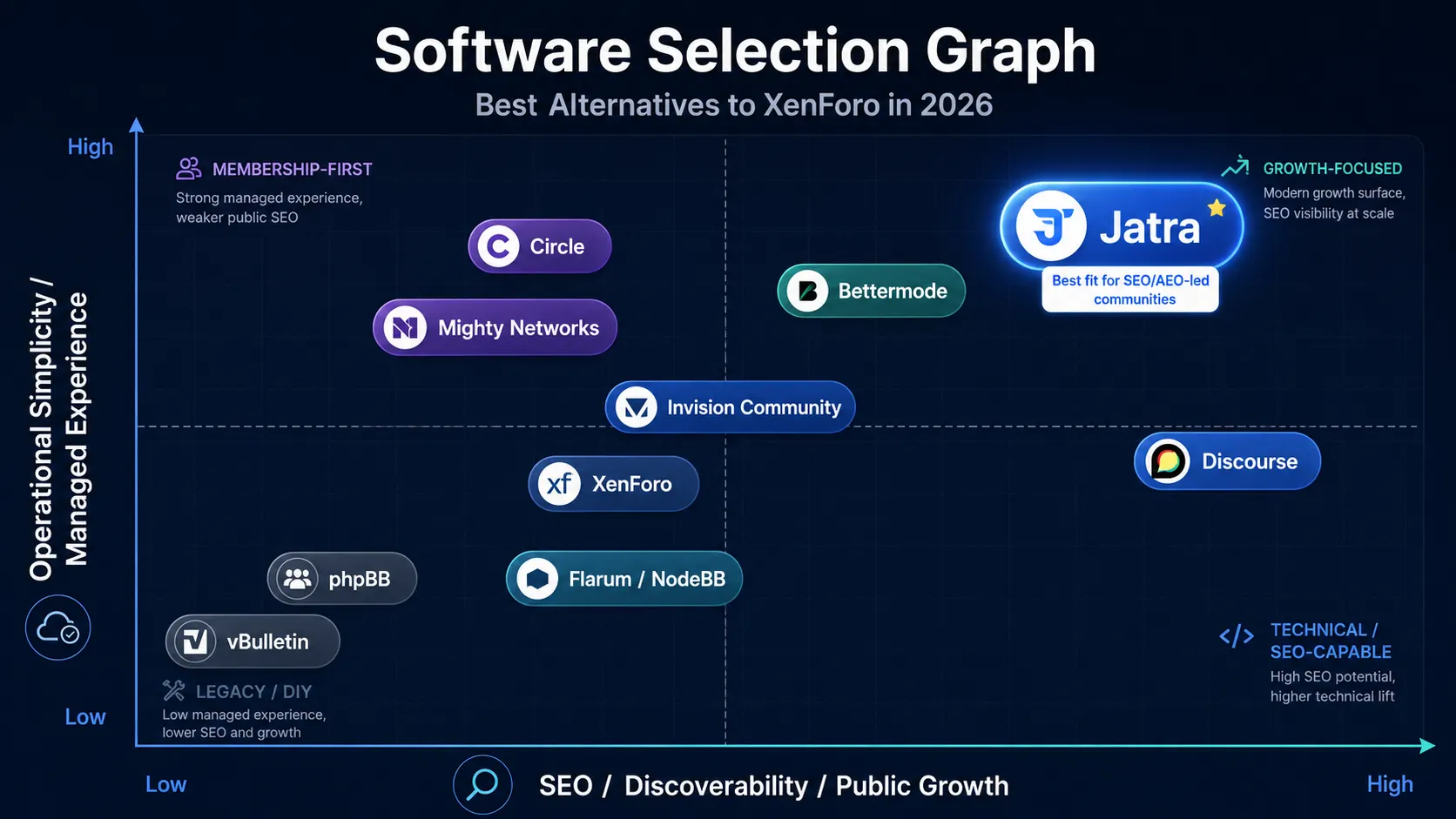
- The right alternative depends on the job. Discourse for open-source knowledge bases, Circle or Mighty Networks for paid memberships, Bettermode for B2B customer success, Jatra for SEO-led acquisition, and XenForo itself if you are staying a discussion forum. No single platform wins all of these.
The comparison at a glance
Ten platforms across the dimensions that decide a real switch. The platforms are grouped by what they replace, not by alphabet.
| Platform | Hosting | Entry price | Native content types beyond threads | Add-on dependency | Mobile experience | SEO architecture | Hands-on support included | Best fit |
|---|---|---|---|---|---|---|---|---|
| Jatra | SaaS | $299/mo | Threads, articles, Q&A, events, ideas, changelog, Resources | None for core features | Responsive, mobile-optimized SSR | Native SSR, multi-type schema, real-time sitemap | Yes - migration planning and founder-led rollout help | SEO/AEO-led communities on own domain (not paid memberships or course-led products) |
| Discourse | SaaS or self-host | $0 self-host / $100/mo Pro | Threads, chat, polls, wiki posts, Q&A (Solved plugin) | High for anything beyond core | Responsive + Hub reader app | SSR-equivalent (crawler HTML), llms.txt native | No - self-managed or paid vendor migration | Technical/DevRel open knowledge communities |
| XenForo (reference) | Self-host or Cloud | $195 one-time + $55/yr / $60/mo Cloud | Threads, article-style threads, Q&A threads, polls | High (paid first-party + third-party) | Responsive web, no app | SSR, but generic DiscussionForumPosting schema | No | Established enthusiast forums |
| Invision Community | Self-host or Cloud | ~$30/mo Cloud | Threads, blogs, gallery, downloads, calendar | Moderate, mostly bundled | Responsive web | SSR, dated defaults | No | Mid-market commercial forums |
| phpBB | Self-host | $0 | Threads only | Required for almost everything | Responsive theme | SSR, no native schema | No | Hobbyist budget forums |
| vBulletin | Self-host or Cloud | $179 one-time / $15/mo Cloud | Threads, blog, CMS, Social Groups | High, ecosystem shrunk after vB.org closure | Responsive, no app | SSR with unresolved Search Console warnings | No | Long-running legacy forums |
| Flarum / NodeBB | Self-host | $0 | Threads only | Plugin-based | Responsive | SSR with plugin schema | No | Modern open-source minimalists |
| Circle | SaaS | $89/mo Pro | Posts, courses, events, live rooms, chat | Low (single rigid model) | Native iOS/Android | CSR body, head-only SSR | No | Paid creator memberships |
| Bettermode | SaaS | $399/mo Starter | Threads, articles, Q&A, ideas, events, KB, changelog | Low | Responsive only, no app | SSR, but sitemap not editable | No - services may be separate | Mid-market B2B customer success |
| Mighty Networks | SaaS | $79/mo Launch | Threads, articles, courses, events, livestream | Low | Native iOS/Android | Mostly behind Cloudflare; landing-only on paid | No | Creator-led paid memberships |
Quick read: Jatra is the only option in this comparison that combines multi-content depth, SEO architecture, no add-on dependency for core features, and hands-on migration help at a price point above XenForo's lifetime license. Discourse is the strongest open-source alternative if you are technical. The middle tier (Invision, vBulletin) is mostly XenForo with worse tradeoffs. The SaaS row at the bottom is a category switch, not a feature swap.
What XenForo still gets right
Six years of running CrazyEngineers on it. This is the honest list.
I want to be careful here because every comparison article that pretends a competitor is bad is wrong. XenForo is well-engineered software built by people who have been doing this longer than almost anyone in the category. Kier Darby and Mike Sullivan were the lead developers at vBulletin before they founded XenForo in 2010, and the product reflects that.
Server-side rendering at every tier. Every public thread page on a XenForo site renders fully on the server. The crawler gets your content on the first HTML fetch with no JavaScript dependency. This is genuinely uncontested by most modern SaaS competitors. Circle renders post bodies client-side. Mighty Networks gates indexing behind paid plans. XenForo just works. (For the deeper version of why this matters in 2026, see our explainer: Server-side rendering (SSR) vs client-side rendering (CSR): what is better for SEO.)
Lifetime license economics. The $195 self-hosted license with a $55/yr update renewal is the lowest serious commercial entry price in the category. At scale, that is uncontested by any managed SaaS. Communities like XDA Developers, ResetEra, and SpaceBattles run on this license model at multi-million page-view volume.
Moderation depth. The warning-point system, per-node permission grids, moderator queues, and trust mechanics are more configurable than what most modern platforms ship out of the box. Discourse trust levels are conceptually nicer; XenForo's are more controllable. (The flip side of this control is the permission-overlap problem I cover in the next section. Configurable and easy-to-reason-about are not the same thing.)
Battle-tested at scale. XenForo handles communities with massive thread depth and large member bases without architectural strain. XDA Developers, ResetEra, and SpaceBattles are the canonical public references. The PHP/MySQL stack is unfashionable in 2026, but it is mature in a way Rails and Node.js communities have not yet earned.
Source-code access for self-hosters. You can read every line of the PHP that runs your community. For technical operators, this is freedom no SaaS platform can match.
If your community is a discussion forum, will stay a discussion forum, and your moderators value control over polish, you should probably stay on XenForo. Most of the people reading this page are not in that situation.
Why I left after six years
CrazyEngineers, the developer-hiring problem, and the server costs nobody mentions.
I migrated CrazyEngineers from vBulletin to XenForo in late 2011. The XenForo team had only shipped 1.0 a few months earlier, but the lineage was clear. The product was being built by the same developers who had taken vBulletin to dominant market share through the 2000s, and the rewrite reflected what they had learned about what to build differently.
The migration itself went cleanly. I liked the minimalist look of the new platform. Compared to where vBulletin's UI had drifted, XenForo felt focused.
What I did not anticipate was what happened to traffic. For the first 14 months after the migration, organic search traffic to CrazyEngineers fell. Not collapsed, but a steady, demoralizing decline. The URL structure had changed. The schema had changed. Google was re-evaluating the site from scratch, and the redirect mapping I had built (extensive but imperfect) was leaking SEO equity at every edge case. By the end of month 15 or 16 the trend reversed and traffic began climbing again, and the existing members had adopted the new platform and brought activity back. But new member registrations never returned to pre-migration levels. Whatever discovery loop had been bringing fresh signups under the old setup had broken, and the recovery on the existing user base did not replace it. I did not understand at the time how much of that loss was URL structure, how much was schema, and how much was XenForo's then-unfamiliar UX to first-time visitors. With six more years of operating experience, I now believe it was mostly the SEO architecture and the click-depth-to-content of the default forum homepage. That insight is part of why Jatra exists.
The migration story is worth telling because it is the experience every XenForo operator either has had or will have when they eventually move off. The platform you migrate to matters less than how well it handles URL continuity, schema preservation, and the redirect map. I will come back to this in the migration section.
Back to the lived experience of running XenForo. The first two years were fine. The community engaged, moderation worked, the codebase was stable. Then I started running into the problem nobody warned me about.
The add-on tax was real, and it compounded annually.
Almost every meaningful feature I wanted to add required a paid third-party add-on. Advanced search beyond MySQL fulltext meant the official Enhanced Search add-on plus Elasticsearch infrastructure to run it. A media gallery meant the first-party Media Gallery add-on. A resources or downloads section meant the first-party Resource Manager add-on. Each of these carried its own license fee and its own annual renewal. Keeping them current meant a recurring subscription tax for features I had naively assumed were core forum software. Anything custom (a careers board, an article-as-distinct-content-type, an interview format with structured fields, a sponsored-post badge system) meant hiring a developer to write a bespoke add-on or modify templates.
Quality developers were rare, and waiting for them was the actual cost.
The talented XenForo developers (a handful of names regulars in the community will recognize) were booked out for months. The available ones produced add-ons that either broke on the next minor upgrade or left so much technical debt in the templates that future work became more expensive.
But the bigger cost was the wait time. Every bug fix, every improvement request, every upgrade compatibility issue meant another two-to-six-week wait for the developer to come back to my queue. A simple fix would sit while they shipped someone else's project. If I tried to hire a new developer instead, they had to learn XenForo's framework from scratch, which usually meant another few weeks of ramp before they shipped anything useful. The community-driven documentation around the framework was helpful but limited. This is not a critique of XenForo's code quality. It is the reality of a niche commercial platform where the developer pool will never match WordPress or Shopify.
The permission system was powerful and confusing in equal measure.
XenForo's user and group permission grid is genuinely flexible, but the permissions overlap in ways that took me years to fully internalize. Group permissions, node permissions, and individual user permissions all stack and conflict. I lost count of the number of times a member reported they could not see a section they should have been able to see, and the resolution required tracing through three layers of permission inheritance to find where the conflict was. Once you know the model, you can work with it. Getting there is a real time investment that the documentation does not fully prepare you for.
Server management was a hidden monthly cost.
Self-hosting XenForo at any meaningful traffic level is not free. I was spending $100 to $150 a month on hosting alone, just to keep the community responsive under traffic spikes, run the MySQL and Elasticsearch instances, manage SSL renewals, configure CDN, and handle backups. If you have a sysadmin on the team, this is a non-issue. If you do not, it is time and money that should have been going into the community itself. The "$195 lifetime license" framing buries this. The license is the cheapest part of running XenForo over a multi-year span.
The UI carried a different kind of cost.
XenForo's interface is unmistakably the descendant of vBulletin's 2000s-era design. When a member lands on the homepage, the first thing they see is a list of categories and subcategories. To reach an actual discussion, they click into a category, then into a subcategory, then into a thread. Three clicks minimum, sometimes four. For an audience native to bulletin boards this is fine. For the engineers, students, and recruiters CrazyEngineers was trying to serve in the 2010s, who were arriving from Reddit, Quora, and LinkedIn, the IA felt archaic before they read a single post. The XenForo team kept improving the visual design through 2.x, but the underlying click-depth never changed. It is still a forum-software interface, optimized for the operator's mental model of categories and subcategories, not the new visitor's expectation of arriving on actual content.
The realization, around 2016.
I was looking at the same forum software I had been on for five years and asking what it would take to make it act like a modern publishing surface. I needed structured articles alongside threads. I needed a Q&A format with accepted answers that did not require shoehorning a "Solved" prefix into thread metadata. I needed an internal careers board. I needed advanced search that did not require a separate Elasticsearch cluster. I needed a media gallery and a resources directory that I was not paying separate license fees for. I needed the SEO surfaces (article schema, Q&A schema, event schema) to be built into the platform instead of patched in by an add-on.
The math became obvious. Every item on that list wanted a separate paid add-on, a separate developer engagement, and a separate upgrade-day liability when the next XenForo point release shipped. The platform was charging me for the modularity it had been built on, and the modularity tax compounded every year.
I started prototyping the alternative in 2016. By mid-2017 the early version of what became Jatra was running for internal testing, and I migrated CrazyEngineers off XenForo onto it later that year. The migration was painful in a way I now recognize as inevitable for any platform-to-platform move. The redirect map alone took weeks to build because of XenForo's /threads/title-slug.NNN/ URL pattern. But every feature I had been paying separately for at XenForo (advanced search, media gallery, resources, structured content types) was a primitive of the new platform instead of a purchased extension.
A note in fairness to XenForo.
A lot of what I described as friction in 2014 through 2017 has improved. The 2.x rewrite made the codebase materially easier to develop against, and the developer community recovered some bench depth after the vBulletin.org shutdown in 2024 pushed mod authors toward XenForo. If I were starting CrazyEngineers fresh in 2026 with no other constraints, would I look at XenForo? I would look. But I would still leave for the same reasons, because the dependency on third-party add-ons for non-discussion content is structural, not a generation-of-developers problem.
The 8 dimensions that decide an alternative
The rubric behind every recommendation on this page.
Content types beyond threads
A 2026 community is rarely "just" a forum. Articles, Q&A with accepted answers, events, ideas, jobs, and changelogs are increasingly part of the same product. The right alternative either ships these natively or makes you pay for add-ons that emulate them.
Add-on dependency
The number of paid third-party extensions required to reach feature parity with what you actually want to ship. Lower is better. This is the single dimension where XenForo loses most clearly against modern alternatives.
SEO architecture
Server-side rendering, multi-type structured data, clean URL structure, real-time sitemaps, and AEO-readiness. Modern Google forum schema (the March 24, 2026 update added digitalSourceType, expanded sharedContent, and improved commentCount handling) is now table stakes for new platforms.
Mobile experience
Native iOS and Android apps where the community justifies them; responsive web where it does not. For paid creator memberships, a branded app matters. For knowledge bases, it usually does not.
Maintenance burden
PHP/MySQL hosting, container rebuilds, security patching, Elasticsearch operations, mail delivery, and CDN configuration are not free time. SaaS platforms eliminate this; self-hosted alternatives pay for it with operator hours.
Migration friction inbound
Whether the platform has battle-tested importers from XenForo specifically. Discourse and Jatra have run XenForo migrations at scale. SaaS creator platforms typically have not.
Total cost of ownership at 12 months
License fees, hosting, add-ons, developer hours, and the time you spend integrating it all. The $195 license number on the XenForo homepage is the smallest line item in most operators' actual budget.
Strategic fit with your acquisition motion
If you are acquiring through paid ads and converting in a checkout flow, a closed paid membership platform is a better fit. If you are acquiring through organic search and AI citations, an SEO-first platform is the only correct answer.
Platform-by-platform breakdown
Each alternative starts with what it does well, then where it fails. The order is rough relevance to a XenForo operator considering a switch.
Discourse
The strongest open-source alternative to XenForo, and the one most XenForo migrators end up evaluating first.
What Discourse gets right. Active monthly release cadence (v2026.4 shipped April 28, 2026). Native llms.txt support since v2026.1.0, ahead of XenForo and almost every commercial competitor. Crawler-rendered HTML view identical to the dynamic view, which gives it SSR-equivalent SEO behavior despite being an Ember SPA. Mature official importers from vBulletin, phpBB, XenForo, Vanilla, IPB, MyBB, SMF, Drupal, and more. Open-source GPLv2 codebase, full data export via self-serve Postgres dump, and 5-level trust system that scales moderation without proportional headcount.
Where Discourse fails for XenForo migrators. Discourse looks more modern than XenForo's table-of-threads UI, but it is still a forum-shaped product. The category-topic-reply hierarchy is the same one XenForo has, rendered with newer typography. If your reason for leaving XenForo is that the UI feels stuck in 2010, Discourse will feel familiar in ways you may not want. On the schema side, every thread emits DiscussionForumPosting regardless of whether it is an article, a Q&A, or a how-to. No native QAPage switching even with the Solved plugin. No native Article schema. The default rel="nofollow noopener" on user links is one generation behind Google's rel="ugc" recommendation from 2019. The 5x pricing cliff from Pro ($100/mo) to Business ($500/mo) bites mid-market buyers exactly when they need migration services or Data Explorer.
The self-hosting story is no easier than XenForo's, either. The official install path is a Docker container that needs SSH access, Postgres, Redis, mail delivery, and monthly rebuild discipline to apply updates. If you avoided self-hosting XenForo because you did not want to manage a server, self-hosting Discourse will not solve that problem. The hosting tax is the same shape, just with a different stack.
Verdict: Pick Discourse if you are technical, your community is knowledge-driven and public, and you value open-source ownership over polish. Do not pick it expecting an escape from XenForo's two biggest non-product issues (legacy forum UI and self-hosted server management).
Jatra
The honest framing. I built Jatra because every platform I had run a community on (XenForo, Discourse, Circle) failed at a different problem. Jatra exists to fix those at the architecture level instead of through plugins and template work.
What Jatra gets right. Server-rendered HTML for every public surface. Multi-type structured data shipped natively across discussions, articles, Q&A with accepted answers, events, ideas, and changelogs. Smart rel defaults on user-submitted links. Clean slug-based URLs and canonical pagination. Real-time XML sitemap generation. Custom domains on every paid plan so SEO equity compounds where it should.
The XenForo contrast is the sharpest part. The features XenForo charges for separately (Resource Manager, Media Gallery, Enhanced Search with Elasticsearch) are bundled into Jatra core. Resources is now a first-class content type. Advanced search is included on every community out of the box, with no Elasticsearch cluster for you to run. Media handling is part of the platform, not a paid extension. There is no subscription renewal for any of these, because there is no separate license to renew.
Why this matters for the business behind the community. Each architectural decision above maps to a concrete outcome. Server-rendered HTML with proper multi-type schema means a thread, an article, and a Q&A page each show up in Google as the content type they actually are, which compounds organic traffic over time instead of capping it at the discussion-forum ceiling XenForo defaults to. The same schema makes the same content eligible for AI Overview citations and Perplexity-class retrievals, which is the acquisition channel that did not exist when most XenForo communities were architected. Bundled core features mean one renewal date instead of five, one vendor relationship instead of a portfolio, and no developer pipeline to maintain just to keep advanced search working. The fully-managed hosting eliminates the $100 to $150 a month I was paying just to keep CrazyEngineers responsive, and the operator hours that went with it. None of these are revolutionary individually. The point is that they compound, and the compounding goes in the direction of the community becoming a more reliable growth surface every quarter, instead of a more expensive one.
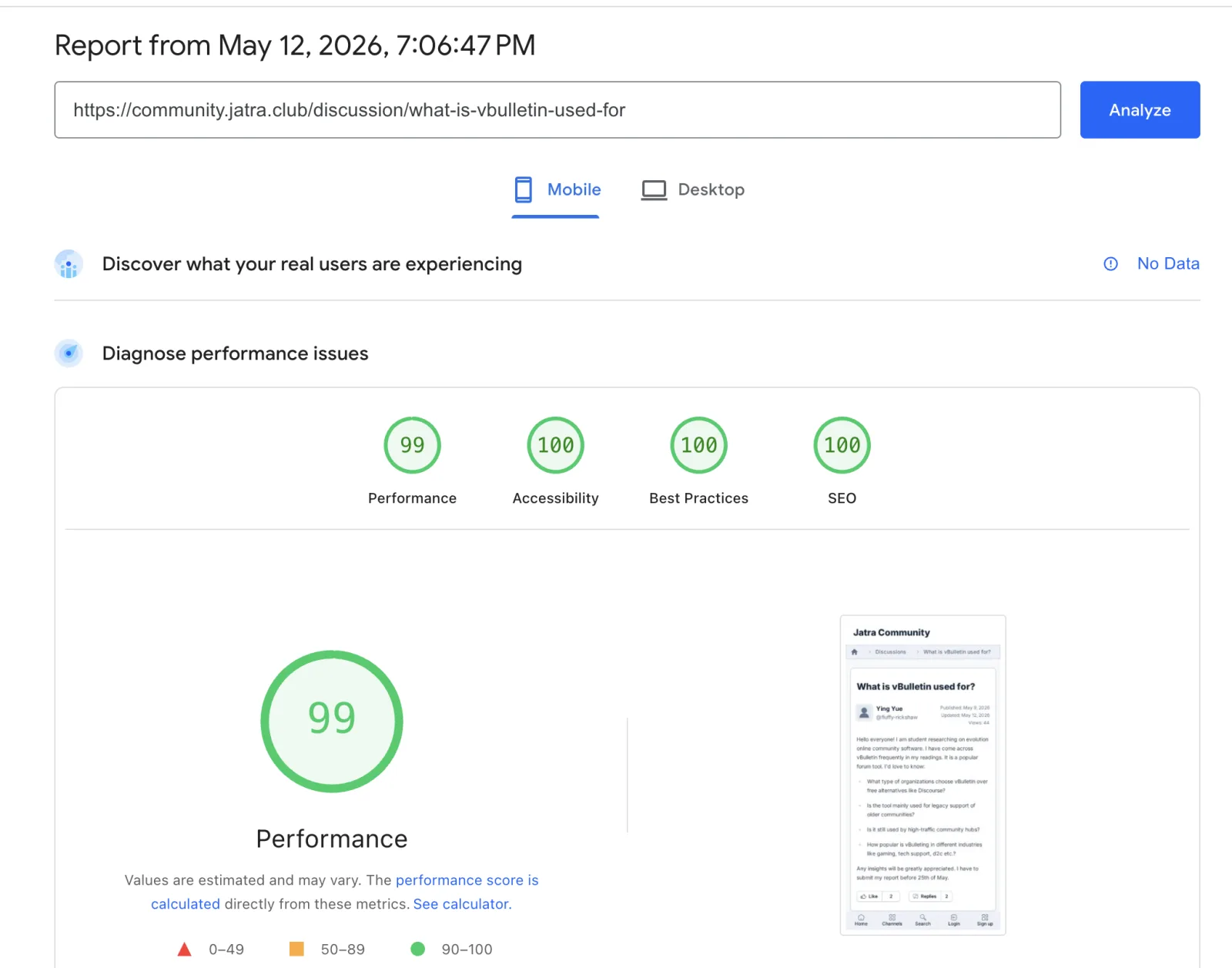
Example audit. On May 12, 2026, mobile PageSpeed Insights against the public Jatra discussion https://community.jatra.club/discussion/what-is-vbulletin-used-for returned: 99 Performance, 100 Accessibility, 100 Best Practices, 100 SEO. The URL is independently verifiable by anyone running PageSpeed Insights on it today.
Where Jatra will not be the right fit. If you are building a private paid membership, a coaching cohort, a chat-first community, or a course-led product, Jatra is overkill. Circle, Mighty Networks, or Skool will serve you better. At $299/mo entry, Jatra is not the cheapest option for a hobbyist forum where total cost matters more than discoverability. XenForo's $195 lifetime license wins that comparison cleanly if your team has the time and skills to run the server. Jatra is also a younger product than XenForo or Discourse, which means a shorter track record. The honest version of that statement is that you should weigh six years of operational history against thirteen and decide which risk profile you prefer.
Verdict. Pick Jatra if your community is a growth surface (SEO-driven acquisition, AI answer-engine citations, multiple content types) and the cost of staying on XenForo (developer pipeline, add-on renewals, server management, schema ceiling) has crossed the point where it is meaningfully holding you back. The migration is real work. The reason it is worth doing is that the work pays off in the direction of compounding traffic and a community that acts like the publishing surface a 2026 business actually needs.
Invision Community
The closest direct peer to XenForo in the commercial forum software market.
What Invision gets right. Bundled content suite (Forums, Blogs, Gallery, Downloads, Calendar) without the add-on tax. Most of what XenForo charges separately for is built in. Cloud hosting starts at ~$30/mo, lower than XenForo Cloud's $60. Strong moderation tooling. Active development. Reasonable URL defaults, server-rendered HTML, decent sitemap coverage.
Where Invision fails. Schema defaults are not 2026-current; multi-type structured data and the March 2026 schema update additions are not native. The UI feels like a peer of XenForo's, which is to say dated by modern community standards. Third-party plugin ecosystem is smaller than XenForo's. And the migration story off Invision is no better than off XenForo when you eventually want to leave.
Verdict: Pick Invision if you want a commercial forum with more built-in content types than XenForo at a lower Cloud entry price, and the SEO ceiling is not your binding constraint.
vBulletin
The platform XenForo's founders left, and which most XenForo migrators considered before choosing XenForo. Including it because some operators on vBulletin are weighing XenForo and should know the broader landscape.
What vBulletin gets right. $179 perpetual self-hosted license, which is the lowest commercial entry price in the category. 26-year native feature breadth (polls, blog, CMS, Social Groups, Shopify integration, PayPal subscriptions). SSR PHP with full content in initial HTML. Full database ownership on self-hosted.
Where vBulletin fails. The third-party developer ecosystem materially shrank after vBulletin.org shut down on August 24, 2024. Unresolved DiscussionForumPosting Search Console warnings (author.name, author.url, Comment nesting) sit open in the platform since 2019 with no roadmap fix. No QAPage schema switching. No llms.txt. CVE-2025-48827/48828 (unauthenticated RCE in vB 5.0.0-6.0.3) was patched in April 2024 without a CVE published, then exploited within 2 days of public disclosure on May 23, 2025. The market share trajectory is unambiguous: 75% of detected commercial forum software in 2013, 14.8% in 2022.
Verdict: vBulletin is not a forward-looking choice in 2026. If you are on it, you are evaluating where to go next; you are not adding it as a new install.
phpBB
What phpBB gets right. Free. SSR by default. 25 years of stability. Battle-tested at hobbyist forum scale.
Where phpBB fails. Query-string URLs. Extension-based sitemaps. No native structured data. No native Core Web Vitals posture. Almost every feature beyond core threads requires an extension you maintain yourself.
Verdict: Pick phpBB only if you have engineering time to modernize it and the budget cannot justify anything commercial.
Flarum and NodeBB
What they get right. Modern Markdown-native composer feel, cleaner default UI than legacy forum software, crawler-visible HTML, active development.
Where they fail. Schema and sitemap coverage are plugin-dependent. Neither ships March 2026 forum schema updates natively. Third-party ecosystem is smaller than Discourse's. For a XenForo migrator wanting modernity, Discourse is usually the better path.
Verdict: Niche choice for open-source minimalists who want something newer than phpBB without committing to Discourse's complexity.
Circle
A category switch from XenForo, not a feature swap. Circle is built for paid creator memberships, not for public forums.
What Circle gets right. Native course delivery (the Marvelous acquisition lineage), branded iOS/Android apps via Circle Plus, polished SPA UX that is "breathtaking out of the box" per entreresource.com, native Stripe-based paid memberships and gated content. Best fit for creators with audiences of 100-5,000 selling $20-$300/mo programs.
Where Circle fails for a XenForo migrator. Post bodies render client-side. On April 17, 2026, raw HTML fetched from public Circle communities returned the page title but not the post body, replies, or comments. The default [name].circle.so subdomain compounds SEO equity on Circle's host, not yours. No confirmed DiscussionForumPosting or QAPage JSON-LD. No llms.txt. Effective transaction fees stack to ~13% of revenue at small scale once Email Hub and Stripe fees are layered.
Verdict: Pick Circle if your community is a paid product. Do not pick Circle if your community is an acquisition channel.
Bettermode
The B2B SaaS customer-success alternative. Wrong category for most XenForo operators, right category for a specific subset.
What Bettermode gets right. Multi-content templates (Q&A, ideas, articles, events, knowledge base, changelog) under one no-code admin. Native first-class integrations with HubSpot, Salesforce, Zendesk, Intercom, Jira. GraphQL API + embed components for in-product deployments. SSR with JSON-LD by default.
Where Bettermode fails. Sitemap is auto-generated with no admin override. A documented Capterra case had Google indexation blocked for a month with no way to fix it from the admin. Community articles canonical-tag to the marketing blog, transferring SEO equity away from the community surface. API is gated to the $1,500/mo Growth tier, which is the precondition for fixing most SEO/AEO gaps. The Feb 2026 pricing change moved the entry tier from $50/mo to $399/mo, alienating the AppSumo LTD cohort and any SMB buyer.
Verdict: Pick Bettermode if you are a mid-market B2B SaaS already in HubSpot or Salesforce and your community is a customer-success surface. Do not pick it for general-purpose forum migration.
Mighty Networks
What Mighty gets right. Native iOS/Android apps with App Store presence on Mighty Pro. Deep engagement currency (streaks, recognitions, badges, leaderboards, course progress) with a multi-year head start over Circle. G2 Quality of Support 8.9 (vs Circle's 8.4).
Where Mighty fails for XenForo migrators. Search indexing is tier-gated to Scale ($179/mo) and above per Mighty's own SEO docs, and plan-gated networks expose only the landing page to search engines regardless of plan. Numeric-ID URLs (/posts/12655762) with no slug control. Transaction fees on every plan; no 0% tier; Stripe-only. Capterra has at least one reviewer reporting a platform change that "wiped out all but one space in my paywalls." That is the kind of vendor-driven product disruption forum operators typically do not tolerate.
Verdict: Pick Mighty if you are a non-technical creator with an audience of 25-5,000 building a $20-$100/mo membership where mobile engagement is the daily product. Do not pick it for SEO-led acquisition.
Migration: what survives and what does not
The redirect map nobody talks about, plus what to expect on the way out.
XenForo has the best inbound migration story in the category: official importers from vBulletin 3/4/5, phpBB, IPB, MyBB, SMF, Drupal, and Discuz. Once you are in XenForo, leaving is a different problem.
What survives an outbound XenForo migration:
- Threads, post bodies (BBCode, converted to Markdown or HTML on most destinations)
- Members, emails, post timestamps
- Attachments (with manual path rewriting)
- Basic permission structures (heavily simplified on most destinations)
What does not survive cleanly:
- Custom add-on data (every paid add-on writes to its own database schema)
- Custom themes and CSS
- Custom BBCode
- Reaction sets and trophy points (partial at best)
- Resource Manager structure (no clean equivalent on non-XenForo destinations without a paid add-on or custom development)
- Media Gallery albums
- Article-format and Question-format threads lose their schema variants on platforms with different content models
The redirect problem. XenForo URLs follow /threads/slug-of-the-thread.NNN/ with a numeric ID. On migration out, every indexed URL needs a 301 to its new destination URL, mapped one-to-one. For a 50,000-thread community, this is a real piece of work. It is the dominant migration cost at scale. Most destinations do not auto-handle this; you build the redirect map server-side.
Destinations with strong XenForo importers:
- Discourse is mature and well-documented at meta.discourse.org, with a 96-reply 20k-view migration thread as the canonical reference.
- Jatra is built specifically to receive XenForo-style migrations. The data model accepts threads, articles, and Q&A as distinct content types (preserving schema variants that flatten on most other destinations), and onboarding includes redirect-map planning.
Destinations without strong XenForo importers:
- Circle, Mighty Networks, and Bettermode all require custom or partner-driven migration work for XenForo source data. Bettermode has a documented Higher Logic Vanilla to Bettermode case study (4,000 media files, 3,500 posts, 2,300 users) executed through partners; XenForo is the same approximate complexity.
Realistic timelines:
- Small XenForo migration (< 10K threads): 1-2 weeks
- Mid-size (10K-100K threads): 4-8 weeks
- Large (100K+): 8-16 weeks, dominated by the redirect-map work
SEO recovery on the new platform usually takes 3-6 months in Search Console data, assuming the redirect map is built correctly and the destination renders crawler-visible HTML.
Who should choose what
Five honest recommendations by buyer type.
You are running a public knowledge-driven community on XenForo and SEO is now your growth lever.
Pick Jatra or Discourse. Jatra if you want multi-content depth (articles, Q&A, events, ideas, changelog) and AEO-readiness shipped today without managing infrastructure. Discourse if you are technical, open-source matters, and you accept the schema ceiling.
You are running a closed paid forum on XenForo and want to move to a paid membership product.
Pick Circle or Mighty Networks. Circle for the polished UX and named creator-economy logos (Pat Flynn, Tiago Forte, Ali Abdaal). Mighty Networks for the mobile-app-led engagement model and engagement currency depth.
You are running a B2B SaaS customer community and the buyer is the customer-success team.
Pick Bettermode. Native HubSpot/Salesforce/Zendesk integrations and Design Studio outweigh the sitemap and pricing gaps for customer-success-led communities.
You are happy with XenForo but want lower add-on dependency.
Pick Invision Community. Bundled blogs, gallery, downloads, and calendar reduce the add-on tax. Schema and AEO ceiling are similar; this is a sideways move, not a category shift.
You are not sure yet.
Run the three tests on whatever platform you are evaluating: View Source on a public thread and search for a visible sentence (crawler visibility); Rich Results Test on a thread URL (schema accuracy); PageSpeed Insights on a media-rich thread (Core Web Vitals). Ten minutes on each candidate will tell you more than ten hours of marketing copy.
Common questions
Three quick XenForo migration questions worth answering here:
Is XenForo still being developed? Yes. XenForo 2.3.8 shipped in January 2026. Point releases arrive every four to six months and major versions every three to four years. The 3.0 design overhaul was deferred from 2.3 with no public ship date as of May 2026.
What is the cheapest serious alternative? For self-hosting, phpBB is free if you have the engineering time. Among commercial options, vBulletin's $179 license undercuts XenForo's $195, but the platform's trajectory makes it a hard recommendation in 2026. Discourse is free to self-host on Docker, with the operational caveats covered in the platform breakdown above.
Will my XenForo add-ons work after migration? Almost never. Add-ons are platform-specific code written against XenForo's data model and template system. Migration usually means rebuilding equivalent functionality on the destination. This is exactly why platforms that ship the equivalents natively (Jatra, Discourse with plugins, Bettermode) make easier replatform destinations than ones where you have to find new third-party developers all over again.
Last updated: May 12, 2026. Platform audits are re-verified quarterly.
Build a branded customer community on your own domain, designed to grow search visibility, engagement, and trust over time.
A CrazyEngineers Technologies Pvt. Ltd. Venture